L2 | Thoracic Vertebrae
 Call Kai
 Learn
Learn Practice Test
 Spaced Repetition
 Match
Match Flashcards
 Knowt Play
1/6

There's no tags or description
Looks like no tags are added yet.
Name | Mastery | Learn | Test | Matching | Spaced | Call with Kai | Chat |
|---|
No analytics yet
Send a link to your students to track their progress
7 Terms
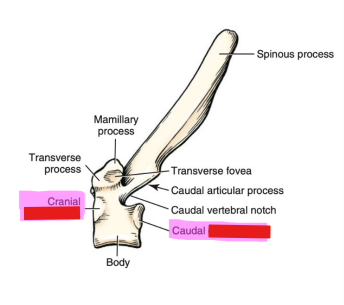
Q: The body of each thoracic vertebra possesses a cranial and caudal ……
A. articular fovea
B. costal fovea
C. vertebral notch
D. transverse foramen
B. costal fovea
Q: The body of the …… thoracic vertebra lacks the caudal costal fovea.
A. 10th
B. 12th
C. 11th
D. 13th
C. 11th
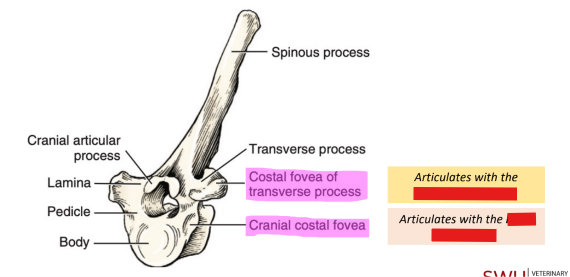
Q: In the thoracic vertebrae, the cranial costal fovea articulates with the ……
A. tubercle of the rib
B. costal arch
C. head of the rib
D. neck of the rib
C. head of the rib
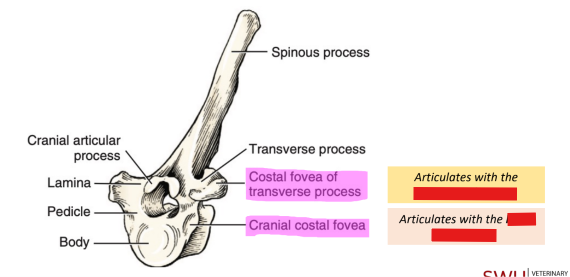
Q: In the thoracic vertebrae, the costal fovea of the transverse process articulates with the ……
A. tubercle of the rib
B. head of the rib
C. costal cartilage
D. sternebrae
A. tubercle of the rib
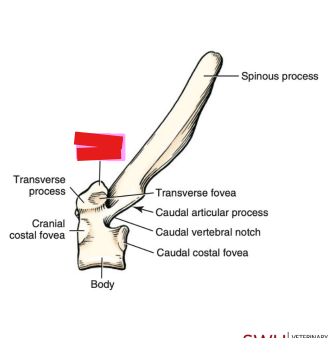
Q: Also known as "metapophyses," the …… starts at the 2nd or 3rd thoracic vertebra as small, knoblike eminences.
A. Accessory process
B. Mamillary process
C. Transverse process
D. Spinous process
B. Mamillary process
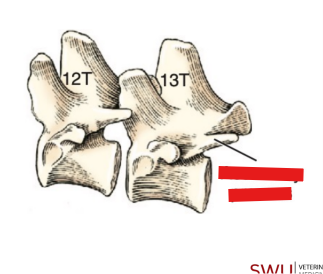
Q: Also known as "anapophyses," the …… appear in the midthoracic region and articulates with the cranial articular process of the vertebra caudal to it.
A. Mamillary process
B. Transverse process
C. Articular process
D. Accessory process
D. Accessory process
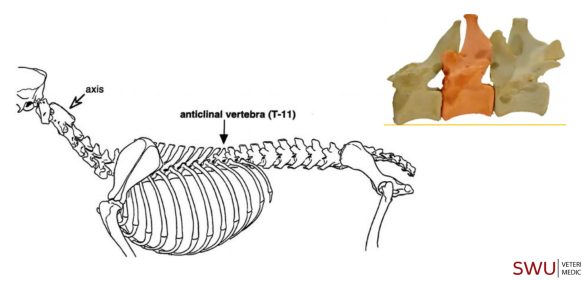
Q: The most vertically oriented spine that acts as a transitional segment of the thoracolumbar region is called the ……
A. anticlinal vertebra (T-11)
B. epistropheus (C2)
C. atlas (C1)
D. floating rib
A. anticlinal vertebra (T-11)