Chapter 15: Ceramics & Glass
 Call Kai
 Learn
Learn Practice Test
 Spaced Repetition
 Match
Match Flashcards
 Knowt Play
1/29

There's no tags or description
Looks like no tags are added yet.
Name | Mastery | Learn | Test | Matching | Spaced | Call with Kai | Chat |
|---|
No analytics yet
Send a link to your students to track their progress
30 Terms
Ceramics
Solid compounds with elements bonded together in a fixed atomic ratio by ionic and/or covalent bonds that comprise:
at least one metal and one nonmetallic element solids or other nonmetal
a combo of at least 2 nonmetallic element solids (MgO, ZrO2) OR
a combo of at least 2 nonmetallic elements solids and another nonmetal
Solid compounds that are formed by the application of heat or by a combination of heat and pressure
General Characteristics of Ceramics
High melting temperature (withstand a lot of heat without losing viscosity)
High compressive strength, but low tensile strength (b/c of low fracture toughness, ceramics are porous)
Hard and wear-resistant (strong atomic bond)
Brittle with low fracture toughness (little to no plastic deformation before fracture
Prone to thermal shock
Generally electrically insulating
Generally thermally insulating
Generally non-magnetic
Chemically stables and oxidation-resistant (ceramics are already compounds of metals with oxygen, nitrogen or carbon)
Do crystallines have long or short range order?
Long range
What are the 3 types of crystalline ceramics?
Oxides → Al2O3 (alumina), SiO2 (silica), FeO, Fe2O3
Carbides → SiC (silica carbide), WC (tungsten carbide), Fe3C (cementite), Al4C3 (aluminum carbide)
Nitrides → BN (boron nitride), Si3N4 (silicon nitride), TiN (titanium nitride), all have high hardness
Low fracture toughness in ceramics means…
high sensitivity to cracks
Tensile strengths are always ______ to _______ of compressive in ceramics
1/10, 1/100
What does it mean if a material is closer to the 1:1 line on a Compressive vs Tensile Strength graph?
The material’s compressive and tensile strength are somewhat equal
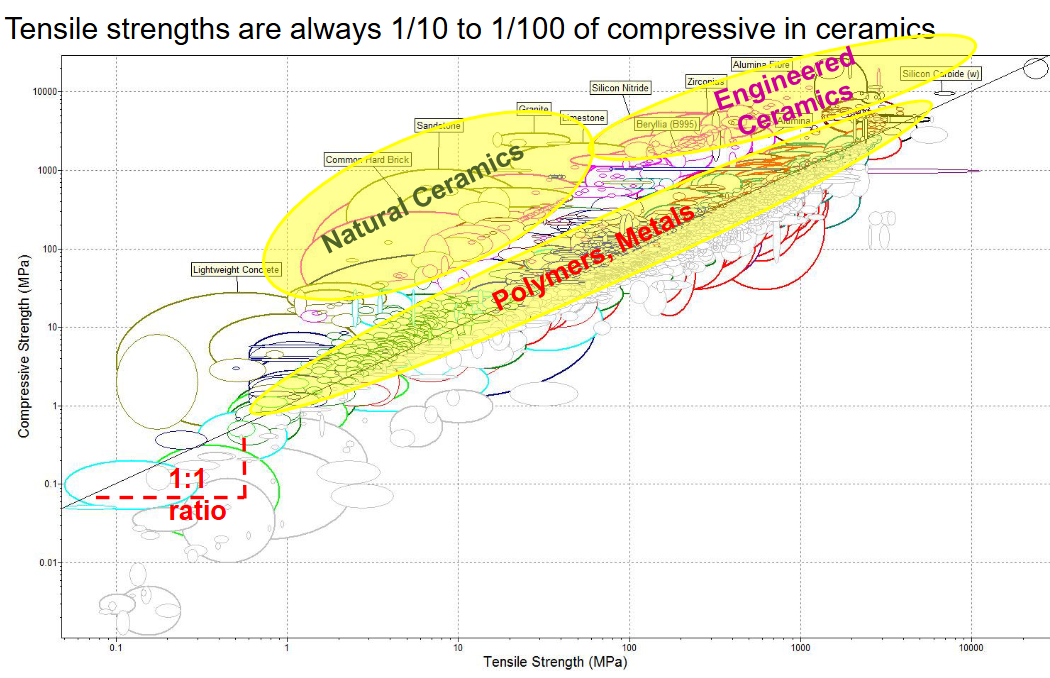
Why are engineered ceramics better?
They have a refined microstructure with less porosity, fewer pores will prevent the voids from behaving as crack initiators in tension.
What are examples of Natural Ceramics?
granite
brick
concrete
What are examples of engineered ceramics?
alumina
zirconia
SiC
Why can’t ceramics be melted and cast into molds?
Due to their high melting temperature
What is the sequence of processing ceramics?
Synthesis of ceramic powders
Ball milling, blending, spray drying of powders using processing additives
Shaping of powders into useful shapes using pressing, slip casting, tape casting, etc.
Consolidation into a dense, monolithic object using sintering or firing
Secondary processing (grinding, cutting, polishing)
Final sintered ceramic product
What is spray drying?
small quantities liquid mixture containing ceramic powder is sprayed
What are some examples of processing additives?
binders
lubricants
plasticizers (makes it easier to shape)
dispersants (prevents clumping)
What is “Green powder” shaping?
shaping of powders into useful shapes (green ceramics)
Does glass have a crystalline or non-crystalline structure?
non-crystalline, short-range order of molecules but no long-range order, amorphous
Glass is usually based on _____
SiO2 (silica) → windows, bottles, optical fibres, etc.
What are some properties of glass?
strong ionic and covalent bonding
brittle
non-conducting
susceptible to thermal shock
Why can’t glasses be used at very high temperatures?
They become more viscous
Are glasses as chemically stable as most ceramics?
No
What does it mean that glass is metastable?
It will crystallize given the right combination of circumstances (slow cooling, long holding time, presence of nucleation sites)
It is not in its most thermodynamically stable structure
Metastability
Not enough time for transformations to fully occur, phase transformation within microstructure not given enough time, not thermodynamic enough, unfavourable
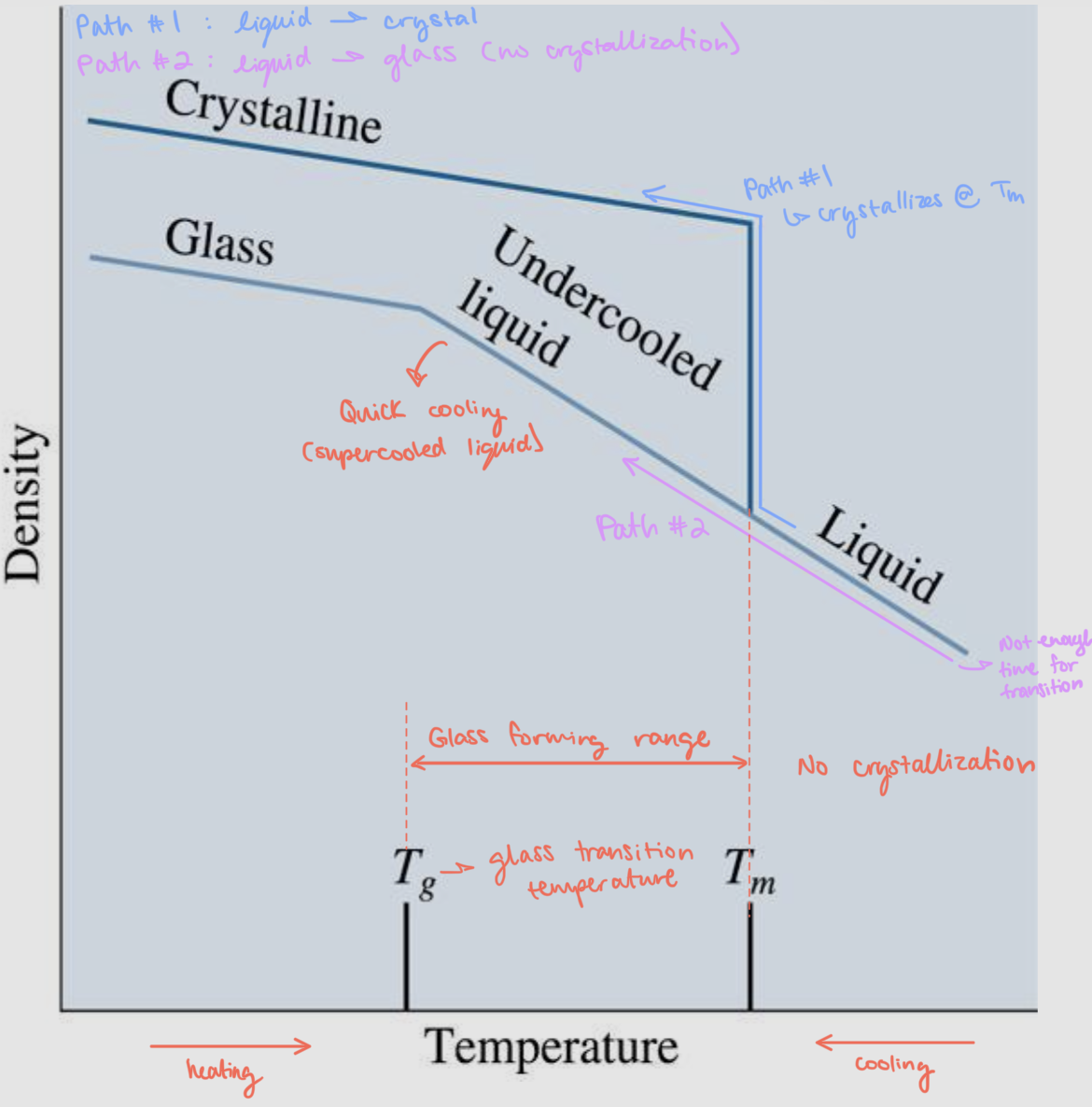
Describe what is happening in the figure
When silica crystallizes on cooling, an abrupt change in the density is observed
For glassy silica silica, the change in slope at the glass temp indicates the formation of a glass from the undercooled liquid
Does glass have a fixed Tm or Tg?
No
Do crystalline materials have a fixed Tm?
Yes
Do crystalline materials have a Tg?
No
Annealing
Placing specimen in oven until glowing red
What does annealing do?
Removes residual stresses
What does tempering do?
Intentionally creates beneficial surface compressive stresses
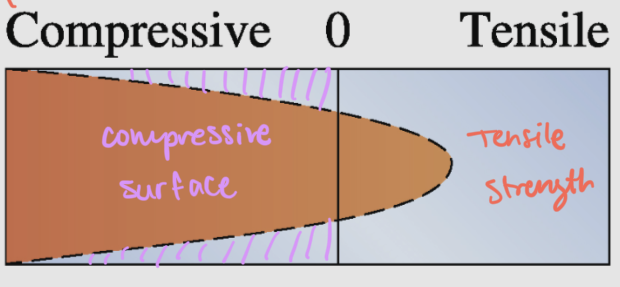
How can you improve the properties/increase toughness of a material?
Impose residual compressive stresses that cancel out some of the tensile forces imposed
Substitutional additives can also increase surface compressive stress