TCP Week 5 (Pre and Post-Op Complications)
 Call Kai
 Learn
Learn Practice Test
 Spaced Repetition
 Match
Match Flashcards
 Knowt Play
1/91

There's no tags or description
Looks like no tags are added yet.
Name | Mastery | Learn | Test | Matching | Spaced | Call with Kai | Chat |
|---|
No analytics yet
Send a link to your students to track their progress
92 Terms
What is included in the Pre-op checklist
H&P:
A thorough H&P is often the best predictor of future events and will help to reduce unnecessary pre-op testing
Labs (guidelines):
≤40 y/o: Hgb, Urine HGC for females
≥40 y/o: Add EKG and serum glucose
Imaging
EKG
Abx Order
NPO Order (usually past midnight, at least 8 hrs prior)
Informed Consent
labs and imaging should not be performed if
you aren't going to use the information that the results are providing
labs and imaging should not be done routinely or for medico-legal reasons as
there is always a chance of a false positive result which may lead to further testing, increased cost, and delays in the perioperative course
A patient's pre-op status is a significant indicator of their
post-op status
common physiological effects of anesthesia and surgery
- Hypotension
- Tachycardia
- Hypoxemia
- Hypothermia
- Anemia
- Pain
cardiac pre-op assessments (hx)
CAD, MI, CHF, HTN, PVD, Valvular disease
what previous cardiac problem can increase perioperative complications
endocarditis or MI (fluid overload)
pulmonary pre-op assessment
- Smoking
- asthma
- COPD
- sleep apnea
nutrition pre-op assessment (hx)
LOW levels of albumin and prealbumin - both are markers of a negative catabolic state and are strong predictors of poor outcomes
protein status is directly related to the stages of healing
hematologic pre-op assessment... what labs
- PT
- PTT
- INR
- Hgb
- Hct
- Platelet count
ASA classification pic
ASA I - healthy, minimal PMH, no smoking or drinking
ASA II - mild systemic disease, but well controlled
ASA III - pt w severe systemic disease, not incapacitating
ASA IV - only operate in emergencies, constant threat to life
ASA V - not expected to survive without operation
ASA VI - brain-dead, organ transplant
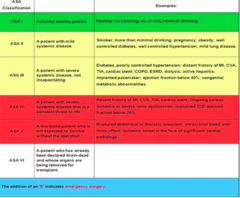
ASA I
healthy, minimal PMH, no smoking or drinking
ASA II
pt with mild systemic disease:
- smoker
- more than minimal drinking
- pregnancy
- obesity
- well controlled DM
- well controlled HTN
- mild lung dz
ASA III
pt with severe systemic disease, not incapacitating:
- DM
- Poorly controlled HTN
- distant hx of MI, CVA, TIA, Cardiac stent
- COPD
- ESRD
- Dialysis
- Active hepatitis
- implanted pacemaker
- ejection fraction
ASA IV
a pt w severe systemic disease that is a constant threat to life:
- recent hx of MI, CVA, TIA, Cardiac stent
- ongoing cardiac ischemia or severe valve dysfunction
- implanted ICD
- ejection fraction
ASA V
a moribund pt who is not expected to survive w/out the operation:
- ruptured ab or thoracic aneurysm
- intracranial bleeding with mass effect
- ischemic bowel in the face of significant cardiac patho
ASA VI
pt who has already been declared brain-dead and whose organs are being removed for transplant
identify predictors of cardiac risk in surgical patients and appropriate preoperative tx of cardiac disease and management of risk factors
- age
- overall physical status
- classing of procedure
- physiological extent of procedure
- comorbidities
the urgency of a procedure may limit the measures that we take pre-op
Age and Risk: age related complications are typically due to an increase in underlying disease
Goldman index
- Original Cardiac Risk Index
- Useful in predicting cardiac events in non-cardiac surgery
9 factors of the Goldman Index
- Age > 70 years (5 points)
- MI within 6 months (10 points)
- Signs of CHF: ventricular gallop or JVD (11 points)
- Significant aortic stenosis (3 points)
- Arrhythmia other than sinus or PACs (7 points)
- 5 or more PVCs per minute (7 points)
- PO2 < 60; PCO2> 50; K < 3; HCO3 < 20; BUN > 50; Creatinine > 3; elevated SGOT; chronic liver disease; bedridden (3 points)
- Emergency (4 points)
- Intraperitoneal, intrathoracic or aortic surgery (3 points)
Goldman index scoring
0-5 points (Class I): 1% Complications
6-12 points (Class II): 7% Complications
13-25 points (Class III): 14% Complications
26-53 points (Class IV): 78% Complications
revised cardiac risk index
- Introduced in 1999
- Simpler and more accurate
- Used to estimate a patient's risk of perioperative cardiac complications
- uses 6 factors
6 factors used for revised cardiac risk index
- Ischemic heart disease
- CHF
- CVA/TIA
- CKD = serum creatinine > 2.0mg/dL
- Insulin dependent DM
- High risk surgery
Revised cardiac risk index scoring
0 = class I: very low, 0.4% complications
1 = class II: low, 0.9% complications
2 = class III: moderate, 6.6% complications
3 = class IV: high, >11% complications
surgery outcomes of malnutrition - malnutrition may cause?
- Poor wound healing
- Overgrowth of bacteria in the GI tract
- Abnormal nutrient loss through stool
- Increased risk of infection
lab values that should make you consider postponing surgery until resolved
**Albumin (nl= 3.5-5): if
Total Enternal Nutrition (TEN)
- Use the GI tract whenever possible!
- Can include a normal oral diet, the use of liquid supplements, or delivery of the daily requirements by use of a tube
- Feeds the GI tract directly
- May increase the risk of aspiration (use gen anesthesia to decrease risk)
Total Parental Nutrition (TPN)
- Bypasses the digestive system entirely and goes directly into the bloodstream
- Uses a dedicated central line
- May increase risk of infection at catheter site
- Expensive
When is anticoagulation therapy pre/post-op indicated?
coagulation studies are not routinely indicated
- Indicated if patient is on ANY anticoagulation therapy
- has a personal or family history of bleeding disorder
- has evidence of liver disease
anticoagulation treatment in pt w h/o DVT or mechanical heart valve
baseline: heart valve requires INR of 3-4
Stop warfarin pre-op 4 days if INR for PT/INR is 2-3, start heparin (bridge)
Stop warfarin pre-op 5 days if INR >3
SUBQ heparin or Lovenox at 3 days pre op, just until sugery
Start IV or Sub-Q heparin AND warfarin post-op
warfarin is a ____
lovenox and heparin are ____
warfarin: direct BT bc blocks vit K production, therefore preventing the body from making new clotting factors
Lovenox and Heparin are not DIRECT BT bc they inactivate clotting factors that are already present
pt on aspirin before surgery guidelines
know hospital protocols and surgeon preferences
If 81mg PO QD, may continue aspirin
If >81mg, stop 2-10 days prior to surgery:
• there is no significant prolongation of bleeding time after the first 48 hours (meaning 2 days is usually enough)
risk vs benefits!
hematocrit (Hct) normal range?
what needs to be met for surgery?
- Male 41-50%
- Female 36-44%
- For surgery >30%
hemoglobin (Hgb) normal range?
what needs to be met for surgery?
- Male 13.8 -17.2g/dL
- Female 12.1-15.1g/dL
- For surgery >10 (will work with 7-9 too though)
anemia contributing to surgery risks
there is no evidence that anemia contributes to surgical morbidity in a well-hydrated, hemodynamically stable patient (Albumin!)
post-op eval (goals)
Management of a patient after surgical procedure
- Includes the assessment, interventions, planning, and prognosis
- Depends on the patient's pre-op health condition, type of surgery, extent of procedure, +/- intraoperative complications
- Goal is to promote healing, prevent complications, and ultimately return the patient to their pre-op state of health
3 phases of wound healing
- Inflammatory Phase
- Proliferative Phase
- Maturation Phase
inflammatory phase of healing
0-6 days:
- Edema, erythema, heat, and pain
- Begins at the time of injury
- Lasts 4 to 6 days
- Hemostasis controls bleeding, and PMNs control bacterial growth
- After 4 days, macrophages migrate into the wound area and produce chemoattractants and growth factors
proliferative phase of wound healing
4-24 days:
- Red, beefy, shiny tissue with a granular appearance
- Consists of macrophages, fibroblasts, immature collagen, blood vessels, and ground substance
- As granulation tissue proliferates, fibroblasts stimulate the production of collagen, which gives tissue its tensile strength and structure (tissue TOUGHER)
- Wound margins contract
- During epithelialization, cells migrate from the wound margins to seal it (heals outside in)
- Epithelialization can occur only in the presence of viable, vascular tissue
- When this phase is complete, a scar forms
scar = end of proliferative phase
maturation phase of wound healing
21 days-24 months:
- Collagen fibers reorganize, remodel, and mature, gaining tensile strength
- Maximal tensile strength that is regained is approximately 80%
wound contraction
occurs in the proliferative stage of healing after collagen is stimulated by the fibroblasts decreasing the wound's surface area, wound edges move towards the center (healing deep to superficial, lateral to medial)
wound epithelialization
occurs just after wound contraction
final stage of healing
during the proliferative stage of wound healing cells move from the wound margins, which?
closes the wound allowing a scar to form
a scar can only form if
VIABLE, VASCULAR tissue is present in the wound
antibiotic prophylaxis
NO PROVEN BENEFIT IN CLEAN WOUNDS
Proven effective in gastric, biliary, and colorectal surgery
Must be given 1 hour before incision (2 hrs for Vanco) to achieve therapeutic level
Usually continued for 24 hours post-op
What antibiotics are given for prophylaxis
GI:
- Cipro (ciprofloxacin)
- Flagyl (metronidazole)
GU: Fluoroquinolone
- Cipro
- Levaquin (levofloxacin)
Skin:
- Ancef (cefazolin)
- **PCN Allergy** = use Cleocin (clindamycin!!)
SEPSIS:
- Zosyn (piperacillin/tazobactam) or alike for broad coverage
classifications of wounds overview
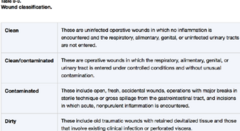
clean wound
these are uninfected operative wound in which no inflammation is encountered and the respiratory, alimentary, genital or uninfected urinary tract are not entered
(so basically skin)
clean/contaminated wound
these are operative wounds in which the respiratory, alimentary, genital or urinary tract is entered under controlled conditions and w/out unusual contamination
Contaminated wound
these include open, fresh, accidental wounds, operations with major breaks in sterile techniques or gross spillage from the GI tract and incision in which acute, non purulent inflammation is encountered
dirty wound
these include old traumatic wounds with retained devitalized tissue and those that involve existing clinical infection or perforated viscera.
post-op conditions: fever
Fever (>38º C or 100.4º F)
A manifestation of cytokine release
timing classifications - fever post-op
immediate: onset in the OR or within hours after surgery
acute: onset within the first week after surgery
subacute: onset from 1-4 weeks after surgery
delayed: onset >1 month after surgery
5 W's of post-op and when they occur
- wind (POD 0-2)
- water (POD 3-5)
- wound (POD 5-7)
- walking (POD 7-10)
- wonder
When is atelectasis common after surgery
0-48 hrs, up to 3 days
when does pneumonia risk increase after surgery?
after the first 48 hrs
other important lung complications to look for after surgery ("wind")
- aspiration
- incentive spirometry for every post-op patient (better than coughing)
- cough and deep breathing exercises
"water" complication occurs when
~POD 3-5
Foley catheter may still be in place, concern for UTI
when can a UTI occur after surgery and what is the most common causative organism?
ANYTIME!
MC etiology = e. coli
GU complications post-op
- pyelonephritis
- catheter sepsis
wound complications after surgery
- Surgical incisions
- I&D with culture
- inflammation: hematoma, seroma
etiology of wound complications and tx
- Staphylococcus
- Streptococcus
Tx:
- Cephaolosporin
- Sulfa (if concern for MRSA)
- Vanco
When should you begin walking after surgery
POD 7-10 (may be anytime)
Walking after surgery decreases risk of
Thrombophlebitis, DVT, & PE!
- Virchow's Triad
- Wells Criteria/PERC rule
Virchow's triad
- Hypercoagulopathy
- Venous stasis
- Endothelial injury
who gets thrombosis prophylaxis after surgery?
EVERYONE!!
best prevention of DVT after surgery
early ambulation!!
Prophylaxis post-op of DVT, PE, Throbophlebitis
Early ambulation is the BEST prevention
- TED (stockings)
- PCBs (compression device)
- ASA
- Plavix
- heparin
- Lovenox
- IVC filter
wonder drugs
- The things you have to think after you've ruled out the most common
- You have to wonder about the drugs that you gave - are they sufficient to cover infection, are they the right ones, is the patient sensitive to them
what can an NG tube cause?
sinusitis
risk of s/p long bone/pelvic fracture or liposuction
fat embolism!
consideration of an intra-abdominal process for post-op
is the anastomosis leaking?
*may want to avoid anti-inflammatories
fever after surgery + diarrhea, suspect?
antibiotic related diarrhea (c. diff)
cause: oral clindamycin!
need to give a probiotic (not just yogurt)
what can cause malignant hyperthermia?
succinylcholine
3 med-related conditions associated with peri operative pt and fever >40ºC (104ºF)
- Serotonin Syndrome
- Malignant Hyperthermia
- Neuroleptic Malignant Syndrome
what can withdrawal cause?
Delirium Tremens
*reminder: 2 withdrawals that can kill you, benzos and alcohol
Delirium Tremens (onset and symptoms)
Typically begins ~72 hours after last alcohol ingestion
Symptoms include:
- fever
- AMS
- agitation
- hallucinations
- seizure
wonky glands: two endocrine causes of post-op fever?
Adrenal Insufficiency: Consider possibility of long-term steroid use, possible missed opportunity for surgical "stress dose" steroids
Thyrotoxicosis: Consider undiagnosed hyperthyroidism or known hyperthyroidism who have not taken their medication due to NPO status
post-op complications: pain
post-op pain is expected: treat PO, IV, PCA
- Be cognizant of allergies
- Watch for respiratory depression, slow GI motility
- On-Q catheter
- Nursing calls.
- No ceiling effect.
- Don't take all of their pain away/injury.
- Reversal agents and benzos.
benzodiazepine reversal agent?
reversal: Flumazenil (Romazicon)
hiccups post op complication and tx
Involuntary, intermittent, spasmodic contraction of the diaphragm and intercostal muscles.
May be caused by lack of CO2 build-up or irritation of the vagus and phrenic nerves.
Tx = valsalva, vagal stimulation (pressing on the eyeballs)
Rx = Thorazine (chlorpromazine)
shivering post op complication and tx
- Hypothalamus is the thermoregulation center of the brain.
- Common in postpartum pts.
- Increases O2 and metabolic demands which are already increased post-op.
- Most important to control after cardiac surgery due to their VERY increased O2 demand. Use warm blankets.
Rx = Demerol (meperidine).
n/v post op complication and tx
- common s/p anesthesia, esp. volatile anesthetics such as sevoflurane and desflurane gasses.
- moving head around while waking up is also a trigger for nausea.
Tx = d/c offending drugs
Rx:
- Zofran (ondansetron)
- Phenergan (promethazine)
- Pre-op use of a Transderm Scop patch (scopolamine transdermal)
- NG tube in extreme cases
cough post op complication
Acute atelectasis, s/p ET tube, allergy, asthma, bronchitis, ACEs.
Do they need their home meds. Zyrtec or albuterol.
anemia post op complication and tx
- acute blood loss is MCC
- other may be dilutional, operative blood loss often underestimated
Sx: pallor, tachycardia, dyspnea, postural hypotension.
Rx:
- iron
- EPOgen (builds more RBCs to carry more O2 to organs and tissues)
**both ok in Jehovah's Witness population
Transfuse when necessary.
ileus post-op complication and tx
Common 24-72 hours s/p anesthesia, which slows everything down.
Sx: abdominal bloating, cramps, N/V/C, decreased or absent bowel sounds. NPO except for ice chips, hard candy, sips with meds, and maybe chewing gum.
Do an x-ray!
Tx:
- Cessation of inciting factors
- NPO
- IV fluids
- electrolyte replacement
- bowel decompression (NG tube) and time
altered mental staus post op complication and tx
delirium:
- anesthesia
- electrolyte disturbances
- hypercarbia
- hypoxemia
- sepsis
- sundowning
- intracranial bleed
- drugs or withdraw from drugs
order a neurology consult if necessary
rash post op complication and tx
post op drug reaction/anaphylaxis or contact dermatitis are MCC
cause: PCN, latex or tape, Red Man syndrome from Vanco.
consider the characteristics of the rash (distribution, timing, morphology, symptoms). Remember latex free Foley with latex allergic pts.
Tx = no labs needed, d/c the cause
Rx = consider corticosteroids and/or
antihistamine (Benedryl (diphenhydramine)
shock post op complication
Acute, generalized, life-threatening condition marked by inadequate cellular perfusion and therefore impaired organ perfusion and function.
Can lead to quick and irreversible damage and/or death.
- Septic
- Hypovolemic ** mc in surgery
- Neurogenic
- Cardiogenic ** mc in surgery
what to look for in post op shock MCC
JVD post surgery = think cardiogenic shock
no JVD post surgery = think hypovolemic
Pearls
•Set pre-op expectations
•Do a thorough H&P (and do your own)
•Be clear and direct