Lipids, Membranes, and the First Cells Review Set (BIOL 203 Module 1/2)
 Call Kai
 Learn
Learn Practice Test
 Spaced Repetition
 Match
Match Flashcards
 Knowt Play
1/36

There's no tags or description
Looks like no tags are added yet.
Name | Mastery | Learn | Test | Matching | Spaced | Call with Kai | Chat |
|---|
No analytics yet
Send a link to your students to track their progress
37 Terms
lipids
A class of macromolecules grouped together by their *hydrophobicity* (they don't dissolve well in water!) and/or by their ability to dissolve well in nonpolar substances
Lipids are nonpolar (hydrophobic) because they contain *many more C-H bonds than polar covalent bonds / functional groups*
Not considered true polymers (lipid structures are not made of a single repeating unit / monomer), structures can vary widely
Used in energy storage, cell communication / signaling, membranes
Fatty acid
A lipid consisting of a long hydrocarbon chain (consists of C and H atoms) bonded to a carboxyl group
Can be saturated or unsaturated

Saturated fatty acids
Follow the line of reasoning...
*Fatty acid molecules that have the maximum number of hydrogen atoms attached* ∴ only have single C-C bonds ∴ no kinks exist in the hydrocarbon chain ∴ are stackable
van der Waals forces can easily interact across these stackable, saturated fatty acid chains ∴ substances with many saturated fatty acids tend to be *solid* at room temp

Unsaturated fatty acids
Follow the line of reasoning...
*Fatty acid molecules that do not have the maximum number of hydrogen atoms attached* ∴ have some double C=C bonds ∴ kinks exist in the hydrocarbon chain ∴ are not easily stackable
van der Waals forces cannot interact across these unstackable, unsaturated fatty acid chains ∴ substances with many unsaturated fatty acids tend to be *liquid* at room temp

If you increase the length of fatty acid hydrocarbon tails... (ability to solidify)
You increase their ability to solidify at room temperature. More van der Waals forces can take place.
If you increase the saturation (introduce more hydrogen atoms / have less C=C bonds) of a fatty acid tail... (ability to solidify)
You increase their ability to solidify at room temperature. More van der Waals forces can take place.
How to increase saturation? hydrogenation!

hydrogenation
Bombardment of hydrogen atoms onto a fatty acid to turn C=C bonds into C-C bonds for preservation (liquids spoil faster than solids)
May also result in trans C=C bonds that can lead to atherosclerosis (formation of plaque in blood vessels)

glycerol
A 3-carbon alcohol (has three hydroxyl groups) that forms the backbone of triglycerides, waxes, and phospholipids

Ester bonds
The bonds commonly found within lipids, formed between the hydroxyl group of one molecule (e.g., glycerol) and the carboxyl group of another molecule (e.g., fatty acid)

Triglycerides
Lipid made of 1 glycerol molecule and 3 fatty acid molecules
Primarily as energy storage molecules: C-H and C-C bonds have more potential energy (nonpolar bonds) in comparison to other molecules; store twice as much energy per gram than carbohydrates
Also has insulative and protective functions
Aka fats

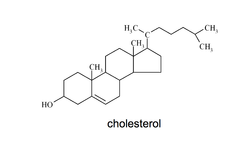
steroids
Lipid made of 4 fused carbon rings
Serve as components of the plasma membrane and as precursors to other molecules, like hormones used in cell signaling
Ex. cholesterol
phospholipids
Lipid made of 1 glycerol molecule, 2 fatty acid molecules, and 1 polar phosphate / choline "head"
Considered *amphipathic* molecules: both hydrophilic and hydrophobic
Serve as a key component in forming the lipid bilayer of the plasma membrane

Selective permeability
Refers to the property of membranes (such as those formed by a lipid bilayer) that allow some substances to pass more readily through them than other substances
This property arises from phospholipids' tendency to form lipid bilayers in water. Phospholipids' polar heads face outward and interact with water, while their hydrophobic fatty acid tails are shielded on the inside. *Substances most able to cross the lipid bilayer must be able to 1) physically move past the polar heads and 2) interact with the inner fatty acid tails.*

Small, nonpolar molecules' permeability
Have very high permeability (readily cross lipid bilayer)! Can "squeeze" past the polar heads and interact with the inner hydrophobic fatty acid tails.
Ex. neutral gases like O2, CO2, and N2

Small, polar molecules' permeability
Have decent permeability (can cross lipid bilayer somewhat). Though they have weak interactions with the inner hydrophobic fatty acid tails, these molecules can still "squeeze" past phospholipids' polar heads.
Ex. H2O, glycerol

Large, polar molecules' permeability
Have minimal permeability (barely cross lipid bilayer). These molecules possess difficulty in "squeezing" past the polar heads and have weak interactions with the inner hydrophobic fatty acid tails. Will often require assistance in moving across lipid bilayer (e.g., transport protein).
Ex. glucose, sucrose

Charged ions' permeability
Have little to no permeability (practically cannot cross lipid bilayer). These molecules cannot interact with inner hydrophobic fatty acid tails. Will always require assistance in moving across lipid bilayer (e.g., transport protein).
Ex. Cl-, K+, Na+

If you increase the saturation of fatty acid tails within the lipid bilayer... (permeability)
You make the lipid bilayer less permeable. (inner fatty acid tails have a greater tendency to solidify)

If you increase the length of fatty acid tails within the lipid bilayer... (permeability)
You make the lipid bilayer less permeable. (inner fatty acid tails have a greater tendency to solidify)
If you increase the temperature conditions around the lipid bilayer... (permeability)
You make the lipid bilayer more permeable. Higher temperatures promote more random movement in the fatty acid tails and discourage solidification.
If you increase the amount of cholesterol embedded within the lipid bilayer... (permeability)
You make the lipid bilayer less permeable. Cholesterol brings fatty acid tails closer together and encourages solidification.
Passive transport
Diffusion of a substance down a gradient (high → low) across a membrane until dynamic equilibrium (no net movement) is reached without the use of an outside energy source
Three types: (simple) diffusion, osmosis, facilitated diffusion

(simple) diffusion
Movement of a substance from high to low concentration (down the concentration gradient) spontaneously without the use of a protein or an energy source until dynamic equilibrium is reached

osmosis
The simple diffusion of water against the solute concentration gradient (water will move from an area of low solute to an area of high solute, assuming no movement of solute)
...or think about "the potential energy gradient" → water will move down the potential energy gradient (high to low potential energy

Potential energy gradient
How I (Cedrick) like to think about *passive transport! Any substance will always move from an area where they have high potential energy to an area where they have low potential energy.*
Substances like ions have more potential energy where there are simply more of them. (hence ions will move from high concentration [high potential energy] areas to low concentration [low potential energy] areas).
Water presents a different situation. Water has more potential energy in areas with lesser solute concentrations because water forms *hydration shells* around solutes. Those shells reduce water's potential energy by restricting their ability to freely move. (hence water molecules will move from areas of low solute concentration [high potential energy] to areas of high solute concentration [low potential energy])
Hypertonic solution
Refers to when more solute is present outside of the cell compared to inside the cell
Water will leave the cell in a hypertonic environment, leading to the cell's crenation / shrinking / shriveling
**Water will generally move toward the hypertonic (high solute) environment (aka the low potential energy environment).

Isotonic solution
Refers to when equal concentrations of solute are inside and outside the cell
There will be no net movement of water between cell and outside environment

Hypotonic solution
Refers to when less solute is present outside the cell compared to inside the cell
Water will enter the cell in a hypotonic environment, leading to the cell's lysis / bursting.

Fluid-mosaic model
The idea that cells' plasma membrane is made of proteins embedded in a fluid phospholipid bilayer
Proteins could either be embedded within the membrane (integral / transmembrane) or on the outside (peripheral)
Something to think about: What kinds of amino acids need to comprise transmembrane proteins so they can be embedded within the *amphipathic* phospholipid bilayer? What kinds of amino acids are needed to shuttle polar solutes through transmembrane proteins? Nonpolar solutes?

Facilitated diffusion
*Passive transport* (no energy, down the gradient) of a substance *using a protein* (channel proteins, gated ion channels, carrier proteins)
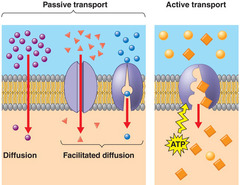
Channel proteins
Involved in the passive transport of a specific molecule; molecules can go in either direction through channel proteins depending on the direction of the gradient
Ex. aquaporins (water)

Gated ion channels
Involved in the passive transport of ions but must be stimulated by a neurotransmitter; ions go down the electrochemical gradient (high to low concentration, to the opposite charge)

Carrier proteins
Involved in the passive transport of a specific molecule that must bind to the protein, which induces the carrier protein to change shape
Molecules can also go in either direction using a carrier protein depending on the gradient
Ex. GLUT-1 (glucose)

Active transport
The movement of ions or molecules across membrane against a gradient, thus requiring energy (ATP) and the assistance of a transport protein (pump)
Ex. Na+/K+ ATPase (sodium-potassium pump)

Sodium-potassium pump
Involved in the active transport of sodium ions outside the cell and potassium ions inside the cell to establish an electrochemical gradient (more + charge on the outside of the cell) → 3 Na+ out, 2 K+ in
1. Pump's initial shape is conducive to binding of 3 Na+ ions inside the cell
2. ATP binds, transfers a phosphate group, and causes a shape change in the pump to release the Na+ ions out of the cell
3. This new shape is now conducive to the binding of 2 K+ ions outside the cell
4. Phosphate group is removed, 2 K+ ions are then released into the cell
5. Cycle repeats

Cotransport
Aka secondary active transport
Refers to when transport of one substance against its gradient is powered by the transport of another substance down its gradient
Ex. sucrose-H+ cotransporter
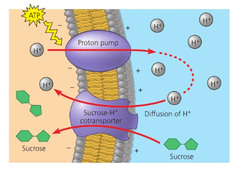
sucrose-H+ cotransporter
As H+ ions move down their concentration gradient (after being pumped against the gradient using ATP and a proton pump) through the sucrose cotransporter protein, the cotransporter undergoes a shape change (powered by the movement of H+ ions down their gradient) that allows sucrose to be transported against its gradient.
