D1.2 Protein synthesis
 Call Kai
 Learn
Learn Practice Test
 Spaced Repetition
 Match
Match Flashcards
 Knowt Play
1/57

There's no tags or description
Looks like no tags are added yet.
Name | Mastery | Learn | Test | Matching | Spaced | Call with Kai | Chat |
|---|
No analytics yet
Send a link to your students to track their progress
58 Terms
Describe transcription(happens in nucleus)
RNA polymerase binds to promoter region of gene(template strand), unwinding and separating DNA strands
RNA polymerase adds RNA nucleotides and forms mRNA by complementary base pairing
mRNA strand detaches from template
DNA rewinds
mRNA leaves nucleus via nucleus envelope pore
Where is rRNA found?
In large subunit of ribosome
True or false: transcription makes a copy of the sense strand of DNA
False, it makes a copy of the antisense (template) strand
True or false: rna polymerase is involved in translation
False, it’s only involved in transcription
True or false: transcription and translation occur simultaneously in prokaryotes
True as they lack a nuclear membrane to separate DNA from ribosomes
Why are DNA templates reliable for transcription?
Highly stable molecule due to H-bonds betw DNA bases & phosphodiester bonds → genetic code doesn’t spontaneously break
In somatic cells that do not divide, the genetic sequence is conserved due to this stability
Transcription as first stage of gene expression
Not even protein is needed in every cell, therefore, only certain genes r expressed:
Genes expressed r ‘switched on’→undergo transcription & translation
Genes not expressed ‘switched off’ do not undergo
What is the structure of a ribosome
Consists of a large subunit and a small subunit(EPA)
Made up of proteins and rRNA
What’s the difference between free ribosomes(cytoplasm) and bound ribosomes(RER)
Bound-make proteins used outside of cell
Free-make proteins used within cell
What do polysomes do?
Maximises efficiency of protein synthesis, allowing a cell to produce multiple copies of a specific protein quickly from just one mRNA strand
Describe translation
In cytoplasm, mRNA attaches to ribosome’s small subunit
Initiator tRNA binds to its amino acid and comes to ribosome’s small subunit
tRNA contains anti-codon(complementary to mRNA codon)
Large ribosomal subunit then binds to form ribosomal complex
Initiator tRNA is located in P site, 2nd lands in A site → amino acids on them bind(peptide bond)
Ribosome moves so 1st tRNA is in exit site, 2nd in P site → 1st tRNA leaves(to be used again) but leaves amino acid behind
Process repeats until stop codon(tRNA without amino acid binds)
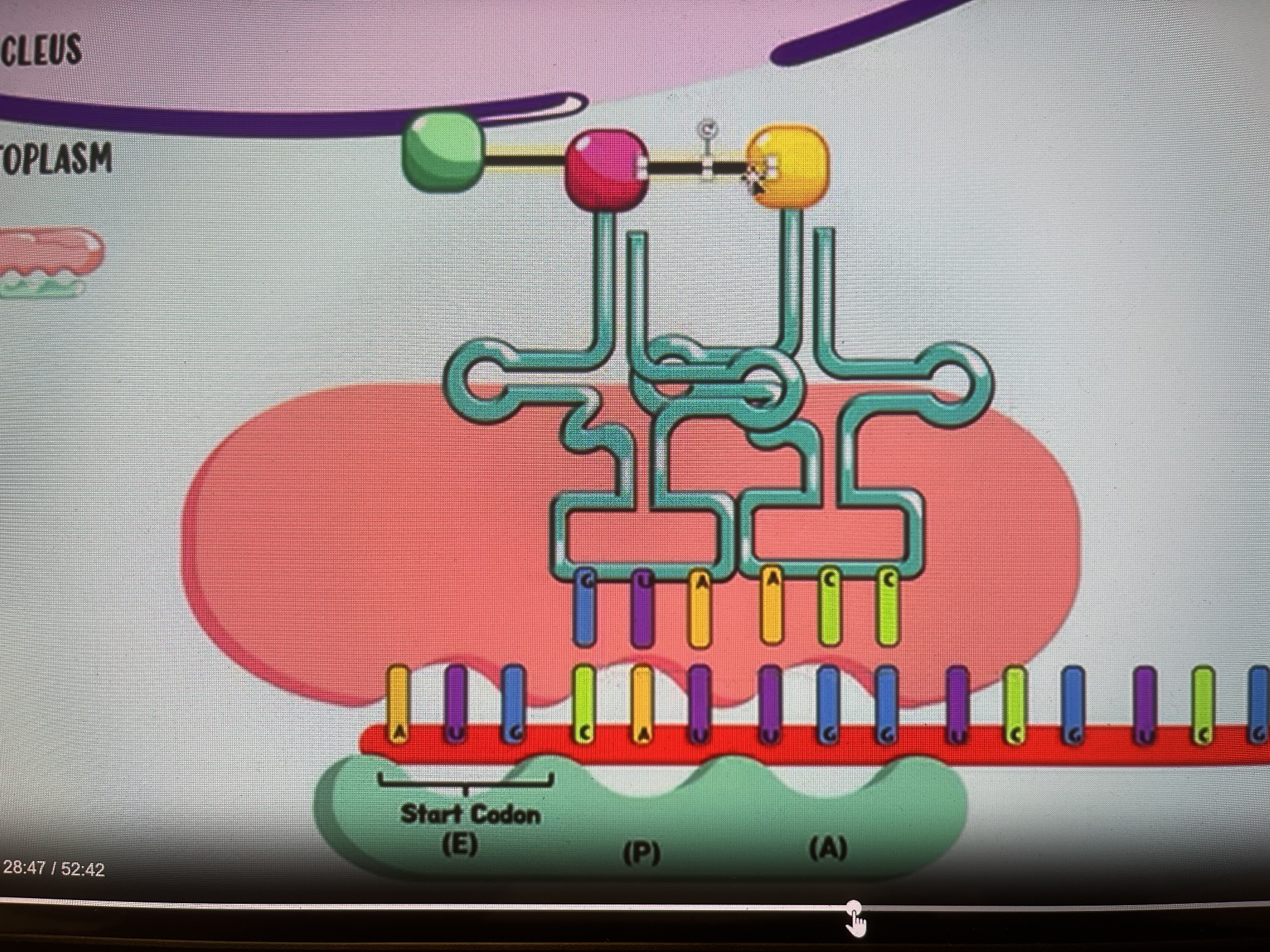
True or false: the large ribosomal subunit binds to form a complex AFTER the initiator tRNA binds to the start codon of mRNA on the small ribosomal subunit
True
Why is the genetic code considered degenerate(or redundant)?
There are 4 bases, 4³=64 possible codons (in triplets) while there are only 20 amino acids.
So multiple codons can code for the same amino acids.
Why is the genetic code considered universal?
The same triplet codes code for the same amino acids in all living things (which is why transfer of genes from one species to another is possible)
Why bond forms between 2 amino acids in translation?
Peptide bond
What completes the formation of an amino acid (polypeptide) chain?
A stop codon
What is an advantage of the degeneracy of the genetic code?
They limit the effect of mutations
What is the start codon code in mRNA?
AUG
How many tRNAs can bind simultaneously on a large subunit?
2
What is a gene mutation?
A change in the sequence of bases in DNA(happens during replication)
What is a point mutation?
When one base in DNA sequence is altered(can results in changed amino acid at this location)
Eg of point mutation: sickle cell anaemia: how it happens
Mutation changes Hb^A gene to Hb^S
Within haemoglobin gene, GAG codon changes to GTG on coding strand
Resulting template codon(CAC) is transcribed into mRNA codon GUG instead of GAG
Different amino acid replaces og amino acid
Effects of sickle cell anaemia
Haemoglobin S produced instead of haemoglobin A→ causes distortion in red blood cell shape
This shape leads to:
Limited oxygen carrying capacity
Blocks capillaries n limits flow of normal rbc
What is silent mutation
Changes DNA codon but not amino acid sequence
What is sense mutation(missense)
Amino acid changes completely, altering protein
What is nonsense mutation
Changes codon to stop codon, leads to shortened protein(nonfunctional)
What is point mutation
When a single nucleotide base in DNA is changed
True of false: silent, missense, nonsense mutations r types of point mutations
True
What is the promoter region in a gene in transcription?
Short sequence of bases NOT transcribed
True or false: the promoter region is the first part of a gene to be transcribed
False: it is not transcribed not classed as part of a gene. It’s a non-coding sequence located NEAR the gene
In which direction is the DNA template strand read, and which direction is mRNA synthesised?
Template strand read from 3’ to 5’
mRNA built from its 5’ to 3’
Same as DNA replication
What does the transcription bubble include? (3)
Template strand
Growing mRNA
RNA polymerase
What is the terminator in transcription?
Sequence of nucleotides that, when transcribed, causes RNA polymerase to detach from DNA(stops transcription)
What do transcription factors do in eukaryotes
Attracts and helps RNA polymerase bind to promoter region
They either activate gene to attract RNA polymerase, or deactivate gene to repel
3 stages of transcription
Initiation: RNA polymerase binds near promoter, separating DNA strands
Elongation: RNA polymerase moves along template→adds 5’ end of free RNA nucleotide to 3’ end of growing mRNA
Termination-RNA polymerase reaches terminator sequence→triggers detachment of RNA polymerase n mRNA strand
What are examples of non-coding sequences
Regulatory sequences: involved in gene expression by enhancing or suppressing transcription(eg: promoter)
tRNA(carries amino acids) and rRNA(makes up ribosomes)
Introns: found within genes of eukaryotes(removed during splicing)
Telomerase: regions of repeated nucleotide sequence at the end of chromosome→provides protection during cell division(facilitates binding of RNA primer at end of chromosome)
What is splicing and what carries it out?
When introns are removed from pre-mRNA by a spliceosome, and exons are connected together to form mature mRNA
Tip: exons→expressed, introns→intervene
True or false: splicing occurs in both eukaryotes and prokaryotes
False. Only in eukaryotes as prokaryotic mRNA doesn’t have introns
What are spliceosomes composed of?
nRNA (nuclear rna) and proteins
What happens after splicing?
A methylated cap is added to 5’ end to protect against degradation by exonucleases
A poly-A tail(long chain of A nucleotides) added to 3’ end for further protection and help mature mRNA exit nucleus
What is alternative splicing?
When spliceosome splices exons together in diff ways to make diff proteins (some exons may be removed)
True or false: one gene can only code for one protein (polypeptide)
False. Alternative splicing results in diff combos of exons, allowing one gene to code for diff proteins
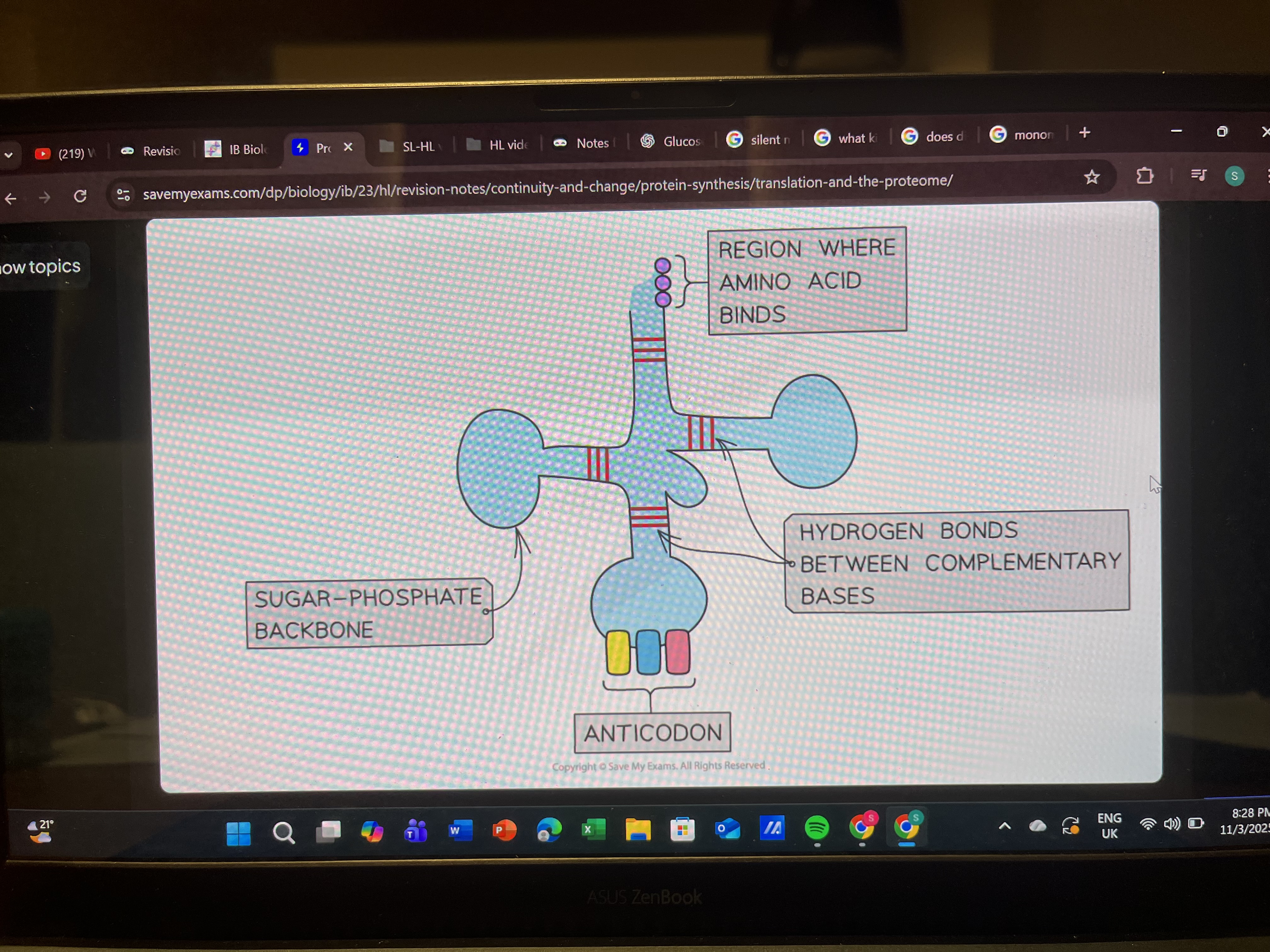
Structure of tRNA
Amino acid binding site
Sugar-phosphate backbone
Hydrogen bonds
Anticodon
In which direction is the mRNA strand translated?
5’ to 3’
Which end is an amino acid always attached to on a tRNA molecule? 5’ or 3’?
3’
Steps of initiation of translation
Small subunit attached to 5’ terminal of mRNA
Initiator tRNA pairs with AUG(start codon of mRNA) at P site
Large subunit of ribosome is added
Function of each ribosome site (APE)
A- holds tRNA carrying next AA being added
P- holds tRNA carrying growing polypeptide chain
E- releases tRNA that lost its AA
What are the sequences of the 3 stop codons?
UAA, UAG, UGA (brought to mRNA by a tRNA molecule that doesn’t contain an amino acid)
State the phases of transcription and translation
Initiation
Elongation
Termination
True or false: tRNA helps translate anticodons into amino acids
False: it translates mRNA codons into amino acids
Describe the modification of polypeptides into their function state. (Include 2-stage modification of pre-pro insulin to insulin)
Pre-proinsulin is attached to the endoplasmic reticulum
It’s modified by an enzyme which removes the signal peptide from the end→this detaches it from the ER and converts it to proinsulin
Proinsulin folds, disulfide bonds form (tertiary protein)
Proinsulin is packed into vesicles at Golgi apparatus and its C peptide is removed
This results in 2 protein chains attached tg by disulfide bonds→final insulin can be released
Which chemical labels unneeded, damaged or misfolded proteins?
Ubiquitin→it begins the process of these proteins being broken down in the proteasome
What is a proteasome and what does it do?
It’s an organelle in eukaryotic cells that contains protease enzymes that break down peptide bonds of unnecessary/damaged proteins
Amino acids are then released and used in translation to make new proteins
True or false: the number of T nucleotides on one strand of DNA is equal to the number of A nucleotides on the other strand
True, same applies to G and C
What is a proteome
The complete set of proteins express by an organism
Unlike the genome (DNA) that stays the same throughout a lifetime, a proteome constantly changes
True or false: complementary bases in DNA and RNA are held together by covalent bonds
False: they are held by hydrogen bonds
True or false: translation involves both rna and dna
False: it involves only rna
How many sites do both free and bound ribosomes each have and what are they for?
4 sites
3 for tRNA and 1 for mRNA