sliding filament theory
 Call Kai
 Learn
Learn Practice Test
 Spaced Repetition
 Match
Match Flashcards
 Knowt Play
1/46

There's no tags or description
Looks like no tags are added yet.
Name | Mastery | Learn | Test | Matching | Spaced | Call with Kai | Chat |
|---|
No analytics yet
Send a link to your students to track their progress
47 Terms
what in the biggest unit that makes up a muscle?
fasicle

what makes up the fasicles?
muscle fibres aka muscle cells aka myocytes

what makes up the muscle fibres/cells/myocytes?
myofibrils

what makes up the myofibrils?
myofilaments

what are the myofilaments?
actin and myosin
which out of actin and myosin is thinner or thicker?
actin - thin
myosin - thick
what is the sarcolemma?
plasma membrane of a muscle fibre/cell/myocyte
what is the myofibril organised into?
sarcomeres - short segments of myofibril
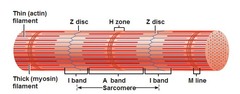
where does the sarcomere span to and from?
Z line to Z line
what is the Z line made of?
actin
what is the centre of the sarcomere called?
M line
what makes up the M line?
myosin
what is the A band?
length of the myosin

what is the I band?
actin only area

what is the H band?
myosin only

what happens to the filaments when the muscle contracts?
they slide over each other
what happens to the A band during contraction?
stays the same (the myosin filament itself does not get any shorter)

what happens to the I band during contraction?
shortens (as the filaments are sliding over each other there less 'actin only' space)

what happens to the H band during contraction?
shortens (as the filaments are sliding over each other there is less 'myosin only' space)

what is excitation-contraction coupling?
mechanism of how an action potential causes muscle fibre contraction
what initiates cardiac muscle contraction?
pacemaker cells in SA and AV nodes initiate an action potential
what happens to the action potential initiated by SA and AV nodes?
travels down the T-tubules between sacromeres which depolarises the whole sarcolemma
what does membrane depolarisation cause?
opens voltage-operated calcium channels (VOCCs) in the T-tubule system and calcium is released
what are the 2 ways that Ca2+ is release from the sarcoplasmic reticulum?
- via IP3
- via ryanodine receptors (RyR)
how is calcium released from the sarcoplamic reticulum via IP3?
- Gq activates Phospholipase C enzyme
- Phospholipase C breaks down PIP2 into IP3 + DAG
- IP3 then binds to the IP3 receptor on the SR
- DAG acts on various proteins (e.g. PKC)
- Calcium channels on the SR open and calcium is released
how is the action of IP3 terminated?
IP3 is cleaved to IP2 by IP3 phosphotase
how is calcium released from the sarcoplasmic reticulum via ryanodine receptors (RyR)?
- calcium binds to RyR on the sarcoplasmic reticulum
- the induces conformational changes in a calcium channel which is closely associated with RyR
- RyR is activated and opens so calcium is released from SR
- this is also known as the 'calcium spark'
what is meant by calcium-induced calcium release?
calcium being released into the intracellular fluid causes more calcium to be released from sarcoplasmic reticulum stores
what initiates skeletal muscle contraction?
nerve signals (action potentials) reaching the neuromuscular junction
what neurotransmitter is released at the neuromuscular junction?
ACh
what does ACh bind to?
nicotinic ACh receptors on sarcolemma (muscle plasma membrane)
what does the binding of ACh cause?
influx of sodium ions and hence depolarisation of membrane potential
where do the action potentials spread?
deep into the muscle down the T-tubule system to depolarise entire sarcolemma
what does depolarisation of the sarcolemma cause?
opening of voltage-gated Ca2+ channels
what happens after the Ca2+ channels open?
influx of Ca2+
what does the Ca2+ influx also cause?
sarcoplasmic reticulum in the muscle cells to release even more Ca2+
what does the Ca2+ do?
binds to troponin C on tropomyosin which is wrapped around the actin filaments
what happens when the Ca2+ binds to troponin C?
tropomyosin undergoes a conformational change and reveals the myosin head binding sites on actin
what needs to happen before myosin head can bind to the actin?
ATP binds to myosin head
what happens to the ATP on the myosin head?
breaks down into ADP and Pi but remains on the myosin head
what does the breakdown of ATP cause?
the myosin head to move backwards and bind to the actin
what happens once the myosin head is bound?
ADP and Pi are released and the myosin head moves forward into its original position, but still bound to the actin filament = power stroke
what does the power stroke cause the actin filament to do?
slide forwards
what happens after the power stroke?
ATP binds and releases the myosin head again
what binds to troponin C?
calcium - c for calcium
what does troponin I bind to?
actin - i and a are vowels
what does troponin T bind to?
tropomyosin - t for tropomyosin