Fatty Liver Disease
 Call Kai
 Learn
Learn Practice Test
 Spaced Repetition
 Match
Match Flashcards
 Knowt Play
1/20

There's no tags or description
Looks like no tags are added yet.
Name | Mastery | Learn | Test | Matching | Spaced | Call with Kai | Chat |
|---|
No analytics yet
Send a link to your students to track their progress
21 Terms
fatty liver disease is also referred to as
hepatic steatosis
hepatic steatosis
is a disorder characterized by fatty deposits (triglycerides) within the hepatocytes
FLD can be classified as
nonalcoholic fatty liver disease and alcoholic fatty liver disease
nonalcoholic liver disease
most common liver disorder in the Western World, and the most common cause of chronic liver disease
nonalcoholic liver disease is both
acquired and reversible
causes of nonalcoholic liver disease
starvation, obesity, chemotherapy, diabetes mellitus, hyperlipidemia, pregnancy, glycogen storage disease or von Gierke disease (glycogen storage disease type 1), total parental hyperalimentation, severe hepatitis, cystic fibrosis, intestinal bypass surgery for obesity, and the use of some drugs such as corticosteroids
fatty liver disease is also the hepatic manifestation of a disorder known as
metabolic syndrome and can lead to steatohepatitis
steatohepatitis
is inflammation of the liver that has been shown to be a precursor for chronic liver disease, leading to fibrosis, cirrhosis, and hepatocellular carcinoma
fatty changes within the liver can also be
diffuse or focal
diffuse infiltration
will cause the liver to appear diffusely echogenic, and it will be more difficult to penetrate
in the presence of diffuse fatty infiltration,
the walls of the hepatic vasculature and diaphragm will not be easily imaged, secondary to the attenuation of the sound beam
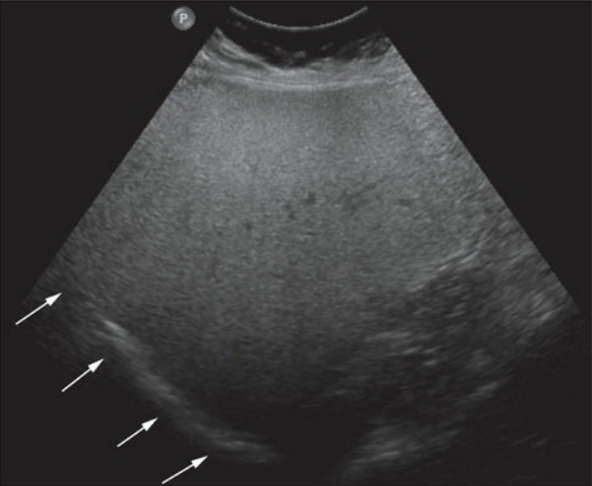
sagittal image of a diffusely fatty liver that demonstrates the inability to clearly visualize the diaphragm
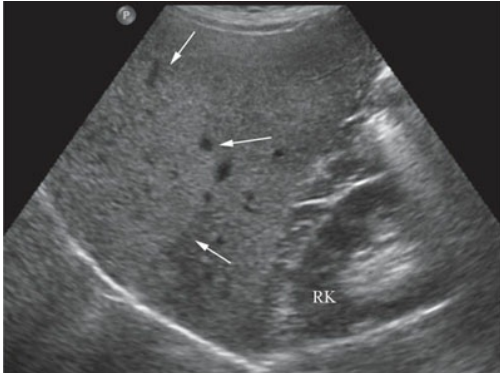
sagittal image of the liver demonstrating an area of focal fatty infiltration
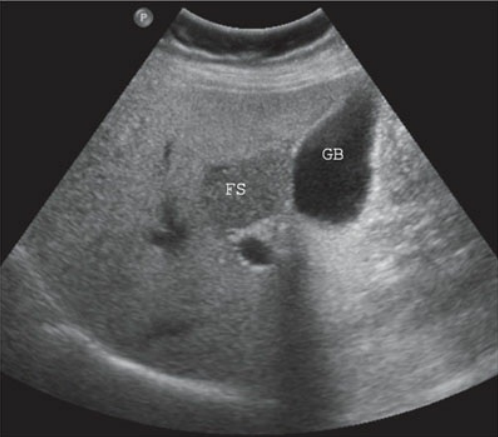
sagittal image of the liver demonstrating focal fatty sparring
the liver segment affected by focal fatty infiltration will appear as
an area of increased echogenicity and can thus appear much like a solid, hyperechoic mass
the liver segment affected by focal fatty sparring will appear as
a solid, hypoechoic mass or possibly even fluid
it is more likely that the signs of sparring and infiltration are seen adjacent to
the gallbladder, near the porta hepatis, and the left medial segment
clinical findings of fatty liver disease
asymptomatic
alcohol abuse
chemotherapy
diabetes mellitus
elevated liver function test (specifically AST and ALT)
hyperlipidemia
obesity
pregnancy
sonographic findings of diffuse fatty liver disease
diffusely echogenic liver
increased attenuation of the sound beam
wall of the hepatic vasculature and diaphragm will not be easily imaged
sonographic findings of focal fatty infiltration
hyperechoic area adjacent to the gallbladder, near the porta hepatis, or part of a lobe may appear echogenic
sonographic findings of focal fatty sparring
hypoechoic area adjacent to the gallbladder, near the porta hepatis, or part of a lobe or an entire lobe may be spared
can appear much like pericholecystic fluid when identified adjacent to the gallbladder