BCHM Exam 1
 Call Kai
 Learn
Learn Practice Test
 Spaced Repetition
 Match
Match Flashcards
 Knowt Play
1/59

There's no tags or description
Looks like no tags are added yet.
Name | Mastery | Learn | Test | Matching | Spaced | Call with Kai | Chat |
|---|
No analytics yet
Send a link to your students to track their progress
60 Terms
Explain compartmentalization and why it benefits the cell
Compartmentalization is the saving of energy within cells by localizing functions to certain structures
cells cannot afford to waste energy or time because they need to maximize efficiency
cells use increased surface area to be more efficient
Are cells in equilibrium?
NO, cells are NOT in equilibrium
Equilibrium means that no changes are occurring overall, so cells can’t be in equilibrium because we know that concentrations within cells are constantly changing
Define energy
Energy is the quantifiable property of any molecule or structure that is a force that can do work
Energy is present everywhere, because it is inherent in mass (E=mc2)
Is energy stored in bonds?
NO, energy is NOT stored in bonds
What are the different types of energy that exist in living cells?
1) Free Energy (Δg)
there’s +Δg and -Δg
+Δg reactions require energy
-Δg reactions releases energy
2) Heat Energy
heat energy is a byproduct of chemical reactions (like ATP reactions)
this heat energy cannot be harnessed by the cell, the only thing it can be used for is maintaining body temperature
3) Chemical Energy
4) Electrostatic Energy
Which free energy reaction REQUIRES energy?
the +Δg reactions require energy
Which free energy reaction RELEASES energy?
the -Δg reactions release energy
Which free energy reaction has energy readily available to do work?
-Δg reactions has energy available to do work
Which free energy reaction requires chemical coupling?
+Δg reactions require chemical coupling since it requires energy to take place, so it needs a -Δg to be couples with it to drive the reaction
______ reactions are exergonic
-Δg reactions are exergonic, meaning the products have a lower energy state than the reactants, therefore energy release occurred
What is ATP?
ATP is a high energy molecule (has a high potential energy geometry) used by the cell
adenosine triphosphate
What is ADP? How is it created?
ADP (adenosine diphosphate) is created from ATP (adenosine triphosphate)
to make ADP, an outer phosphate group on ATP is broken (hydrolysis)
Why are humans multicellular?
Human cells use compartmentalization to be more efficient
the cell utilizes volume to surface area ratio, which allows for more efficient diffusion and transfer in the cell
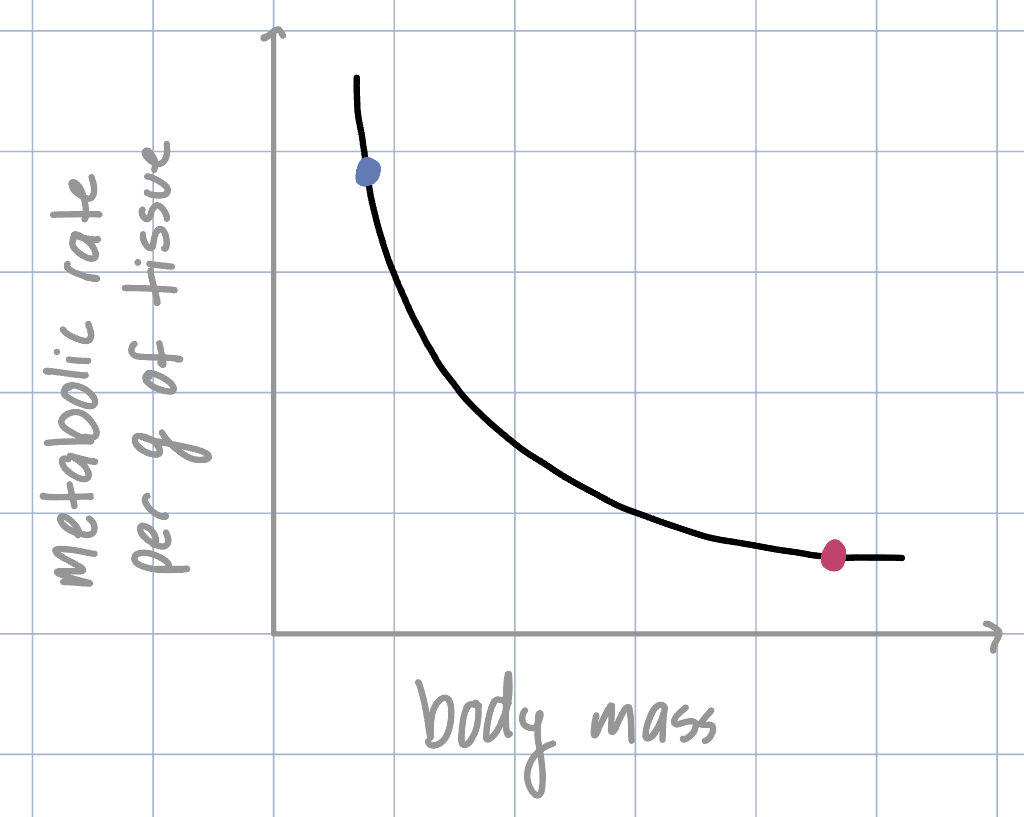
What is BSA? Given a mouse and an elephant, which animal would be on which point on this graph?
BSA = Baseline Surface Area
having higher lean muscle on average will increase metabolic rate
mouse would be the blue point
elephant would be the red point
What is BMR?
BMR = Basil Metabolic Rate
BMR is the metabolic rate of an organism at rest
Given a 100 g large brown rat and a 1 g mouse, what is the difference between their (a) total metabolisms?
(a) total metabolisms
the rat weights 100x more than the mouse, therefore the rat’s total metabolism is about 32x higher than the mouse’s
BMR = 1003/4 = 32
(b) per gram metabolism
total power (J/s) = change in energy / change in time
the 100 g rat has more total power than the mouse (more mass), but the mouse has a higher mass-specific power per gram than the rat
the mouse has more energy per gram of body tissue
this is partly due to the surface area to volume ratio
What is the Second Law of Thermodynamics?
the total entropy of a system will always increase over time during a spontaneous process
Δg = ΔH - T*Δs
Define entropy
entropy (Δs) is disorder or randomness
cal/mol*K
How can enthalpy be slowed down?
the only way to slow down enthalpy is to drop the temperature (since enthalpy is the total heat in a system)
Define enthalpy
Enthalpy (H) is the total heat of a system at constant pressure
kcal/mol
Define Metabolic Coupling
the functional coordination between cells or pathways where the activity of one directly drives the activity of the other
Define Bioenergetics. Why is it important?
Bioenergetics = the study of energy flow
continuous energy flow in the cell is necessary so that energy can be sent to where it needs to be as quickly as possible
Describe the bioenergetic process of ATP:
bioenergetic process: how ATP (energy) moves from the mitochondria to where it is needed
in the Mitochondria, there is an ADP/ATP carrier protein system that exchanges ATP (which leaves the mitochondria) for ADP (which enters the mitochondria to replace the ATP that’s leaving because that ADP will be turned into ATP)
kinase enzymes in the cytosol remove a phosphate from the ATP, turning those molecules into ADP → this process of breaking off a phosphate releases energy
transport proteins move ATP from the cytosol to the ER and can be used by proteins and ion pumps
the Mitochondria themselves can move within the cell via microtubules to where ATP demand is high (Ex. the synapse space between two neurons located on the end of the nerve cell is where a lot of ATP is needed, so Mitochondria are constantly relocating there)
What is the cytosol?
Cytosol is the water-based fluid inside the cytoplasm of the cell
Describe the Maxwell Boltzmann Distribution
gas molecules in a closed container (at equilibrium) will NOT be distributed in a bell-shaped curve
the curve will be skewed to the right
the cell as a whole does not follow this distribution (the cell is not at equilibrium, changes are constantly occurring)
there are specific areas within the cell that follow Boltzmann distribution (Ex. free molecules like potassium and sodium)

Does the graph represent positive or negative free energy?
low energy molecule → high energy molecule
+Δg
work and energy are increasing
energy is being required
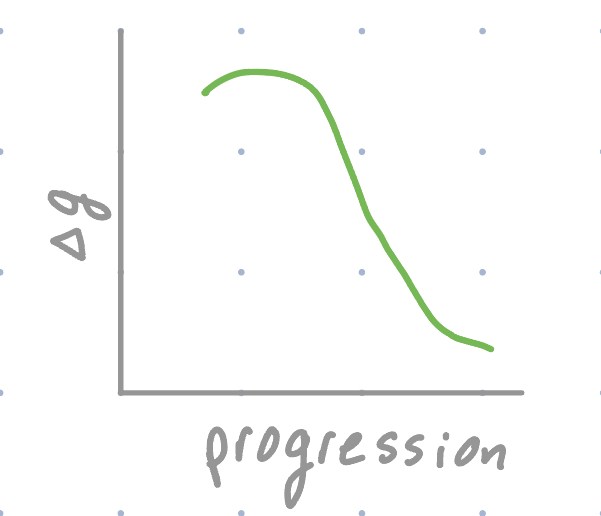
Does the graph represent positive or negative free energy?
high energy molecule → low energy molecule
-Δg
work and energy are decreasing
energy is released
______ reactions are endergonic
+Δg reactions are endergonic, meaning the products have a higher energy state than the reactants, therefore energy was required
Order the following molecules from highest Δg to lowest Δg:
CH4
COOH
CO2
highest to lowest Δg : CH4, COOH, CO2
CH4 is the most reduced and least oxidized, therefore has the most energy (because the C has electrons in high-energy arrangements)
COOH is between the two
CO2 is the least reduced and most oxidized (C has two double bonds with two O’s), therefore has the least energy available
the __________ reduced a molecule is, the MORE energy it has
MORE
more reduced = more energy
more reduced means the electrons are in a higher-energy arrangement
the __________ reduced a molecule is, the LESS energy it has
LESS
less reduced = less energy
Define electron
an electron is a finite point that has a wave function
electrons do not spin and do not orbit
Explain the Double Slit Experiment and what is showed
Matter particles (Ex. marbles) were shot through 2 slits and onto a wall, which created a 2 slit pattern on the wall
When wave particles were shot through the 2 slits, there were interference patterns of many bands created on the wall
When electrons were shot through the 2 slits, they acted like the waves and created interference patterns
But when the electrons were observed with an instrument, they acted differently and actually created the 2 slit pattern that the matter created
Conclusion: when a wave is observed with an instrument, the wave collapses and acts as a particle, called wave-particle duality - electrons exhibit both wave-like and particle-like properties depending on how they are measured
Define wave-particle duality
when a wave is observed with an instrument, the wave collapses and acts as a particle
electrons exhibit both wave-like and particle-like properties depending on how they are measured
Define quanta
electromagnetic radiation (a beam of light) contains energy in little packets called quanta
energy is transferred in quanta steps

Label the node and antinode. Where are electrons more likely to be found and why?
orange = node
green = antinode
electrons are more likely to be found in the antinode where there is more area
Define electron orbital
regions around an atom’s nucleus where electrons are most likely to be found
electrons will go to their minimum energy state (most stable energy level), which is their orbital
What keeps an electron from collapsing into the nucleus?
The electrons collapsing into the nucleus is prevented by the electron being confined to its orbital, which it wants to stay in because that is the electron’s most stable region with lowest energy
this minimum energy state is created by the balance of kinetic and potential energy
so since the lowest energy standing wave is not in the nucleus, the electron is kept away and the folding in of electrons is prevented
Define quantum tunneling
a wave particle tunnels through a potential energy barrier
during catalytic reactions, when the potential energy wall doesn’t get lowered, the electron tunnels through the barrier instead of over it
What is the buffer region when the pKa = 4.76?
buffer region is ±1 pKa
buffer region would be 3.76-5.76
Define buffer region
the range of which a solution can resist large changes in pH
buffer region is ±1 pKa
buffer region will be the flatter part of a titration cuve
When does pH = pKa during titration?
pH = pKa when 50% of the original weak acid has been converted to its conjugate base by adding base
What organ controls the pH of urine?
kidneys filter waste and water from the blood to make urine
the renal tubular cells of the kidneys control the pH of urine
titratable acidity is a measure of acid excreted into urine by the kidneys (H+ ions secreted into urine)
Amine group’s pKa = ____
amine pKa = 9
N-R3
carboxyl group’s pKa = ____
carboxyl pKa = 4
R-COOH
Explain how much acid and how much base would be in a buffer using a carboxyl group at each of the following pH’s:
(a) pH = 2
(b) pH = 4
(c) pH = 6
(a) pH = 2
solution is more acidic than pKa
more COOH than COO-
COO- + H+ → COOH
conjugate base + acid → acidic product
(b) pH = 4
since we know the pKa of a carboxyl group is 4 and the pH is 4, pH=pKa, therefore there is 50% COO- (conjugate base) and 50% COOH (carboxylic acid)
(c) pH = 6
more basic than pKa
more COO- than COOH
COOH + OH- → COO-
acid + base → conjugate base
Explain how much acid and how much base would be in a buffer using an amine group at each of the following pH’s:
(a) pH = 7.5
(b) pH = 9
(c) pH = 11
(a) pH = 7.5
more acidic than pKa
more NH3+ than NH2
NH2 + H+ → NH3+
base + acid → conjugate acid
(b) pH = 9
since we know the pKa of an amine group is 9 and the pH is 9, pH=pKa, and therefore there is 50% NH2 and 50% NH3+
(c) pH = 11
more basic than pKa
more NH2 than NH3+
NH3+ + OH- → NH2
acid + base → conjugate base
Water being insulating is a __________ property
dielectric
What are the types of water organization?
1) bulk water
tap water
has a random/disordered arrangement
found in open spaces in the cytosol (away from cell structures)
2) vicinal water
layered / structured water that directly and tightly binds to surfaces of molecules or membranes
3) clathrate water
cages of water molecules
arranged in a highly-ordered lattice around hydrophobic molecules
How are water molecules bonded together?
water is a polar molecule, therefore orients itself around other charged molecules, including other water molecules
the O has a partial negative charge, and the H’s both have a partial positive charge
the O on one water molecule hydrogen bonds to an H on another water molecule

Explain gel ↔ sol transitions in the cytoplasm
the cytoplasm is viscous, and transitions from more gel-like to more sol-like (or vice-versa) - caused by changes in the actin cytoskeleton
gel = more solid, more structured, less entropy
sol = more fluid, less structured, more entropy, more bulk water needed to transition to sol
gel-sol transitions can propel ions needed for enzymes
Define colloids
particles that are intermediate in size between a solution (not viscous) and suspension (very viscous)
the cytoplasm is a “colloidal system”
Define cytoplasm
the viscous, colloidal system inside the cell that consists of water, proteins, organelles, and other particles
Define hydration shell
a shell of ordered water molecules around an ion
Which ion has a more tightly-bound hydration shell? Why?
(a) Mg2+ or Na+
(b) K+ or Na+
*overall, a higher charge density will cause a stronger hydration shell, which is caused by a higher charge or a smaller molecule with a more concentrated charge
(a) Mg2+ or Na+
Mg2+ because it has a higher charge, therefore has a stronger attraction to water
(b) K+ or Na+
Na+ because it is smaller than K+, so the electrons are more packed together and therefore the charge is more concentrated
atomic radius increases down the periodic table and increases to the left
Does a hydration shell have high or low entropy?
low entropy because it is organized
so when a hydration shell is ripped off, entropy increases because that caused disorder
Define hydrophobic effect
the tendency of non-polar molecules to aggregate together in water (rather than dissolve), and water is forced to form a clathrate cage around those molecules
the hydrophobic effect contributes to the folding of proteins
How does the presence of hydrophobic molecules impact proteins? How does this relate to the Second Law of Thermodynamics?
proteins will fold so that hydrophobic molecules are in the middle of the protein (being shielded from the water)
Thermodynamics: this process creates a lower-energy, more thermodynamically stable state
Define hydrophobic interaction
hydrophobic interactions occur when hydrophobic molecules are pushed together by the clathrates around each molecule, creating a lower-energy, more thermodynamically stable state

How does the presence of hydrophobic molecules within fatty acids impact the water surrounding fatty acids?
fatty acids are made up of a hydrophilic “head” and a hydrophobic alkyl group “tail”
the water molecules will order themselves in a clathrate cage around the hydrophobic alkyl group
