Enzymes and Biochemistry-Honors Biology
 Call Kai
 Learn
Learn Practice Test
 Spaced Repetition
 Match
Match Flashcards
 Knowt Play
1/34

Earn XP
Description and Tags
Unit 2 vocab
Name | Mastery | Learn | Test | Matching | Spaced | Call with Kai | Chat |
|---|
No analytics yet
Send a link to your students to track their progress
35 Terms
Carbon
An element that is the main building block to life
Monomers
Single units: small molecules that can join together to make larger molecules called polymers
Polymers
A larger molecule made of monomers
Dehydration synthesis
The removal of water to form bonds between monomers to form polymers
Hydrolysis
The addition of water to break bonds between polymers to form monomers
Carbohydrate
Composed of carbon, hydrogen, and oxygen
1:2:1 [1 part carbon] [2 parts hydrogen] [1 part oxygen]
Glycosidic link/bond
The chemical bond that connects sugar molecules together
Lipid
insoluble organic compounds that are made up of fatty acids and long term energy storage
Protein
A large molecule made up of amino acid that performs many jobs in cells such as building structures and speeding up reactors
Amino acid
The building block (monomer) of proteins
Peptide bond
The bond that connects amino acids together to form proteins
Nucleic acid
A biological molecule that stores and carries genetic information such as DNA and RNA
Glyco-
Sugar prefix
Lipo-
Fat
Nucleo-
Nucleus
Hydro-
Water
Mono-
One
Di-
Two
Poly-
Many
Synth-
To put together
-Ose
Sugar
-lysis
Dissolving (breaking apart)

Enzyme
Biocatalysts: speeds up the rate of a reaction by lowering barriers known as biological catalysts.
Activation energy
Minimum energy required to start a chemical reaction

Active site
The place on an enzyme where the substrate binds.

Substrate
Thing that binds to an enzyme
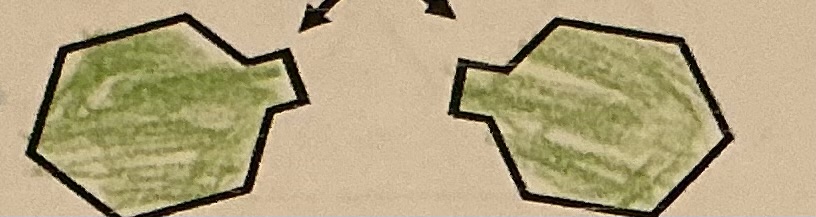
Product

Denature
When an enzyme that has lost its normal 3d or tertiaray structure
R group
A variable group that can represent different types of atoms or groups of atoms
Hydroxyl
A group containing an oxygen and hydrogen-OH usually makes molecules polar
Carbonyl
A carbon double bonded to oxygen c=o it can be an aldehyde or ketone
Carboxyl
A carbonyl and hydroxyl together - COOH often acts as an acid
Amino
A nitrogen with hydrogens- nh2 often acts as a base
Methyl
A carbon bonded to three hydrogens ch3 can affect a molecules shape and function
Phosphate
A phosphate bonded to oxygen atoms - po4 important in energy transfer and DNA and RNA