Biology C3S1
 Call Kai
 Learn
Learn Practice Test
 Spaced Repetition
 Match
Match Flashcards
 Knowt Play
1/21

Earn XP
Description and Tags
Cell Structure and Function
Name | Mastery | Learn | Test | Matching | Spaced | Call with Kai | Chat |
|---|
No analytics yet
Send a link to your students to track their progress
22 Terms
What’s the main difference between prokaryotes and eukaryotes?
Prokaryotes = lack membrane bound nucleus
Eukaryotes = have membrane bound nucleus
Archae and bacteria are two main domains of prokaryotic cells, state the characteristics for both domains in terms of number of cells, cell wall and location where it lives
Archae: Unicellular,lacks peptidoglycan, live in exreme harsh conditions
Bacteria; Unicellular, have peptidoglycan, most widespread group
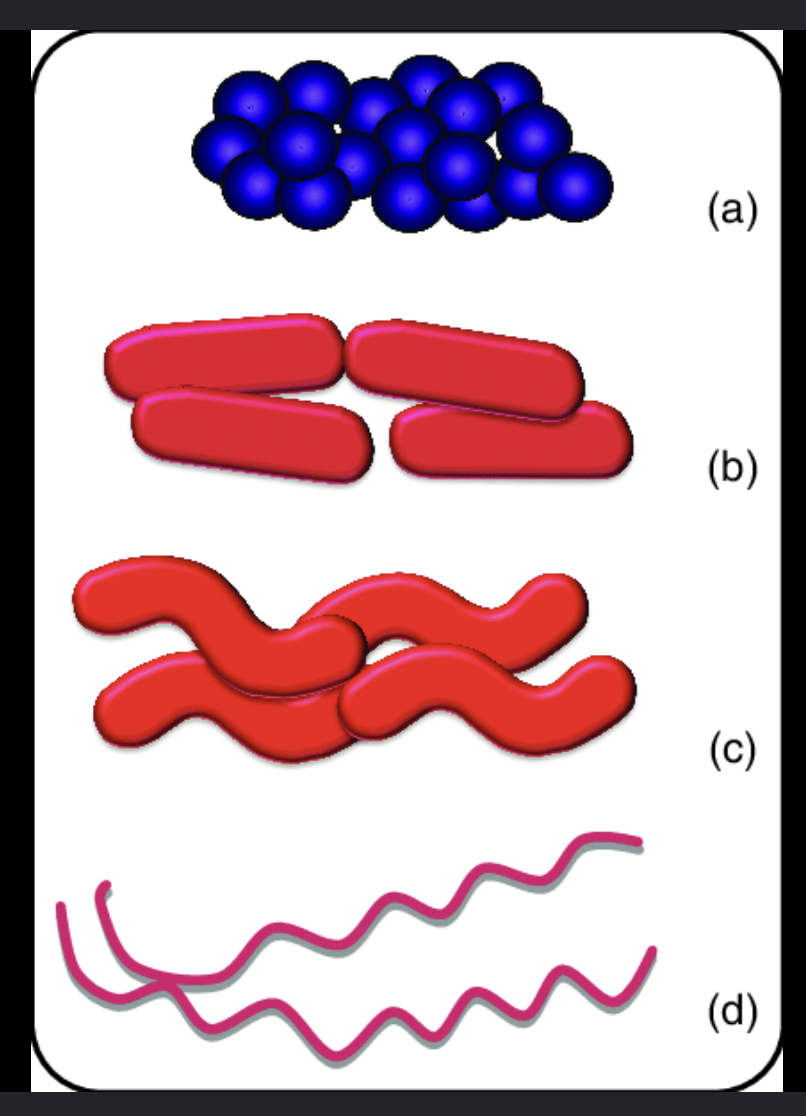
State the shape for each of the structure in the diagram
a) Coccus
b) Bacillus
c) Spirillum
d) Spirochete
Structure of prokaryotes internally is not as abundant as eukaryotes because prokaryotes are original cells. Prokaryotes undergo many different adaptations to produce many organelles as we know today. State briefly about the content in prokaryotic cells
Cell envelopes, cytoplasm, nucleic, plasmids, ribosomes
Explain in more detail about cell envelope of prokaryotic cells, what does it contain? and what is the function?
Plasma Membrane - is made out of lipid bilayer. Internal pouches known as mesosomes can be formed to increase the surface area
Cell Wall - to maintain the shape and is strengthened by peptidoglycan (remember for bacteria only, Archaea no)
Glycocalyx - polysaccharide layers
Explain in more detail about cell Cytoplasm and other organelles like ribosome, nucleoid, and plasmids of prokaryotic cells
Cytoplasm is semifluid medium that contains water, enzymes, inorganic and organic molecules that is encapsulated by plasma membrane (which is made up of lipid bilayer, has peptidoglycan for bacteria and glycocalyx)
Ribosomes - site of protein synthesis and is located within cytoplasm
Nucleoid - region that contains single DNA molecule
Plasmids - small accessory of DNA
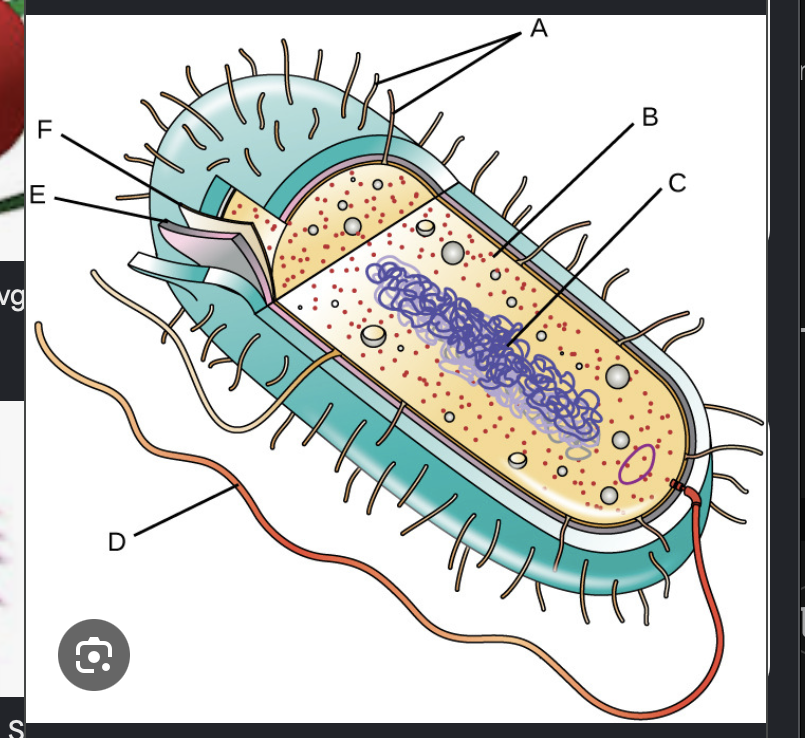
Apart from internal structures, prokaryotes also have external structure. Try to label the external (and internal) structure of prokaryotes that you know
External
A - Fimbriae
D - Flagellum
unlabelled - conjugation pilli
Internal
B - Ribosome
C - Nucleoid
F - Plasma membrane
E - Cell wall
What are the function of flagellum, fimbriae, and conjugation pillus (external structures of prokaryote)
Flagellum - movement
Fimbriae - bristle like fibre that projected from cell surface. The purpose is for adhesion
Conjugation pillus - tubular structures used to pass DNA from cell to cell (during conjugation)
State the characteristics of Eukaryotic cells in terms of nuclues, organelles, plasma membrane, and content within the cells that make it different than prokaryotic cells
• has membrane bound nucleus
• Has compartmentalized organelles that perform specific funtions
• Plasma membrane seperates cell contents with the environment and regulates entry of materials in and out of cells
Apart from not having membrane bound nuclues and organelles, another factor that can distinguish prokaryotes from eukaryotes is not having cytoskeleton. What is the function of cytoskeleton?
• Maintain shape
• Transport materials (e.g: movement of vesicles from RER to GA involved cytoskeleton)
Organelles in cell have different origins. Organelles like nucleus as we know today are result of different processes like invagination, etc. State the origin of nuclues and endomembrane system.
Nucleus: invagination of plasma membrane led to formation of internal structure (invagination: change the shape of existing tissue)
Endomembrane system (ER, GA): Proliferation of membrane
(Proliferation: add more cells)
Explain about what is endosymbiotic theory. Is it proven with any evidence?
Mitochondria and chloroplasts originated from smaller prokaryotic cells that were ingulfed by a larger eukaryotic ancestor. The engulfed prokaryotes later form a symbiotic relationship where the host benefitted from the ability to make energy or perform photosynthesis.
Evidence:
• size of mitochondrja and chloroplast are similar to the size of bacteria
• Both organelles have double membrane
• Contain their own ribosomes and produce some protein
Nucleus and ribosome
There are 4 main components of nucleus and the genetic information can be in two forms. What are they?
• Nuclear membrane
• Nuclear pore
• Nucleolus
• Nucleoplasm
Content in the form of:
• Chromatin
• Chromosomes (during cell division)
State the function of ribosome, its shape, the composition, the content inside the ribosome, the location
• site of protein synthesis
• Composed of rRNA
• Contain enzyme that forms peptide bond
• RER/Cytoplasm
Difference betwewn endomembrane organelles qith energy related organelles
Endomembrane - organelles commumicare with eo through membrane channels and small vesicles
Energy related organelles - independant and self sufficient
Difference between SER and RER
SER:
• No ribosomes
• Synthesis lipds
• Breakdown toxins
RER:
• have ribosome
• Synthesis protein
• Forms glycoprotrin
Both:
• forms transport vesicles
What's the content of lysosomes and how does it work?
Lysosomes is membrane bound vesicles that contain powerful digestive enzyme. Lysosome fuse with incoming vesicles and digest macromolecules taken into a cell,
Vacuoles are plant cells equivalent of lysosomes. What is the functions and content inside the vacuoles?
Contain organic, inorganic materials and enzyme. Functions are to store water, nutrients and developement of turgor pressure for structural support
What is the relation of chloroplast with mitochondria in plant?
Chloroplast usu sunlight energy and CO2 to produce carbohydrates. Carbohydrates are used by mitochondria to produce energy. Mitochondria produced CO2 and H2O as byproduct which in turn is used by the chloroplasts
Cytoskeleton is a network if protein fibre inside cytoplasm that act like the internal framework of dells. State the functions.
functions
• maintain shape
• Intracellular support
• Cell movement
• Cell division
What's the content of lysosomes and how does it work?
Lysosomes is membrane bound vesicles that contain powerful digestive enzyme. Lysosome fuse with incoming vesicles and digest macromolecules taken into a cell,
Vacuoles are plant cells equivalent of lysosomes. What is the functions and content inside the vacuoles?
Contain organic, inorganic materials and enzyme. Functions are to store water, nutrients and developement of turgor pressure for structural support
What is the relation of chloroplast with mitochondria in plant?
Chloroplast usu sunlight energy and CO2 to produce carbohydrates. Carbohydrates are used by mitochondria to produce energy. Mitochondria produced CO2 and H2O as byproduct which in turn is used by the chloroplasts
There a few types of cytoskeleton fibre, what are those? Elaborate.
1. Microfilament
- is the thinnest
- Helps in cell movement and cell division
2. Intermediare filaments
- medium (thickness)
- Maintain cell shape
3. Microtubules
- thickest
- Movement of chromosomes