[MOD1LEC] Genes, Cell Division
 Call Kai
 Learn
Learn Practice Test
 Spaced Repetition
 Match
Match Flashcards
 Knowt Play
1/21

There's no tags or description
Looks like no tags are added yet.
Name | Mastery | Learn | Test | Matching | Spaced | Call with Kai | Chat |
|---|
No analytics yet
Send a link to your students to track their progress
22 Terms
What are the four main phases of the cell cycle?
G1 - first gap phase; cell is growing and playing its typical metabolic roles
S - synthesis phase where DNA is replicated
G2 - second gap phase; growth and preparation for mitosis
M - mitotic phase where the cell divides. This phase contains prophase, metaphase, anaphase, telophase, and cytokinesis
G1 through G2 is termed interphase
Meiosis
The cell division of s*x cells (egg and sperm)
Two divisions occur
Results in four daughter cells unique from the original
Daughter cells contain 23 single chromosomes
Mitosis
The cell division of somatic cells (non-sex cells)
One division occurs
Results in two daughter cells identical to the original
Daughter cells contain 23 pairs of chromosomes
Mitosis accounts for the growth of all tissues after birth, the replacement of dead cells, and the repair of damaged tissues
What are traits of normal cell division distinct from cells affected by cancer?
Contact inhibition - cells cease dividing when they come into contact with other cells
Cell cycle - normal cells only divide after a proper cell cycle has occurred and when they are mature
Mortality - normal cells only divide around 50 times and then they die via apoptosis
Cancer cells divide infinitely as long as they are provided nutrients
Cell surface - normal cells “stick” together to form tissues, while cancer cells tend to “round-up”
This enables metastasis to occur, where the cancer cells break off and spread throughout the body
![<p>Prophase [Phases Of Mitosis]</p>](https://assets.knowt.com/user-attachments/cbe34b4f-b45b-4035-9b87-8a7d51717036.png)
Prophase [Phases Of Mitosis]
The stage where chromosomes condense
The nuclear envelope breaks down
Spindle fibers grow from centrioles
Centrioles migrate to opposite poles of the cell

![<p>Metaphase [Phases Of Mitosis]</p>](https://assets.knowt.com/user-attachments/3b44c6ba-2d13-47df-825f-1ff7f01f5d06.png)
Metaphase [Phases Of Mitosis]
The stage where chromosomes line up along the equator or midline of the cell
Some spindle fibers attach to the chromosomes
Shorter microtubules form the aster and attach to the plasma membrane

![<p>Anaphase [Phases Of Mitosis]</p>](https://assets.knowt.com/user-attachments/f428c072-255b-423b-876c-bfc86d1ff933.png)
Anaphase [Phases Of Mitosis]
The stage where sister chromatids separate as spindle fibers pull chromatids to opposite poles of the cell
Each pole (each side of the cell) now has an identical set of genes
Each pole and its contents will become a genetically identical daughter cell

![<p>Telophase [Phases Of Mitosis]</p>](https://assets.knowt.com/user-attachments/4064b239-9766-4b54-b474-717cba836a4e.png)
Telophase [Phases Of Mitosis]
The end of nuclear division
Chromosomes gather at each pole of the cell
Chromosomes decondense and turn back into chromatin
A new nuclear envelope appears at each pole
New nucleoli appear in each nucleus
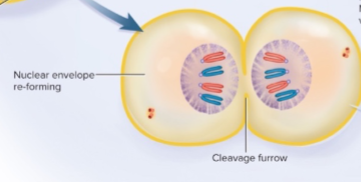
Cytokinesis [Phases Of Mitosis]
The stage where the cytoplasm is divided into two distinct cells so that each daughter cell has some
The forming of the cleavage furrow occurs at the equator of the cell
Once the daughter cells have been formed, they return to interphase, specifically G1, or the phase where they are performing their normal metabolic functions
Gene
An information-containing segment of DNA
Codes for the production of a molecule of mRNA
mRNA goes on to synthesize one or more proteins
The amino acid sequence of a protein is determined by a nucleotide sequence in the DNA
The genome
46 human chromosomes come in two sets, where humans receive one set of 23 from each parent
All the DNA in one 23-chromosome set is called the human genome
The human genome consists of about 3.1 billion nucleotide pairs
Human Genome Project (HGP)
A project carried out from 1990 to 2003 which provided society with knowledge of the base sequence (A, T, C, G) of more than 99% of the genome
Genomics
The comprehensive study of the whole genome and how its genes and noncoding DNA interact to affect the structure and function of the whole organism
Genes average about 3,000 bases long, but range up to 2.4 million bases
All humans, worldwide, are at least 99.99% genetically identical
Even the 0.01% variation means that we can differ from one another in more than 3 million base pairs
Before the HGP, we know the chromosomal locations of fewer than 100 disease-producing mutations. We now know more than 1,400
DNA replication
The double helix of DNA is unzipped and unwound, and each original strand acts as a template for the replication of a new partner strand. Nucleotides are matched to synthesize the new partner strands into two new double helixes
The new double helixes contain an old strand and the new copied strand
DNA replication is semiconservative, meaning that each strand in an unzipped double helix will act as a template for synthesis of a new, complementary strand
New DNA is made by enzymes called DNA polymerases
The genetic code
The body can make millions of different proteins from just the same 20 amino acids
The genetic code is a system that enables these 4 nucleotides to code for the amino acid sequences of all proteins
Base triplets (found in DNA) » Codons (copy of DNA turned into mRNA) » Amino acids » Proteins
The genetic code is expressed in terms of codons
Stop codons
The signal to the protein-synthesizing machinery inside of a cell that it has reached the end of the chain of codons
UAG, UGA, UAA are all stop codons
AUG serves as a code for methionine and is a start codon
What is protein synthesis?
How DNA and different types of RNA collaborate to produce proteins
The genetic code in DNA specifies which proteins a cell can make
All of the body’s cells except the s*x cells and some immune cells contain identical genes
Different genes are activated in different cells. For example, genes for digestive enzymes are active in the stomach and pancreas cells but not in muscle cells; any given cell only uses one-third to two-thirds of its genes, while the rest remain dormant
What is a simplified version of protein synthesis?
When a gene has been activated, a messenger RNA is created (a mirror of the gene)
Transcription - the step from DNA to mRNA that occurs in the nucleus
Translation - the step from mRNA to protein synthesis. Most translation occurs in the cytoplasm
mRNA
Carries the genetic code from the nucleus to the cytoplasm
mRNA is synthesized in the nucleus and acquires a protein cap that lets it leave the nucleus
DNA is too large to leave the nucleus, so a small mRNA copy is created so it can leave through a nuclear pore
An enzyme called RNA polymerase binds to the DNA and assembles the RNA. Certain distinctive base sequences (often TATATA or TATAAA) inform the polymerase of where to begin
tRNA
Binds to a free amino acid floating around in the cytosol and delivers it to a ribosome to be added to a growing protein chain
One loop of the molecule includes an anticodon, or a series of three nucleotides complementary to a specific codon of mRNA
The first tRNA to bind to a ribosome at the start of translation is called the initiator tRNA
The anticodon determines what the mRNA says and then gives it an amino acid corresponding to that base triplet
Ribosomes
“Reading machines” found in the cytosol that are made up of a small subunit and a large subunit
Each is composed of several enzymes and rRNA
The two subunits only come together during the translation of mRNA
The tRNA binds to the A site, then the P site, then the E site of the ribosome
Protein processing and secretion
Protein synthesis is NOT finished when its amino acid sequence (primary structure) has been assembled
To be functional, it must coil or fold into precise secondary and tertiary structures
In some cases, it associates with other protein chains (quaternary structure)