CDC PART 1 NP2
 Call Kai
 Learn
Learn Practice Test
 Spaced Repetition
 Match
Match Flashcards
 Knowt Play
1/50

There's no tags or description
Looks like no tags are added yet.
Name | Mastery | Learn | Test | Matching | Spaced | Call with Kai | Chat |
|---|
No analytics yet
Send a link to your students to track their progress
51 Terms
Situation: Ella, a 23-year old, is currently experiencing nausea and vomiting. She had already missed her period for a month.
Q1: What signs and symptoms of pregnancy is she currently experiencing?
A. Positive
B. Probable
C. Presumptive
D. Definitive
C. Presumptive
Subjective - reported by the mother
Probable - objective
Q2: Aside from the aforementioned signs and symptoms, what other signs and symptoms could Ella experience in the same category?
A. Softening of the cervical tip
B. Abdominal enlargement
C. Breast Changes
D. Passive movement of unengaged fetus
ANSWER: C. Breast change
A. Probable - goodels
D. Ballottement - porbable
Q3: What vitamin is crucial for Ella given that she is in the first trimester?
A. Iron
B. Vitamin B9
C. Vitamin B7
D. Calcium
ANSWER: B. Vitamin B9: low folc acid → NTD
Folic acid to prevent neural tube defect
Q4: A nurse explains the menstrual cycle to a client. The client is on day 25 of her cycle and is not pregnant. What is most likely happening in the uterus at this time?
A. The lining of the uterus is getting thicker because of estrogen
B. The lining of the uterus is breaking down because progesterone levels are falling
C. The uterus is preparing for implantation because of progesterone
D. The uterus is shedding its lining because progesterone levels are increasing
ANSWER: B. The lining of the uterus is breaking down because progesterone levels are falling
Low progesterone = shredding of the uterus
A. The lining of the uterus is getting thicker because of estrogen
D. The uterus is shedding its lining because progesterone levels are increasing - menstruation
Situation: Suzanne and Kevin Matthews, a young adult couple, 4 months pregnant, come to your antepartal clinic for a routine visit. Suzanne, in tears, states, "My husband isn't interested in me anymore. We haven't had sex since I became pregnant." The couple engaged in coitus two to three times per week prior to this pregnancy. Kevin states, "I'm afraid I'll hurt the baby."
Q5: As their nurse, what health advice would you give to the couple?
A. Advise them to avoid sexual activity throughout pregnancy to prevent harm to the fetus
B. Encourage them to resume sexual activity at the same frequency as before pregnancy
C. Explain that sexual activity is generally safe during pregnancy unless complications are present
D. Recommend abstinence until fetal viability is confirmed by ultrasound
ANSWER: C. Explain that sexual activity is generally safe during pregnancy unless complications are present
Complication that are contraindicated: placenta previa, abruptio placenta
Situation: A 26-year-old G1P0 at 39 weeks' gestation is lying on the bed in lithotomy position and is in active labor. Continuous fetal monitoring shows recurrent late decelerations.
Q6: Which action should the nurse take first?
A. Administer oxygen at 8-10 L/min via face mask
B. Increase the rate of IV fluids
C. Notify the healthcare provider immediately
D. Reposition the client to a left lateral position
ANSWER: D. Reposition the client to a left lateral position
VEAL-CHOP-MINE
VEAL CHOP MINE Nursing Mnemonic
FHR Pattern (VEAL)--Cause (CHOP)--Management (MINE)
V ariable ------C ord compression --M aternal repositioning
E arly decel ---H ead compression--I dentify labor progress
A cceleration--O kay!----------------N o interventions
L ate decel-----P lacental insuff -----E xecute interventions
Variable deceleration: Knee-chest or Trendelenburg
Early deceleration: Fetal head is compressed; identify the labor progress
Acceleration: baby is okay; no interventions
Late deceleration: Left lateral position

Q7: Which nursing intervention should the nurse perform first?
A. Place the mother in semi-fowler's position
B. Reposition the client to a side-lying position
C. Assess fetal heart tones for late decelerations
D. Encourage the client to begin pushing with contractions
ANSWER: B. Reposition the client to a side-lying position
FHR Pattern (VEAL)--Cause (CHOP)--Management (MINE)
V ariable ------C ord compression --M aternal repositioning
E arly decel ---H ead compression--I dentify labor progress
A cceleration--O kay!----------------N o interventions
L ate decel-----P lacental insuff -----E xecute interventions
Variable deceleration: Knee-chest or Trendelenburg
Early deceleration: Fetal head is compressed; identify the labor progress
Acceleration: baby is okay; no interventions
Late deceleration: Left lateral position
ANSWER: B. Presence of fetal infection or anoxia

Q8: As the mother progresses to the second stage of labor, which among the following should the nurse prioritize in terms of assessment?
A. Maternal Vital Signs
B. Frequency and duration of contractions
C. Degree of cervical effacement
D. Fetal heart tones during and after contractions
ANSWER: D. Fetal heart tones during and after contractions
prolong contraction → fetal distress
Situation: A woman in labor is admitted to the delivery room. During assessment, the nurse notes that the amniotic fluid is greenish in color, and the fetal heart rate is 180 beats/minute. The fetus is in cephalic presentation.
Q9: Which condition does the nurse suspect?
A. Hypoxia or hypotension of mom
B. Presence of fetal infection or anoxia
C. Fetal compensation
D. Amniotic Fluid Embolus
ANSWER: B. Presence of fetal infection or anoxia
“MECONIUM STAIN’
Q10: Ella is currently in the 2nd day of postpartum. What kind of discharge should the nurse teach Ella to expect?
A. pinkish brown
B. dark red
C. scarlet
D. serosanguinous
ANSWER: B. Dark red
Lochia:
• Rubra - red (1-2 days)
• Serosa - pink (3-10 days) - contains WBC
• Alba - white (10-14 days - up to 6 weeks)
Q11: The mother is getting skilled at breastfeeding but now faces a new problem her nipples become frequently sore. What should the nurse advice the mother to do?
A. Let it air dry
B. Report to a healthcare provider
C. Put ointment
D. Clean with soap
ANSWER: A. Let it air dry
Problem: engorgement
• promote breastfeeding
• temporary
• air dry
Q12: A postpartum client is assessed 3 days after an episiotomy. Which finding should the nurse identify as a possible sign of infection?
A. Mild edema at the incision site
B. Pain and increasing perineal pressure
C. Slight bruising around the incision
D. Pinkish lochia with small clots
ANSWER: B. Pain and increasing perineal pressure
A and C - expected
D - normal
'' TULOY TULOY ANG PAMAMAGA’’
Q13: Which of the following would indicate a patient needs further teaching about breastfeeding from the nurse?
A. "I know breastfeeding is recommended for the first year of my baby's life."
B. "To prevent nipple pain, I may need to vary the position I use to feed."
C. "While breastfeeding, I need to drink at least 12 glasses of fluid a day."
D. "I recognize that breastfeeding may help me lose some pregnancy weight."
ANSWER: C. "While breastfeeding, I need to drink at least 12 glasses of fluid per day"
→ 6-8 fluids only
Situation: A 28-year-old primigravida at 34 weeks' gestation arrives at the emergency department complaining of severe headache, blurred vision, and epigastric pain. Assessment reveals blood pressure of 170/110 mmHg, facial edema, and +3 proteinuria.
Q14: The nurse suspects severe preeclampsia. Which intervention is most important to prevent the client from progressing to eclampsia?
A. Encourage ambulation to improve circulation
B. Increase oral fluid intake to maintain hydration
C. Administer magnesium sulfate as prescribed
D. Place the client in high fowler's position
ANSWER: C. Administer magnesium sulfate as prescribed
→ Downer
BURP
• BP
• Urine Output
• RR
• Patellar reflex
• ALL DOWN
Antidote: Calcium gluconate
Signs of severe pre-eclampsia: Prone to seizure/convulsion
Q15: Which nursing intervention should the nurse question?
A. Maintaining the affected leg elevated on pillows
B. Applying elastic compression stockings as prescribed
C. Positioning the client in left lateral recumbent position
D. Encouraging active range-of motion exercises of the left leg
ANSWER: D. Encouraging active range-of-motion exercises of the leg
Complication: pulmonary embolism
Elastic compression stocking: before waking up
Q16: The nurse is informed that only one unit of O-negative blood is immediately available in the obstetric unit. Which client should the nurse prioritize for blood transfusion?
A. A postpartum client day after cesarean section with hemoglobin of 10 g/dL
B. A client with abruption placentae
C. A pregnant client with iron-deficiency anemia reporting mild fatigue
D. A postpartum client with lochia rubra and hematocrit of 33%
ANSWER: B. A client with abruption placentae
→ Prone to hypovolemic shock
O negative: universal donor
Q17: A nurse is providing discharge teaching to a pregnant client with mild gestational hypertension. Which statement by the client indicates that further immediate referral is NOT necessary?
A. Weight gain of more than 3 pounds per week
B. Chest pain during breathing
C. Blurring of vision with headache
D. Vaginal bleeding in the third trimester
ANSWER: A. Weight gain of more than 3 pounds per week
→ Less severe than other options
A. Weight gain of more than 3 pounds per week-mildest
B. Chest pain during breathing - refer
C. Blurring of vision with headache - refer
D. Vaginal bleeding in the third trimester - refer
Q18: A nurse teaches a client about the proper timing of breast self-examination (BSE). The nurse should advise the client to perform BSE how many days after menstruation begins?
A. 10-14 days
B. 3-4 days
C. 8-10 days
D. 5-7 days
ANSWER: D. 5-7 days
When breasts are not tender anymore
Q19: A breastfeeding mother asks the nurse if she can receive injectable depot medroxyprogesterone acetate (Depo-Provera) for contraception. Which should the nurse tell the mother?
A. It is contraindicated
B. It is the advised method of contraception
C. It should be avoided until breastfeeding has completely stopped
D. It may only be used after breast milk supply has been established
ANSWER: B. It is the advised method of contraception
Estrogen containing pill → not allowed
Progesterone containing pill → allowed
depo provera? → allowed progesterone only
high levels of it can interfere with milk production and lower your milk supply
Q20: An adolescent client receiving treatment for acne vulgaris states understanding of the health teaching when she says:
A. "Washing my face frequently will help prevent future breakouts"
B. "Applying the medication only to invisible pimples prevents skin irritation"
C. "I should use mild cleansing and avoid picking or squeezing lesions"
D. "Applying the medication only to visible pimples prevents skin irritation"
ANSWER: C. "I should use mild cleansing and avoid picking or squeezing lesions"
A. "Washing my face frequently will help prevent future breakouts"
B. "Applying the medication only to invisible pimples prevents skin irritation"
C. "I should use mild cleansing and avoid picking or squeezing lesions"
D. "Applying the medication only to visible pimples prevents skin irritation"
Q21: A nurse is assessing a client diagnosed with endometriosis. Which manifestation would the nurse most likely expect?
A. Progressive dysmenorrhea with deep dyspareunia and infertility
B. Heavy painless menstrual bleeding with enlarged nodular uterus
C. Lower abdominal pain with fever and malodorous vaginal discharge
D. Irregular intermenstrual bleeding relieved after menopause
ANSWER: A. Progressive dysmenorrhea with deep dyspareunia and infertility
Endometriosis is when the lining of your uterus grows outside of the uterus and attaches to other parts of your body.
SYMPTOMS:
• Full Body: Fatigue, Exhaustion
• Lower Back: Chronic lower back pain, Pelvic pain
• Abdomen: Pain in the intestine or lower abdomen
• Digestive Issues: Diarrhea, Constipation, Bloating
• Vagina: Menstrual cramps during or after sex, Pain during urination, Heavy menstrual periods, Spotting/bleeding, Infertility

Q22: A patient tells the nurse, "I feel disconnected from other people. I avoid close relationships because I'm afraid of rejection, even though I want emotional support." Which developmental stage is most close associated with this behavior?
A. Identity vs. Role Confusion
B. Industry vs. Inferiority
C. Intimacy vs. Isolation
D. Generativity vs. Stagnation
ANSWER: C. Intimacy vs. Isolation
**There's no age but with the keyword "I avoid close relationship"
Q23: A mother tells the nurse that her 3-year-old child insists on saying "no," wants to do things independently, and frequently becomes upset during toilet training. According to Freud's psychosexual theory, fixation at this stage later in life may most likely result in which behavior?
A. Excessive dependability and gullibility
B. Compulsive orderliness and need for control
C. Difficulty establishing intimate relationships
D. Strong attachment to same-sex parent
ANSWER: B. Compulsive orderliness and need for control
Client has negativism
Q24: A mother tells the nurse, "I'm worried because my 8-year-old daughter is much shorter and thinner than most of her classmates. Which response by the nurse is the most appropriate?
A. "Children grow at different rates, so you should not worry too much."
B. She will probably catch up once she reaches puberty."
C. "Her growth pattern may still be normal, but let's review her height and weight trends first."
D. "You should immediately schedule a visit with the child's healthcare provider."
ANSWER: C. "Her growth pattern may still be normal, but let's review her height ans weight trends first"
Q25: A competent adult client diagnosed with cervical cancer tells the nurse, "I do not want chemotherapy, even if my family disagrees." The client's husband later tells the nurse, "Do not tell her how serious the condition is because she might lose hope." Which ethical principle should primarily guide the nurse's action?
A. Autonomy
B. Fidelity
C. Justice
D. Beneficence
ANSWER: A. Autonomy
Respect the competent adult's decision or AUTONOMY
Q26: If the school-age child has an unsuccessful resolution of the psychosocial crisis according to Erikson, which of the following may result?
A. Trust-fear conflict and general difficulties relating to people
B. Independence fear conflict and severe feelings of self-doubt
C. Sense of inferiority and difficulty learning and working
D. Aggression-fear conflict and feelings of inadequacy or guilt
ANSWER: C. Sense of inferiority and difficulty learning and working
Industry vs. Inferiority → School age
Q27: Nurse Ella is assessing Archie, a 30-month-old child. She is correct if she states that the expected type of play Archie should be exhibiting at this age would be:
A. Parallel play
B. Associative play
C. Solitary play
D. Solitary play
ANSWER: A. Parallel play
“kanya-kanyang laro!”
B. Associative play: preschool/ school age
C. Solitary play: infant

Q28: During a routine examination of a 1-month-old baby, what should the nurse expect to observe?
A. Follows moving objects consistently across midline
B. Briefly lifts the head when placed in a prone position
C. Grasps a rattle voluntarily and transfers it between hands
D. Rolls from abdomen to back without assistance
ANSWER: B. Briefly lifts head when placed in a prone position
A. 12 inches forward short vision
C. 5(4)-6 months
D. 6 months
Q29: During a developmental assessment, the mother of 9-month-old infant tells the nurse, "My baby still does not crawl." How should the nurse interpret this finding?
A. Normal variation in development
B. Fine motor developmental delay
C. Gross motor developmental delay
D. Evidence of neurologic impairment
ANSWER: A. Normal variation in development
pa iba iba mga bata
pwede deretcho/skip
Q30: During a developmental screening, the nurse assesses a 2-year-old child. Which finding best indicates age-appropriate development?
A. Uses a cup without spilling
B. Speaks in 2 word phrases
C. Both
D. Neither
ANSWER: B. Speaks in 2-word phrases
2 years old - 2-word phrases.
mama, dada, go eat
3 years old - 3-word sentences
mama go away
dada eat yaya
A. Uses a cup without spilling
B. Speaks in 2 word phrases
C. Both
D. Neither
Q31: The nurse explains to a mother that infants typically begin saying "mama" and "dada" with specific meaning at approximately what age?
A. 4 months
B. 6 months
C. 9 months
D. 15 months
ANSWER: C. 9 months
"Dada" "mama"
Q32: A nurse is teaching a new mother about umbilical cord care for her newborn. Which statement by the mother indicates correct understanding of the teaching?
A. "I should apply iodine solution to the cord stump after bathing and keep it dry."
B. "I should keep the cord stump clean and dry and fold the diaper below it."
C. "I should wash the cord stump daily with soap and water until it falls off."
D. "I should cover the stump with gauze to protect it from air exposure."
ANSWER: B. "I should keep the cord stump clean and dry and fold the diaper below it"
Keep it open, do not put any antiseptic
A. "I should apply iodine solution to the cord stump after bathing and keep it dry."
C. "I should wash the cord stump daily with soap and water until it falls off."
D. "I should cover the stump with gauze to protect it from air exposure."
Q33: A 15-year-old tells the nurse, "I do not really want to smoke, but all my friends do it during lunch, and I do not want to look childish." Which factor is most likely influencing this behavior?
A. Need for self-sufficiency
B. Separation anxiety
C. Peer acceptance
D. FOBI
ANSWER: C. Peer acceptance
→ Peer influence
Section 4: Pediatric Nutrition & Conditions (Questions 34-45)
Q34: A nurse is teaching the mother of a toddler about appropriate dietary sources of iron. Which food selected by the mother indicates a need for further teaching?
A. Steak
B. Cooked beans and peas
C. Citrus fruits
D. Spinach
ANSWER: C. Citrus fruits
→ Rich in vitamin C
A. Steak - mayaman sa iron
B. Cooked beans and peas - mayaman sa iron
D. Spinach - mayaman sa iron
Q35: A nurse prepares discharge teaching for the mother of a clinically stable preterm infant born at 33 weeks' gestation. Which statement by the mother indicates the best understanding of measures that support continued pulmonary development at home?
A. "I should avoid bringing my baby outdoors during the first few months of life."
B. "I should minimize crying episodes because crying increases oxygen demand."
C. "I should keep my baby away from individuals with respiratory infections and smoke exposure."
D. "I should place my baby in a side-lying position after feeding to improve lung expansion."
ANSWER: C. "I should keep my baby away from individuals with respiratory infections and smoke exposure"
‘‘ bata mas mahina ang baga’’
Q36: When ordering a regular diet for a young toddler, the nurse should choose foods such as:
A. Spaghetti and bread
B. Corndog and fries
C. Hamburger and grapes
D. Hotdog and potato chips
ANSWER: A. Spaghetti and bread
Corndog and hotdog can increase the risk of aspiration → slice it diagonally
Grapes → small; risk for aspiration
B. Corndog and fries - rf aspiration
C. Hamburger and grapes - madulas, rf aspiration
D. Hotdog and potato chips - rf aspiration
Q37: When teaching a parents' class, the nurse explains that medication and household cleaning products should be kept out of the reach of the pre-school because of:
A. They have high level of curiosity
B. They rebel against parental authority at this phase
C. Their appetite is greater to support rapid growth
D. Their sense of taste is developing at this time
ANSWER: A. They have high level of curiosity
B. Adolescent
C. Slow - not rapid
Q38: A mother shares to the nurse about her preschooler child who is bedwetting. Which of the following would be appropriate to advise?
A. Allow Robby to wear diapers every night
B. Bribe your child as a way of reinforcement
C. Tell him that if he feels like peeing, he should go to the bathroom
D. Give less fluid at night
ANSWER: D. Give less fluid at night
→ Urinate first before sleeping
Diuresis is normal up to 5 years old
d/t immature hypothalamus
Bribe = not effective
Bedwetting = enuresis
A. Allow Robby to wear diapers every night - “pano sya matututo?”
B. Bribe your child as a way of reinforcement
C. Tell him that if he feels like peeing, he should go to the bathroom - tulog nga eh tangina
D. Give less fluid at night
Q39: A mother of a 7-year old boy reported that the son resists attending classes in school. As the school nurse, what should be the appropriate action for this:
A. Talk to the mother and teacher of the child to determine cause
B. Advise the parents of the child to let the child take a leave from school
C. Speak with the child and tell him that what he is doing disrupts his future
D. Separate the child from his peers
ANSWER: A. Talk to the mother and teacher of the child to determine cause
Assess first:
• Bullying
• Academic pressure
• Anxiety
Q40: A 4-year-old child is brought to the clinic because the mother noticed a firm mass in the abdomen while bathing the child. Which finding is most consistent with Wilms tumor?
A. Painful abdominal distention with vomiting
B. Firm, nontender abdominal mass
C. Frequent diarrhea and weight loss
D. Enlarged liver with jaundice.
ANSWER: B. Firm, nontender abdominal mass
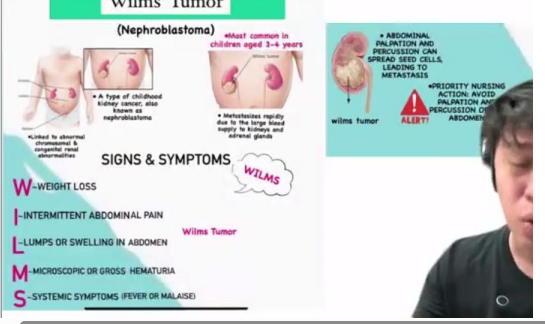
Wilm's tumor → nephroblastoma
Do not palpate the abdomen → may spread the tumor
SIGNS & SYMPTOMS (WILMS):
W - Weight loss
I - Intermittent abdominal pain
L - Lumps or swelling in abdomen
M - Microscopic or gross hematuria
S - Systemic symptoms (Fever or malaise)
Q41: A mother of a child with Wilms tumor asks about home care. Which instruction should the nurse include?
A. "Your child should avoid contact sports and rough play."
B. "Press gently on the abdomen each day to check the mass."
C. "Give high-protein supplements to shrink the tumor."
D. "Encourage abdominal massage to improve circulation."
ANSWER: A. "Your child should avoid contact sports and rough play"
A. "Your child should avoid contact sports and rough play."
B. "Press gently on the abdomen each day to check the mass."
C. "Give high-protein supplements to shrink the tumor."
D. "Encourage abdominal massage to improve circulation."
Q42: A child is diagnosed with Wilms tumor and is scheduled for treatment. Which plan of care should the nurse expect?
A. Frequent assessment of the abdomen to monitor tumor size
B. Surgery combined with chemotherapy and/or radiation treatment
C. Antibiotic therapy
D. Fluid restriction and bed rest
ANSWER: B. Surgery combined with chemotherapy and/or radiation treatment
Q43: An 8-year-old child is admitted for evaluation of severe stunted growth. The nurse notes delayed dentition, protuberant abdomen, thin extremities, and height significantly below the expected percentile for age. Which intervention should the nurse anticipate as the priority in management?
A. Initiation of growth hormone replacement therapy immediately
B. Restriction of physical activity to reduce metabolic demands
C. Comprehensive assessment of nutritional status and underlying chronic disease
D. High-protein supplementation
ANSWER: C. Comprehensive assessment of nutritional status and underlying chronic disease
assess first
Q44: Ear drops, instilled twice a day, are prescribed for a 2 year old child. What should the nurse teach the parent when it comes to instilling drops in the toddler's ear lobe?
A. up and forward
B. up and backward
C. down and backward
D. down and forward
ANSWER: C. Down and backward
Child: "Down"
>3 years old: down and back
Above 4 years old: up and back
Q45: A newborn is noted to have excessive drooling, choking during feeding, and episodes of cyanosis that worsen when attempting to swallow formula. Which congenital defect should the nurse most strongly suspect?
A. Cleft Palate
B. Pyloric stenosis
C. Tracheoesophageal fistula
D. Hirschsprung's Disease
ANSWER: C. Tracheoesophageal fistula
Coughing choking cyanosis + drooling of saliva
Q46: A nurse realizes that an incorrect medication dosage was documented in the client's chart. Which action is most appropriate?
A. Erase the incorrect entry and rewrite the correct dosage
B. Draw a single line through the incorrect entry, initial it, and document the correct information
C. Use correction fluid to remove the error before charting again
D. Leave the error unchanged to avoid accusations of tampering
ANSWER: B. Draw a single line through the incorrect entry, initial it, and document the correct information
SLIDE mnemonic
S – Styles: Use proper headers for titles.
L – Links: Write meaningful text, not "Click Here."
I – Images: Add clear text descriptions (alt-text).
D – Design: Use high-contrast colors and big fonts.
E – Evaluation: Check the document using accessibility tools.
Q47: A nurse notes that a prescribed pediatric medication dose is significantly higher than the recommended safe dose. After verifying the calculation, the physician insists the order is correct. What should the nurse do next?
A. Administer the medication because the physician prescribed it
B. Delay administration and follow the chain of command
C. Ask another nurse to administer the medication
D. Document the concern after administering the medication
ANSWER: B. Delay the administration and follow the chain of command
SAFETY
Q48: Which task is most appropriate for the nurse to delegate to an unlicensed assistive personnel (UAP)?
A. Assessing breath sounds of a child with asthma
B. Teaching another how to administer insulin
C. Obtaining intake and output measurements for a stable client
D. Evaluating pain relief after medication administration
ANSWER: C. Obtaining intake and output measurements for a stable patient
UAP: Routines and ADLs\
A. Assessing breath sounds of a child with asthma - LPN
B. Teaching another how to administer insulin - RN
C. Obtaining intake and output measurements for a stable client
D. Evaluating pain relief after medication administration - NURSING PROCESS; RN
Q49: A nurse researcher wants to compare the mean blood pressure levels among three different groups of hypertensive clients receiving different diets. Which statistical test is most appropriate?
A. Pearson correlation
B. Chi-square test
C. ANOVA
D. Standard deviation
ANSWER: C. ANOVA
→ 3 groups >
Q50: A nurse administers IV morphine to a postoperative client who rated pain as 9/10. Which documentation entry is most legally appropriate?
A. Client reports pain decreased from 9/10 to 4/10 thirty minutes after IV morphine; respirations 18/min
B. Client appears more comfortable after pain medication
C. Morphine effective; client resting quietly in bed
D. Pain relieved after medication administration; updated physician in charge
ANSWER: A. Client reports pain decreased from 9/10 to 4/10 thirty minutes after IV morphine; respirations 18/min
OBJECTIVE
FACTUAL
SPECIFIC
SUBJECTIVE: PATIENT SAYS (SPECIFIC)