VO 5+6 Parameterization II
 Call Kai
 Learn
Learn Practice Test
 Spaced Repetition
 Match
Match Flashcards
 Knowt Play
1/43

There's no tags or description
Looks like no tags are added yet.
Name | Mastery | Learn | Test | Matching | Spaced | Call with Kai | Chat |
|---|
No analytics yet
Send a link to your students to track their progress
44 Terms
What does microphysics describe?
the description of the formation, growth and sedimentation of hydrometeors
Main tasks of microphysics
phase transition with accompanying release of latent heat
determining the quantity and nature of hydrometeors for electromagnetic calculations (radiation, radar, satellite comparisons)
type and amount of precipitation
aerosol interactions (zb washout of condensation nuclei)
Theoretical foundations of microphysics
no universally valid method
scales are mostly below 1 cm
difficult to fain insight from high-resolution simulation (no pure subgrid)
Important approaches from microphysics
one and two-moment bulk schemes
bin schemes
Thermodynamic phase transitions - basics, simplest assumption, reality
3 phases → 6 transitions
in the model it must be decided how the total amount of H2O is divided into water vapor, water and ice
Simplest assumption:
saturation water vapor depends only on temperature and pressure
T>0 water
T<0 ice
T=0 water+ice
thermal equilibrium
Reality:
saturation water vapor depends on droplet radius, ice crystal shape and condensation nuclei
mixed-phase clouds exist for T<0 → no thermal equilibrium
Kessler parameterization
only considers water vapor, cloud water, rain (no ice)
Five processes:
Condensation: Water vapor to cloud water
Evaporation: Cloud water to water vapor
Autoconversion: Cloud droplets collide and become raindrops
Accretion: Falling raindrops collect cloud droplets through
collisions.
Evaporation: Cloud droplets to water vapor
Autoconversion as a function
\frac{dM}{\differentialD t}=k_1\left(m-a\right)
with M rain and m cloud water
Two tuning parameters:
a: at what amount of cloud water autoconversion begins, when m<a the term is turned off
k_1: how quickly cloud water is converted into rain
Autoconversion and Accretion as a function
\frac{dM}{\differentialD t}=-\frac{dm}{\differentialD t}=k_1\left(m-a\right)+k_2^{^{\prime}}mM^{\frac78}
another tuning parameter:
k’_2: collection efficiency, how effectively raindrops collect cloud droplets
even this simple parameterization has many tuning parameters that are difficult to determine!
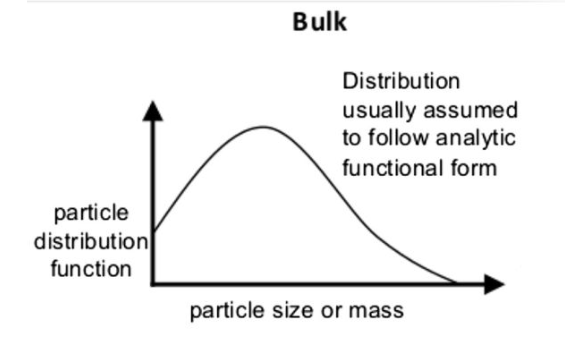
Bulk microphysics schemes
→ assume an analytical particle-size distribution (because total mass of cloud water and rain is not enough)
one-moment: only the mass of each hydrometeor category is calculated (zb 1kg of cloud water)
two-moment: mass and number of hydrometeors are determined (zb 1kg of cloud water and 1,000,000 droplets)
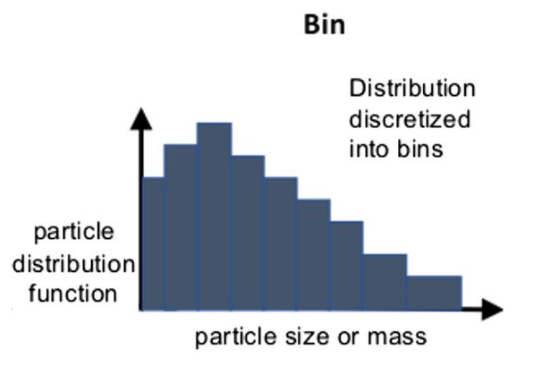
Bin microphysics schemes
approximate the distribution through several bins
→ also called spectral
usually 30-45 bin (ice and water) are used (expensive)
What else do microphysics depend on?
other parameterizations
vertical updrafts: they determine how long and quickly precipitation objects can grow before they falls (often from convection parameterizations)
turbulent mixing leads to evaporation at cloud edges
aerosols from the BL act as condensation nuclei
Example of a Bulk two-moment scheme with 6 hydrometeors:
cloud water, rain, cloud ice, snow, graupel, hail
12 prognostic variables: 6×2 (two-moment)
can predict hail prognostically
since 2015 part of COSMO/ICON at DWD
complex because many processes must be formulated using tuning parameters and closures
need so solve: many coupled PDGLs
hydrometeors always >0
Explain formation, growth and sedimentation of hydrometeors
Formation:
hydrometeors form through phase transitions
zb: water vapor condenses into cloud droplets or deposits onto ice particles
in reality depends on temperature, pressure, condensation nuclei droplet radius, ice crystal shape
Growth:
condensation or depositition
autoconversion
accretion
other ice-related processes can form snow, graupel, hail
vertical updrafts important - keep particles inside the cloud longer → more time to grow
Sedimentation:
hydrometeors fall under gravity
larger and heavier particles fall faster
when they become large enough, they leave the cloud as a form of precipitation
during the fall they can continue growing, melt or evaporate
Common hydrometeor categories
cloud water
drizzle
rain
cloud ice
snow
graupel
hail
Must microphysics be parameterized?
Yes. Even at very high model resolution, there is no general fundamental theory!
What types of precipitation are determined by microphysics?
All forms of precipitation
How does microphysics influence model dynamics?
Direct influence through latent energy (zb moist adiabatic processes)
With which parameterizations is microphysics closely linked?
Radiation
Convection
Aerosols
Radiation in NWP models
Warming/cooling of the surface, the driver of the daily cycle
Warming/cooling of the air layers directly
Forecast for photovoltaic performance
Radiation in gases
scattering and absorption of radiation (zb Rayleigh, Mie)
scattering and absorption depend on wavelength and angle
Radiation and hydrometeors interaction
highly dependent on the geometry and properties of the hydrometeors
radius of cloud droplets has enormous influence on radar (different effect if many small or many large droplets)
if the distribution of droplet sizes is not considered → biases
interaction dependent on wavelength and angle
Why is cloud geometry important for radiation?
Cloud geometry determines the optical path of radiation through the cloud
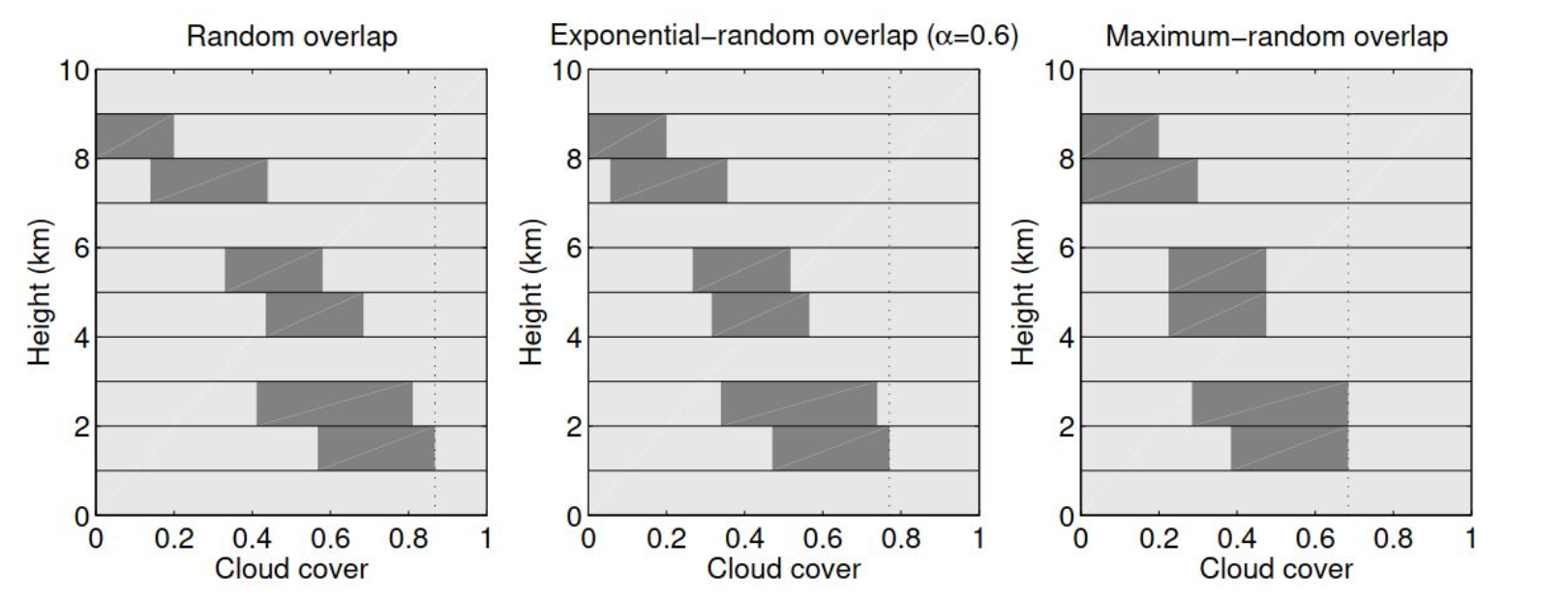
in a 1D column different overlap assumptions with the same cloud fraction lead to different cloud cover
overlap assumptions:
random overlap
exponential-random overlap
maximum-random overlap
Why is radiation difficult to parameterize?
wavelength and angle dependent
3D
sensitive to the number, size and type of hydrometeors
affected by aerosols
cloud geometry important
non-trivial interactions with the earths surface
What kind of radiation approaches are there?
spectral bands
2-stream approach
effective radius of cloud droplets
these approaches reduce computational effort for radiation
What is the spectral bands approach?
instead of calculating each wavelength individually, closely correlated wavelengths are calculated together
number of groups is conceptually closely related to grid resolution → the more groups the better the result
individual groups can be calculated independently of each other
What is the 2-stream approach?
we reduce everything to two radiation fluxes, one upward one downward
for each band/group only one upward and one downward calculation is performed
each direction represents an integral over all angles in a hemisphere (also nur hoch oder runter)
each column can be calculated separately as no horizontal exchange occur (kein Austausch zwischen 2 Säulen)
What is the effective radius approach?
instead of considering the full droplet distribution, a single radius is used that is supposed to achieve the same result (r_eff)
How does ECMWF solve radiation?
via EcRad
5 main components:
surface
gas
aerosols
clouds (with cloud generator)
solver (5 different ones)
→ Gas, aerosol, cloud and surface optical properties are calculated and passed to a radiative-transfer solver
→ radiation is evaluated on a coarser spatial grid and at longer time intervals than the dynamical core
→ the resulting fluxes are interpolated back to the model grid.
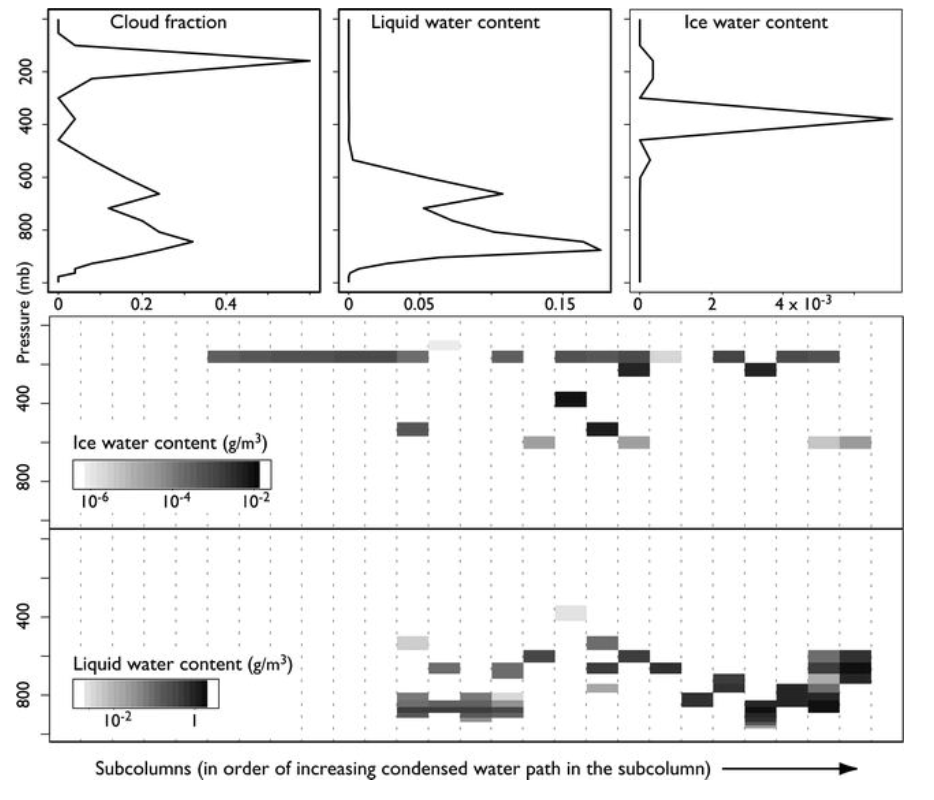
What is a cloud generator?
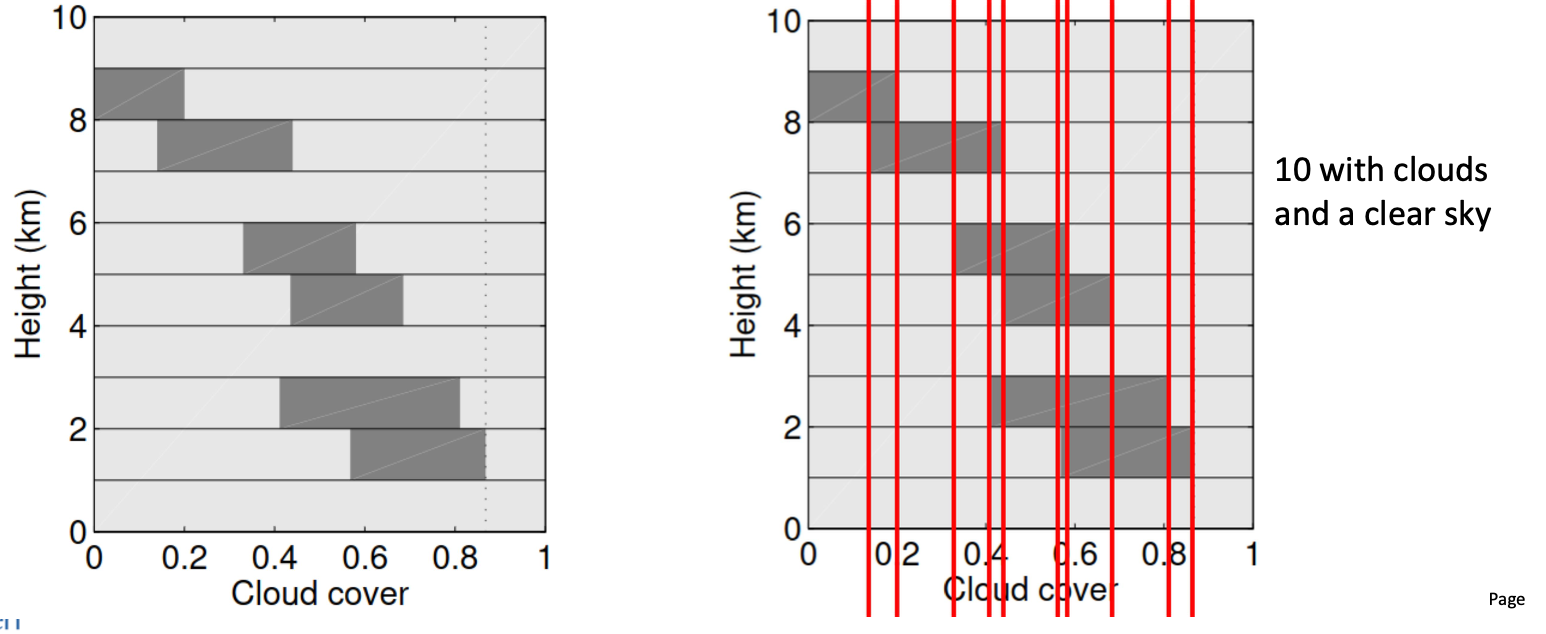
it creates several possible 1D cloud profiles, called sub-columns, from the modeled cloud cover in the individual atmospheric layers
you draw a line at every start/end of a cloud
picture right : 10 sub-columns with clouds, one with clear sky
What is a stochastic cloud generator?
Randomly generates several subprofiles from average profiles of cloud cover, cloud water, and ice
distinguishes not only between cloudy and clear but also varies the amount of moisture
Assumptions about overlap probability and assumed distributions of water and ice in each layer are taken into account
In the example, 25 cloud profiles were generated, of which 5 have no clouds at all and some are identical.
Rayleigh and Mie scattering
Rayleigh scattering: particles are much smaller than the wavelength
Mie scattering: particles are approximately the same size as, or larger than, the wavelength
for clouds and aerosols, Mie scattering is often especially important because the particle sizes are comparable to visible wavelengths
Wavelength of green light vs fine dust (PM 2.5)?
Green light has a wavelength of approximately
λ≈550 nm=0.55 μm
PM2.5 particles have diameters of up to
2.5 μm
PM2.5 particles can be several times larger than the wavelength of green light. Therefore, their interaction with visible light is mainly in the Mie-scattering regime
Red light:
λ≈633 nm=0.633 μm
What is the output