Session 1 Chapter 1
 Call Kai
 Learn
Learn Practice Test
 Spaced Repetition
 Match
Match Flashcards
 Knowt Play
1/31

There's no tags or description
Looks like no tags are added yet.
Name | Mastery | Learn | Test | Matching | Spaced | Call with Kai | Chat |
|---|
No analytics yet
Send a link to your students to track their progress
32 Terms
Why study global health?
To understand:
The progress that has already been made
The challenges that still remain
That diseases are not limited by national boundaries (TB, HIV, and Polio)
That there are disparities among groups
The health-development link
The need for different actors to work together
progress in global health
global life expectancy increased 37% from 1960 to 2016
the rate of child mortality fell 62% from 1990 to 2016
Nearly 3 billion children have been vaccinated against polio with only 22 cases in 2017
There were 44% fewer maternal deaths in 2015 than in 1990
Fifty-three million tuberculosis deaths were averted from 2000 to 2016 through successful diagnosis and treatment
There were 900,000 fewer deaths due to HIV/AIDS in 2016 compared to 2005
The number of Guinea worm cases has decreased over 99.9%, from 3.5 million in 1986 to 30 in 2017
The global prevalence of tobacco smoking decreased from 24% in 2007 to 21% in 2015, despite population growth
remaining global health challenges
There were 5.6 million under-5 child deaths in 2016.
Almost half of all under-5 child deaths are related to malnutrition.
There were 435,000 malaria deaths in 2017.
1.3 million HIV-negative people died from tuberculosis in 2017, in addition to 300,000 people with HIV.
1.8 million people became infected with HIV in 2017.
In 2017, there were 940,000 deaths caused by AIDS
There were 303,000 maternal deaths in 2015.
Approximately 1 billion people are infected with roundworm.
The prevalence of diabetes has doubled since 1980
how are diseases not limited by political boundaries
Prior to 1960, dengue fever was concentrated largely in Southeast Asia and the coast of South America. However, cases are now seen in five continents
The “avian flu” first appeared in East Asia, but it, too, is spreading to other regions
existing health disparities
life expectancy in Japan is 84, but only 52 in Sierra Leone
Hepatitis B vaccine used in high income countries but not as much in lower income countries
The important link between health and development example
Poor health of mothers is linked to poor health of babies and the failure of children to reach their full mental and physical potential. In addition, ill health of children can delay their entry into school and can affect their attendance, their academic performance, and, therefore, their future economic prospects.
intersectoral nature of global health concerns
different actors need to work together to address them are additional reasons why we should be concerned with global health. Although locally relevant solutions are needed to address most health problems, some health issues can be solved only with a global approach.
some problems such as HIV/AIDS need more financial resources
global health becoming prominent worldwide
spread of HIV, SARS scare in the early 2000s, avian flu, and outbreaks of Ebola in West Africa and the DRC have all brought attention to global health.
Orgs increasing awareness of global health
The advocacy efforts of Doctors Without Borders
the establishment of the Millennium and Sustainable Development Goals
the philanthropy of the Bill & Melinda Gates Foundation
Health (WHO definition)
a state of complete physical, mental, and social well-being and not merely the absence of disease or infirmity.
Public Health (Winslow’s definition
the science and art of preventing disease, prolonging life, and promoting physical health and mental health and efficiency through organized community efforts toward a sanitary environment
examples of public health activities
The promotion of handwashing
The promotion of bicycle and motorcycle helmets
The promotion of knowledge about HIV/AIDS
Large-scale screening for diabetes and hypertension
Large-scale screening of the eyesight of schoolchildren
Mass dosing of children against worms
The operation of a supplementary feeding program for poorly nourished young children
The taxation of tobacco and alcohol
The regulation of industrial pollution
The regulation of food labeling
Public health vs medicine
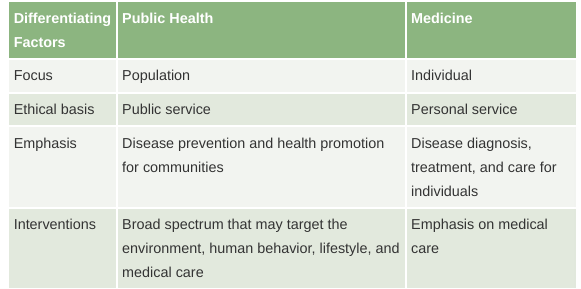
Global health
Different definitions: An area for study, research, policy and practice on health issues that transcend borders and require international cooperation with a focus on population health in low- and middle-income countries.
global health issues
Emerging and re-emerging infectious diseases
Antimicrobial resistance
Eradication of polio
TB
Malaria
HIV
The increasing prevalence of diabetes and heart disease globally
essential global health concepts
Determinants of health
Key risk factors for different health conditions
Global burden of disease
Measurement of health status
Importance of culture to health
Demographic and epidemiologic transitions
Organization and function of health systems
Links among health, education, poverty, equity and the political economy of health
Cross sectional issues in global health
Environmental health and climate change
Nutrition and food security
Women’s health and sexual and reproductive health (SRH)
Child and adolescent health
Humanitarian health
Health, human rights and social justice
Urgent health challenges for the next decade
Elevating health in the climate debate
Delivering health in conflict and crisis
Making health care fairer
Expanding access to medicines
Stopping Infectious diseases
Preparing for epidemics
Protecting people from dangerous products
Investing in the people who defend our health
Keeping adolescents safe
Earning public trust
Harnessing new technologies
Protecting the medicines that protect us (AMR)
Keeping Health care clean (1/4 lack WASH)
One health
The integrative effort of multiple disciplines working locally, nationally, and globally to attain optimal health for people, animals, and the environment.
Planetary health
Planetary Health, in simple terms, is the idea that human health and the health of the planet are directly linked — you can't have one without the other.
It has two connected parts:
The human side — Are we running our political, economic, and social systems in ways that let people everywhere reach the best possible health, well-being, and fairness?
The natural side — Are we staying within the Earth's environmental limits (clean air, stable climate, functioning ecosystems) that make human life possible in the first place?Planetary health is the achievement of the highest attainable standard of health, wellbeing, and equity worldwide through judicious attention to the human systems—political, economic, and social—that shape the future of humanity and the Earth’s natural systems that define the safe environmental limits within which humanity can flourish. Put simply, planetary health is the health of human civilisation and the state of the natural systems on which it depends.
planetary health = the health of human civilization and the health of the natural systems we depend on. If we damage the planet's natural systems past a safe point, human health eventually suffers too — so the two have to be managed together, not separately.
Planetary health is the achievement of the highest attainable standard of health, wellbeing, and equity worldwide through judicious attention to the human systems—political, economic, and social—that shape the future of humanity and the Earth’s natural systems that define the safe environmental limits within which humanity can flourish. Put simply, planetary health is the health of human civilisation and the state of the natural systems on which it depends. 2
One health vs planetary health
It may be helpful to think of One Health as focusing on the interconnectedness of animal, human, and environmental health; whereas Planetary Health has a greater focus on the health of the environment and the connections between that and human and animal well-being
World Bank Regions (7)
East Asia and Pacific
Europe and Central Asia
Latin America and the Caribbean
Middle East and North Africa
North America
South Asia
Sub-Saharan Africa
WHO 6 regions
Africa
The Americas
Southeast Asia
Europe
Eastern Mediterranean
Western Pacific
World Bank 4 Income groups
Low-income economies ($1,035 or less)
Lower middle-income economies ($1,036 and $4,045)
Upper middle-income economies ($4.046 and $12,535)
High-income economies ($12,536 or more)
Low-income countries
Afghanistan
Ethiopia
Haiti
Mozambique
Neal
Zimbabwe
Lower Middle-Income countries
Bangladesh
Bolivia
Cameroon
Egypt
India
Morocco
Philippines
Swaziland
Upper-Middle-Income
Botswana
Costa Rica
Jamaica
South Africa
Turkey
Venezuela
High-Income
Argentina
Belgium
Canada
Denmark
Italy
Netherlands
Portugal
Singapore
SDGs
Formulated in 2015
17 SDGs
Countries that signed pledged to meet goals by 2030
All relate to health, whether directly or indirectly
What are the 17 SGDs
no poverty
zero hunger
good health and well-being
quality education
gender equality
clean water and sanitation
affordable and clean energy
decent work and economic growth
industry, innovation, and infrastructure
reduced inequalities
sustainable cities and communities
responsible consumption and production
climate action
life below water
life on land
peace, justice, and strong institutions
partnerships for the goals
Central messages of this chapter
Strong links among health, human development, labor productivity, and economic development
Health status determined by variety of factors
Enormous progress in improving health status over last 50 years
Much progress is the result of public hygiene, better water and sanitation, and better education
Enormous disparities in health status and access to health services within and across countries
Some health problems can only be solved through “international cooperation”. Examples?
Each of us should be concerned with the health of others for humanitarian, personal health, as well as for economic and security reasons.
People and communities have the ability to enhance their own health status; what is often missing is the capacity.
Low-income countries should focus on
“…burying old people, instead of young people, making the transition as fast as possible, and doing so at least cost”The health goals for all countries are to enable their people to enjoy the maximum possible health at the least cost and in fairly distributed ways.
Small Pox eradication
Background: 1966 — smallpox in 50+ countries, ~10–15M cases/year, ~2M deaths/year, up to 30% fatality.
Intervention: Enabled by mass-producible heat-stable vaccine + bifurcated needle (cheap, reusable, easy to use). WHO campaign launched 1959, gained real traction in 1965 with U.S. support; used a "search and containment" strategy (ring vaccination) rather than trying to vaccinate everyone.
Impact: Eliminated in Latin America (1971), Asia (1975); last natural case in Somalia (1977); declared eradicated in 1980 — first disease ever eradicated.
Costs/benefits: ~$23M/year (1967–79); total ~$298M from donors + endemic countries combined; U.S. recoups its entire investment every 26 days in avoided vaccination/treatment costs.
Lessons learned: strong leadership/partnership (WHO + CDC), dedicated in-country staff, flexibility, monitoring, community participation, publicity driving donations, and side benefit of building routine immunization systems.
Why smallpox was eradicable: no animal reservoir, direct transmission only, easy-to-spot rash, lifetime immunity in survivors, severe symptoms limited spread — features not shared by every disease (hence not every disease is a good eradication candidate).