Biochem Chap 3 Pt. 4 - Protein Purification
 Call Kai
 Learn
Learn Practice Test
 Spaced Repetition
 Match
Match Flashcards
 Knowt Play
1/70

There's no tags or description
Looks like no tags are added yet.
Name | Mastery | Learn | Test | Matching | Spaced | Call with Kai | Chat |
|---|
No analytics yet
Send a link to your students to track their progress
71 Terms
What are the 4 general stages in the basic scheme of protein purification?
Preparation/extraction/clarification → Capture (isolate, concentrate, stabilise) → Intermediate purification (remove bulk impurities) → Polishing (achieve final high-level purity).
What are does "cell disruption" mean, different types, and why must it be done gently?
Breaking open cells to release the protein of interest;
osmotic lysis (only animal cells)/mechanical disruption/chemical
must be gentle to avoid denaturing/destroying the protein's function.
What is osmotic lysis and what cells does it work on?
Hypotonic lysis — only works on animal cells (they lack a rigid cell wall), causing them to swell and burst in low-salt solution.
What are the mechanical disruption methods for cell lysis?
High-speed blender, French press, and sonication.
What are the chemical methods for cell disruption?
Detergents (e.g., SDS, NP-40) and enzymes (e.g., lysozyme, which cleaves bacterial cell wall components).
What is the resulting mixture after cell disruption called?
A homogenate or extract — contains large and small molecules from the cytosol (enzymes, ribosomes, metabolites) plus membrane-bound organelles.
What is the general goal/protocol for protein purification?
*common apporoach - (Total Protein —→ Pure Protein) Fractionate to separate the protein of interest from unwanted proteins, using as few steps as possible with as little loss of activity (denaturation) as possible.
What is important to avoid during purification?
denaturing conditions like heat - destroys the protein's native structure and function — the goal is to end with active, pure protein.
What 5 protein characteristics can be used as the basis for fractionation, and what techniques exploit each?
Charge (ion exchange, electrophoresis, isoelectric focusing), Polarity (paper chromatography), Size (dialysis, gel electrophoresis, gel filtration, ultracentrifugation), Specificity (affinity chromatography), Solubility (salt precipitation).
How does centrifugation separate components of a mixture?
separates by mass; Under centrifugal force, components with larger mass sediment faster (i.e., have a larger sedimentation coefficient).
What is the general principle behind all liquid chromatography techniques?
A protein mixture dissolved in a liquid (mobile phase) —→ is percolated (eluted) through a column containing a porous solid matrix (stationary phase); different techniques exploit different ways proteins differ from each other.
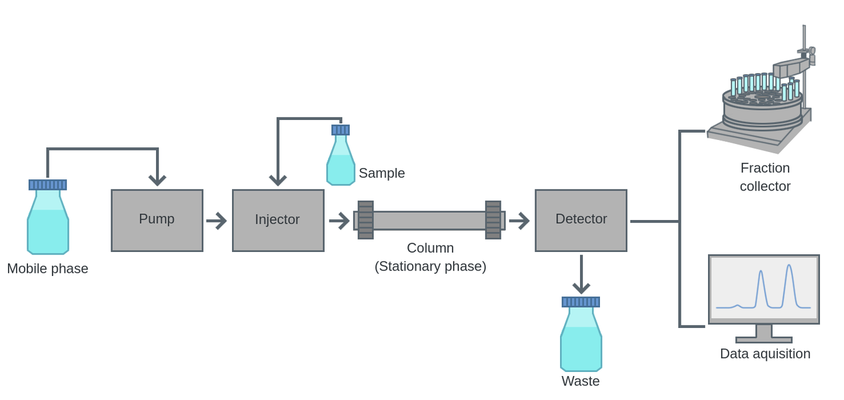
What are the "Big 4 (+1)" liquid chromatography techniques?
Ion Exchange Chromatography, Gel Filtration Chromatography, Affinity Chromatography, HPLC, and (+1) Hydrophobic Interaction Chromatography.
What does Ion Exchange Chromatography (IEC) separate proteins by?
Charge. (uses + or - matrix)
What is a CM (carboxymethyl) matrix and what does it do?
A NEGATIVELY charged matrix; (beads are anionic - ) it's a "cation exchanger" because it exchanges/binds cations (positively charged proteins).
What is a DEAE (diethylaminoethyl) matrix and what does it do?
A POSITIVELY charged matrix; it's an "anion exchanger" because it exchanges/binds anions (negatively charged proteins).

What is the key rule for which proteins elute first in IEC?
Zero and like-charged proteins (same charge as the matrix, or neutral) elute (are washed out) first TOGETHER!! since they aren't attracted to/bound by the matrix. — absorbed then desorbed
How is bound (adsorbed) protein released (desorbed) from an ion exchange column?
By increasing salt concentration (e.g., ↑[NaCl], since salt ions of the same charge exchange with the protein DEAE matrix) OR by altering the pH of the mobile phase (which changes the protein's charge).
Like amino acids, what determines whether a protein has a net positive or negative charge at a given pH?
Comparing the protein's pI to the pH — if pI is above the pH, the protein is positively charged; if pI is below the pH, the protein is negatively charged.
What makes a protein "acidic" vs. "basic" in terms of amino acid content?
Acidic proteins are rich in Asp/Glu (D,E) and have low pI, net negative charge near pH 7;
basic proteins are rich in His/Lys/Arg (H,K,R) and have high pI, net positive charge near pH 7;
neutral proteins have balanced D,E and H,K,R content.
SKILL - know what order proteins elute in
What is Gel Filtration Chromatography (GFC) also called?
Size-exclusion, molecular exclusion, or molecular sieve chromatography.
How does GFC separate biomolecules, and what's the elution order?
By size, via percolation through a cross-linked gel with pores — largest molecules elute first (can't enter the pores, take the shortest path around beads), smallest elute last (enter the pores, take a longer path through the beads).
How can GFC be used to determine an unknown protein's molecular weight?
A plot of log(MW) vs. elution volume (Ve) for known standard proteins gives a straight line;
you can find the elution volume of the unknown, use the line to determine its log(MW), and calculate its MW.
What is the principle behind Affinity Chromatography (AC)?
Separates/purifies a target molecule based on its specific attraction (affinity) to a particular ligand attached to a solid support (matrix) — a highly specific, selective "capture" method.
How is protein eluted (released) from an affinity column?
By changing conditions toward dissociation (e.g., salt concentration or pH change),
or by adding an excess of free ligand/ligand analog to competitively displace the bound protein.
also by adding a competitor for ligand (cysteine & imidazole groups also bind Ni2+)
can add a protease to cut protein
Why is Affinity Chromatography considered a "shortcut" in purification?
it can bypass several intermediate steps (fractional precipitation, dialysis, ion exchange, hydrophobic interaction chromatography)
can go almost directly from cell disruption/centrifugation to gel filtration/product.
What is "His-tagging" and how does it enable affinity purification?
Genetically engineering a poly-histidine tail onto a target protein;
His-tagged proteins bind tightly to Ni²⁺ ions immobilized on a column/ other compounds can be added to competively bind
so only the His-tagged protein is adsorbed while everything else washes through.
What does HPLC stand for and what makes it different from standard chromatography?
High Pressure/Performance Liquid Chromatography
— uses a high-pressure system to push the liquid mobile phase through the column, allowing separation of complex mixtures with high resolution.
What is Normal Phase HPLC, and what elutes first?
Uses polar silica beads
hydrophobic (nonpolar) compounds elute first,
hydrophilic compounds elute last.
What is Reverse Phase HPLC, and what elutes first?
Uses silica beads derivatized with alkyl groups (e.g., C8, C18 - very long) making a nonpolar matrix;
hydrophilic compounds elute first, hydrophobic compounds elute last.
*be able to predict how different amino acids show up in order
What is Amino Acid Analysis (AAA) and how is it performed?
Hydrolyzing a protein (breaking all peptide/amide bonds) using strong acid (e.g., 6M HCl) or strong base,
(converts Gln —> Glu & Asn —→ Asp) *wont be able to tell if you have each other — so use Asx & Glx in description
then quantitatively analyzing the resulting free amino acids by HPLC.
What does Hydrophobic Interaction Chromatography separate proteins by?
Their relative hydrophobicity/surface exposure of hydrophobic residues.
What factors affect protein solubility?****
pH (proteins are least soluble at pH = pI),'
solvents (e.g., acetone),
high temperature.
Why are proteins least soluble at their isoelectric point (pI)?
At pI, the protein has zero net charge, so there's less charge-charge repulsion between protein molecules, allowing them to aggregate and precipitate more easily.
What is "salting in"?
making proteins dissolve - @ low salt concentrations, added salt increases protein solubility because the salt ions prevent proteins from "sticking" to each other via charge-charge interactions.
What is "salting out"?
At high salt concentrations, salt lowers protein solubility because it pulls water away from proteins (removes their solvation sphere),'
causing them to precipitate ("crash") out of solution;
different proteins precipitate at different salt concentrations.
What is the best/most commonly used salt for salting out, and why?
Ammonium sulfate ((NH4)2SO4) — it can dissolve to a high molar concentration and is a "kosmotropic" (stabilizing) ion.
What does dialysis use to separate/exchange components in solution?
Osmosis — to change ions in solution
small molecules/ions pass through a semipermeable dialysis membrane to equilibrate, while large molecules (like proteins) are retained inside.
Commonly used to change buffers during purification.
What is the general principle behind gel electrophoresis (GE)?
Separation (of DNA or RNA) is based on migration of charged biomolecules through a gel matrix under an charged electric field.
anions run to anode (+)
cathode is -
What does Native Gel Electrophoresis separate proteins by?
both charge AND size,
since proteins retain their native folded structure and native charge.
At what pH is Native GE typically run, and what charge does this give most proteins?
pH 9, which gives most proteins a negative charge (so they migrate toward the anode).
In electrophoresis through a gel matrix, how does size affect migration distance?
Largest molecules move least (get stuck in the porous gel matrix);
smallest molecules move furthest.
What is PAGE, and what is it made from?
Polyacrylamide Gel Electrophoresis — reaction to forms polyacrylamide (a cross-linked polymer)
How are proteins visualized/detected after gel electrophoresis?
Staining, e.g., with Coomassie blue dye.

What is SDS and what does it do to proteins?
Sodium dodecylsulfate — an anionic detergent that coats proteins uniformly and denatures them. (bad if you desire an active protein)
Why does SDS give all proteins the same charge-to-mass ratio?
Because of its strong negative charge, SDS coats proteins evenly, giving each protein roughly the same charge per unit length regardless of its native charge.
What does SDS-PAGE separate proteins by, and how does this compare to GFC?
Separates by size ONLY (largest move least — opposite elution order compared to GFC, where largest elute first).
Why does SDS-PAGE give subunit MW rather than total MW (unlike GFC)?
Because SDS denatures proteins and disrupts non-covalent interactions holding multi-subunit complexes together, so each individual polypeptide chain runs separately.
What kind of plot does SDS-PAGE produce for determining MW, and what does it look like?
A plot of log(MW) vs. relative migration gives a straight line, similar to GFC — used to determine an unknown protein's molecular weight by comparison to standards.
How can SDS-PAGE be used to track the progress of a protein purification?
By running gel samples from each purification step;
as purification proceeds, the number of bands decreases;
a single clean band typically indicates a pure protein.
What is paper electrophoresis/chromatography used for?
Separating biomolecules like amino acids based on charge (electrophoresis) or polarity (chromatography) using paper as the support medium.
How are amino acids detected on paper chromatography/electrophoresis?
By staining with ninhydrin.

What color does ninhydrin normally produce with primary amino acids, and what is this compound called?
A purple/blue color called Ruhemann's purple (λmax = 570 nm).

What's unique about proline's reaction with ninhydrin?
Since proline is a secondary amine (not primary), it gives a brown/yellow color instead of the typical purple.
What is a well-known forensic/pop-culture application of ninhydrin chemistry?
Detecting latent fingerprints (as referenced in CSI) — ninhydrin reacts with amino acids in fingerprint residue to reveal prints.
What does Isoelectric Focusing (IEF) separate proteins by?
Their isoelectric points (pI's) — the pH at which each protein has zero net charge.
How does IEF work mechanically?
Proteins migrate through a stable pH gradient in an electric field;
each protein migrates until it reaches the pH matching its own pI, where it has no net charge and stops moving ("focuses" at that position).
What is 2D Gel Electrophoresis and what are its two dimensions?
A technique separating complex protein mixtures in two steps
Run IEF gel in one dimension to sep by PI
Run SDS-Page in 2nd dimension to sep by size
use to determine all proteins expressed in a call = proteomics
What can 2D gel electrophoresis be used to study on a large scale?
All proteins expressed in a cell — this is the technique underlying proteomics.
What are antibodies, and what is their basic structure?
Proteins that bind very tightly and specifically to their targets (antigens); produced by vertebrates as an infection defense;
each antibody molecule is made of two identical light chains and two identical heavy chains, giving two identical antigen-binding sites.

What does ELISA stand for and what is it used for?
Enzyme-Linked Immunosorbent Assay — uses antibody-enzyme conjugates that produce a detectable signal upon substrate addition.
useful for detecting viruses (HIV, food allergens)/ very sensitive method

What are the three main ELISA formats?
Direct assay (labeled primary antibody binds antigen directly),
Indirect assay (unlabeled primary antibody + labeled secondary antibody),
Capture/"Sandwich" assay (capture antibody binds antigen, then a separate detection antibody binds and is visualized).
What is Western blotting (immunoblotting)?
blot = transfer protein from gel to membrane
then detects a specific protein of interest using a targeted antibody.
detect w/ antibody targeted to protein of interest (immunoblotting)
What are the two main methods for transferring protein from gel to membrane in Western blotting?
Electrotransfer (using an electric current)
capillary transfer (using buffer wicking through the gel/membrane stack via paper towels/weight).
What is the general workflow of a Western blot after transfer?
incubate with primary antibody (Ab1) specific to the target protein,
wash away excess,
incubate with an enzyme-linked secondary antibody (Ab2) that binds Ab1,
wash away excess,
then add substrate to develop a detectable color/signal at the target protein's location.
How do Asn—> Asp and Gln —> Glu
via strong acid/base hydrolysis
What Mechanism does an HIV Test use
Indirect ELISA - 1o antibody is from serum of Aids patient
What fractionation technique/s exploits charge
ion exchange, electrophoresis, isoelectric focusing
What fractionation technique exploits polarity
paper chromatography
What fractionation techniques exploits size
dialysis, gel electrophoresis, gel filtration, ultracentrifugation
What fractionation techniques exploits specificity
Affinity chromatography
What fractionation techniques exploits solubility
Salt precipitation