Lecture 12: Glaciation Cycles
 Call Kai
 Learn
Learn Practice Test
 Spaced Repetition
 Match
Match Flashcards
 Knowt Play
1/56

There's no tags or description
Looks like no tags are added yet.
Name | Mastery | Learn | Test | Matching | Spaced | Call with Kai | Chat |
|---|
No analytics yet
Send a link to your students to track their progress
57 Terms
Glaciation and Quaternary Period
A period of dramatic biogeographic upheaval caused by repeated glacial-interglacial cycles
Glaciation and Quaternary Period is comprised of two epochs:
Pleistocene and the Holocene
When was the Pleistocene?
beginning 2.58 Ma
When was the Holocene?
beginning 11.7 Ka
What did the Pliocene cooling: the more recent epoch consist of?
downward trend in global temperature
When was the pliocene?
5.33 Ma - 2.58 Ma
At the start of the Pliocene, temperatures were much?
warmer than today
What was the overall trend in temperature during the Pliocene?
Downward trend toward drier climates
What did Pliocene cooling climate oscillations consist of?
high frequency-low amplitude oscillations
What happened during Pliocene cooling?
forests declined, grasslands and savannas expanded
epoch ends with shift to high amplitude, longer duration glacial-interglacial cycles until the start of the Pleistocene
Pleistocene glacial-interglacial cycles
glacial periods were long
interglacial relatively short, with warm periods lasting ~10K years
What did the Pleistocene consist of?
Period of great fluxes in:
Temperature
Precipitation
Atmospheric and ocean currents
Ice distribution
Sea levels dropped
Who was Louis Agassiz?
A Swiss geologist/biologist that developed the first comprehensive theory on Pleistocene glaciation in 1836
Postulated polar ice masses were highly?
dynamic
In an earlier period, glaciers extended into?
lower latitudes (subarctic and temperate) in the Northern Hemisphere, “Ice Age”
Great impacts on the distributions of?
plants and animals
Major factors influencing climate distilled to factors influencing?
the temporal and spatial variation of solar radiation reaching the Earth
What were the Major factors influencing climate?
Variations in:
Earth’s orbit
Absorption and reflectivity atmosphere
Absorption and reflectivity surfaces
Solar radiation output from the sun
Other factors
Positions of land masses
Area of ice accumulation
Atmospheric gases
Feedback interactions
What did Variations in the Earth’s orbit consist of?
affecting where solar radiation strikes the Earth and when it does
What did Variations in the Positions of land masses consist of?
affects where ice accumulates
What did variations in Atmospheric gases consist of?
greenhouse gases affect climate
Glacial-interglacial cycle - high amplitude swings in global temperature
Driven by cyclical changes in earth’s orbit
Predominantly affects where and when solar radiation strikes earth
What are cyclical changes in earth’s orbit driven by?
changes in positions of other planets and their gravitational pull on earth
Who was Milutin Milankovitch?
Serbian geophysicist that developed Milankovitch cycles
When did Milankovitch develope Milankovitch cycles?
published in 1920, 1930
What do Milankovitch cycles predominantly determine?
Earth’s temperature
Three main patters: drivers of Earth’s climate
Eccentricity
Obliquity
Precession
What is Eccentricity?
the shape of Earth’s orbit (elongated eclipse)
How does Eccentricity determines Earth’s climate?
Earth’s elliptical orbit lengthens and shortens in a 96-thousand year cycle, when orbit is more elliptical the perihelion becomes warmer
What is Obliquity?
the tilt of Earth’s axis; sits at a tilt in relation to the sun and wobbles
How does Obliquity determines Earth’s climate?
the tilt of Earth’s axis changes on a 41k year cycle;
when the tilt is greater, more solar radiation is intercepted by polar regions during the summer
What is Precession?
the orientation of the Earth’s axis in relation to the sun: summer/winter;
Earth’s elliptical orbit progresses in space relative to the ecliptic on a 22-thousand year cycle
How does Precession determine Earth’s climate?
Affects whether periods of most direct solar radiation (during summer solstice in the Northern hemisphere) occur when the Earth is at the perihelion (ice melting) or aphelion (ice accumulation), or some intermediate position
What do warmer summers in Northern Hemisphere allow for?
melt snow faster than it can accumulate in the summer
What do colder summers in the Northern Hemisphere allow for?
the accumulation of snow
Changes in Earth’s orbit’ vary independently in cyclical fashions and interact to affect:
Total energy (heat) budget of Earth
Temporal and spatial variation in the global distribution of solar radiation (heat)
Pleistocene Glaciation:
impact of continental land masses (1/3 of the Earth covered in ice)
80% of glacial ice
What was the extent of Pleistocene Glaciation?
The Last Glacial Maximum (LGM)
The largest impacts in the Northern Hemisphere
The size of glaciers and impact of their weight
When was the Last Glacial Maximum (LGM)?
26.5 - 19 Ka
What was the Last Glacial Maximum (LGM)?
period of time where 1/3 of land area was covered in ice
What was the largest impact in the Northern Hemisphere?
80% of ice accumulation
What was the size of glaciers and impact of their weight?
2-3 km thick
weight warped the crust underneath
lowered sea levels 125-134m
Before ~1 Ma: populations
Cold periods: ~25-30 K long
Warm periods: ~10-15 K long
After ~1 Ma:
Cold periods: ~80-90 K long
Warm periods: ~10-15 K long
How many years are left of the Holocene?
~10-15 K years
What were the affects on non-glaciated areas by the LGM?
Cooler air temperature
Generally dryer
Oceans cooler
Climate zones shifted
Opposite shifts during interglacials (oscillating climates)
What did Cooler air temperature involve during the LGM?
Average air temperatures were 4-8 °C cooler
Varied greatly temporally and spatially
How was the Earth generally dryer during the LGM?
Through Adiabatic cooling: Water expands out and cools
How were oceans cooler during the LGM?
Ocean surface temperature 2-3 °C cooler; Broadly, but response were more complex
How did climate zones shift during the LGM?
Shifts downward in elevation ~1000 m for tree lines and snowlines
What does reduced evaporation mean?
cold air holds less moisture
What does reduced evaporation result in?
generally less precipitation, expanded aridification
How were climates during glacial periods unstable?
stadials (cold periods)
interstadials (warm periods)
What were D-O events (Dansgaard-Oeschger Events)?
short spikes in temperatures that occur during cold temperatures
What did D-O events involve?
abrupt shifts in climate during last glacial period
shifts may have occurred within decades
How were transitions in climate abrupt?
change from LGM occurred in <3-thousand years
younger Dryas 14-12.9 ka: Northern Hemisphere plunged back into and then out of glacial conditions within decades
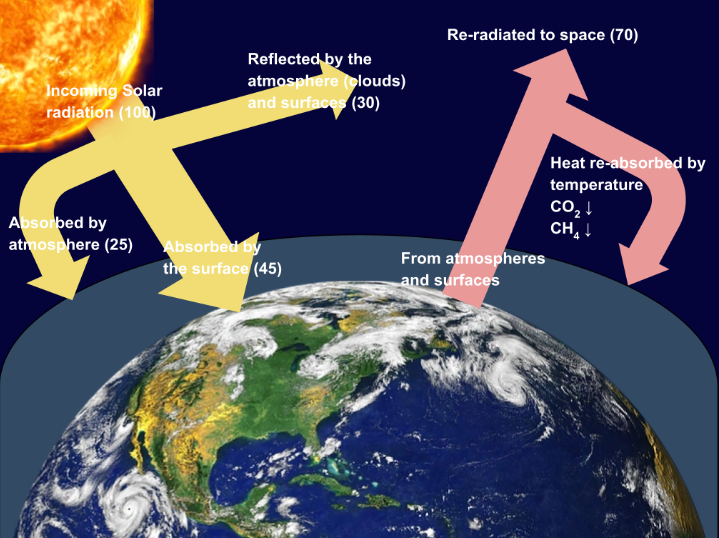
Feedback to climate change:
Where greenhouse gases may fit in: earth’s energy budget