Phylogeny
 AP Practice
 Call Kai
1/18

Earn XP
Description and Tags
Name | Mastery | Learn | Test | Matching | Spaced | Call with Kai |
|---|
No analytics yet
Send a link to your students to track their progress
19 Terms
Phylogeny
volutionary history & relationship of a species or a group of related species
Phylogenetic trees
represent hypotheses based on Morphological similarities & DNA/amino acid/protein sequence similarities
Morphological similarities
(physical features) of living or fossil species
molecular data (DNA)
typically provides more accurate and reliable evidence than morphological traits
branch point/node
Branching indicates evolutionary relationships, and the point where a split occurs is called a
divergence event/speciation
Each node shows a _______ _____/______ and therefore represents the most recent common ancestry of any two groups or lineages
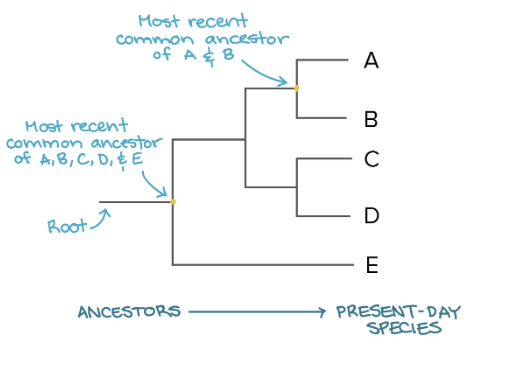
rooted
a single lineage at the base representing a common ancestor
Cladograms
constructed by using shared derived traits to distinguish different groups of species from one another
clades (monophyletic groups)
a group of organisms that descended from a single ancestor
Descent with modification
Organisms evolve from common ancestors and then diversify
shared ancestral character
If a characteristic is found in the ancestor of a group
derived traits
New characteristics that arise during evolution
indicate common ancestry
present in more than one lineage
outgroup
represents the lineage that is least closely related to the rest
parsimony
that the events occurred in the simplest, most obvious way
pathway of evolution probably includes the fewest major events that coincide with the evidence
polytomy
A branch with more than two species coming off
gained, lost
Traits can be _____ and _________ multiple times over the evolutionary history of a species
taxon
Each level of classification is called a
Domain, Kingdom, Phylum, Class, Order, Family, Genus, Species
taxon (listed from largest to smallest)
Binomial nomenclature
is the scientific naming of species
Part 1 is its genus name, and part 2 is its species name