A&P 1 Exam 4
 Call Kai
 Learn
Learn Practice Test
 Spaced Repetition
 Match
Match Flashcards
 Knowt Play
1/212

Earn XP
Description and Tags
Name | Mastery | Learn | Test | Matching | Spaced | Call with Kai | Chat |
|---|
No analytics yet
Send a link to your students to track their progress
213 Terms
Neurons
initiate and conduct impulses
Neuroglia cells
facilitate the communication function of neurons and support/protect them
Dendrites
receive signals from other cells
Cell body
organizes and keeps the cell functional
Axon hillock
where impulses are generated in the neuron (part of the axon)
Node of Ranvier
allows fast diffusion of ions
the gaps between myelin sheaths on the axon of the PNS
Schwann cell
produces the myelin sheath in the PNS
What is inside the cell body?
Nissl bodies (Rough ER)
What do Nissl bodies do?
make neurotransmitters
Nucleus
controls the entire neuron
Axon
transfers signals to other cells and organs
Myelin sheath
increases the speed and protection of the signal, a fatty sheet that protects the axon
When does most myelination occur?
before birth
When do we reach adult like levels of myelination?
by 3 years old
Axon terminal
forms junctions with other cells
What is the only part of a neuron that can initiate and conduct impulses?
the axon
What are neurotransmitters?
the chemical message sent to other neurons or cells
What is the function of neuroglia cells?
support and protection of neurons
Do neuroglia generate impulses?
no
What are the neuroglia cells of the central nervous system?
astrocytes
ependymal cells
oligodendrocytes
microglia
Astrocytes
hold the neuron and capillaries anchored in the CNS (forming blood/brain barrier), assist in regulating/processing of information by neurons
What absorbs excess potassium ions and neurotransmitters to protect the whole brain?
astrocytes
Ependymal cells
line the spinal cord and ventricles of the brain and is involved in producing cerebrospinal fluid
Oligodendrocytes
responsible for myelination of CNS axons
Microglia
brain’s immune cells, remove dead cells and pathogens via phagocytosis
Large amounts of migroglia indicate what?
brain infection
What are the neuroglial cells of the peripheral nervous system?
satellite cells and Schwann cells
Satellite cells
surround neuron cell BODIES in ganglia
regulate neurotransmitter levels
absorb toxins to protect neuron cell bodies
Schwann cells
myelinate neurons in the PNS
maintain and regenerate neurons after injury
fatty cells that are rolled around axons
increase the transmission rate
Resting membrane potential
the difference in electrical potential across the plasma membrane when the cell is not stimulated or when the cell is in a state of relaxation
Membrane potential
the difference in voltage between the inside and outside of the cell
What causes a membrane potential?
the ions inside and outside of the cytoplasm
Typically, is the inside of the cell more negatively or positively charged?
negative
Typically, is the outside of the cell more negatively or positively charged?
positive
What is the resting membrane potential of a neuron?
-70mV
What is the resting membrane potential for non-excitable cells?
between -5 and -10mV
When is an impulse created?
when the membrane potential changes from the resting membrane potential
How do ions move across the plasma membrane?
channels and gates
Repolarization
returning to the resting membrane potential (becoming more negative)
What elements are used to cause depolarization?
Na+ is the most common, Ca+ and K+
Hyperpolarization
moving farther away from the resting membrane potential (becoming more negative)
What does hyperpolarization do?
inhibits actions
What factors influence whether the RMP is generated?
the phospholipid bilayer
ions movement across plasma membranes
proteins in the cytoplasm
How does the phospholipid bilayer affect the RMP?
allows fat soluble molecules to diffuse but not ions
What ways can ions move across a plasma membrane?
membrane protein channels
gated channels
transport proteins
unequal diffusion of Na+ and K+
How do proteins in the cytoplasm affect the RMP?
negatively charged proteins inside the PM are not outside the PM
Membrane protein channels
specific to a substance
embedded in the phospholipid bilayer and allow water soluble molecules and ions to cross
What are the types of gated channels?
ligand gated and voltage gated
Leak channels
always open to allow facilitated diffusion of ions
What are the most common leak channels?
K+ channels
Ligand (chemical) gated channels
involve ligands that bind to a specific receptor (usually NT in the nervous system)
Voltage gated channels
open only in response to voltage changes across the PM and when one side is negative and the other positive
Transport proteins/carrier molecules
proteins in PM that move ions and other substances
Name a type of transport protein
Na K Pump
Na+K+ Pump
embedded in the PM, Na+ goes OUT and K+ goes IN
How many Na+ ions are moved out of the cell with a Na+K+ Pump?
3
How many K+ ions are moved into the cell with a Na+K+ Pump?
2
What function do proteins in the cytoplasm have?
they are negatively charged to increase the difference in polarity of inside vs outside the cell
What are the functions of the nervous system?
maintain homeostasis, communicate, and coordinate the body
How does the nervous system communicate?
impulses and neurotransmitters
Central nervous system
brain and spinal cord
Peripheral nervous system
cranial nerves
spinal nerves
receptors
What does the peripheral nervous system do?
carries info between body and CNS and vice versa
Interneurons
found only in the CNS, relay incoming signals
What is the function of the CNS?
process/integrate information and then decide on response
What are the neurons of the PNS?
sensory neurons and motor neurons
Sensory/afferent neurons
takes information towards the CNS
What are the 2 types of sensory neurons?
visceral and somatic
Visceral sensory
sensory information from visceral organs TO CNS
Somatic sensory
sensory info from skeletal system, skin, muscles, hoings, and senses TO CNS
Motor/efferent neurons
carry info FROM CNS to body for response/reaction
Types of efferent neurons
somatic motor and autonomic motor
Somatic motor nervous system
sends motor info to skeletal muscles, voluntary
Autonomic motor nervous system
sends motor info to the heart, smooth muscles, and glands
involuntary
What is the process that oligodendrocytes use to myelinate the CNS?
each flat extension of the oligodendrocyte wraps around an axon segment creating the myelin sheath
Can an oligodendrocyte wrap around more than one axon?
yes
Can a Schwann cell wrap around more than one axon?
no
Neurilemma
outermost layer of the myelin sheath of the PNS, where the nucleus/cytoplasm/organelles get squeezed into during the “wrapping” process

Is this a CNS or PNS neuron?
CNS

Is this a CNS or PNS neuron?
PNS
Multiple sclerosis
an autoimmune disorder that attacks oligodendrocytes (CNS)
females are affected more
typically onset at age 15 to 50
EARLY DIAGNOSIS is key to prognosis
What are the symptoms of multiple sclerosis?
muscle weakness starting in the face then progressing
sensory difficulties
cognitive impairment
balance disorders
exacerbations/remissions
not always fatal
What are the treatments for multiple sclerosis?
immune suppressing drugs
corticosteroids to reduce nerve inflammation
plasmapheresis
What are the risk factors for multiple sclerosis?
being female
running in the family
being from somewhere far away from the equator
smoking
Unipolar neuron
a single elongated process with the cell body located off to the side
found in all sensory neurons except for nose and eyes
distal myelinated parts are the dendrites
Multipolar neuron
have more than two processes, a single axon, and multiple dendrites
the most common type of neuron
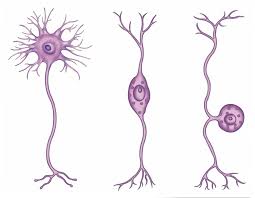
What is the shape of the neuron on the left?
multipolar
What is the shape of the middle neuron?
bipolar
What is the shape of the neuron on the right?
unipolar