BI276 midterm 2
 Call Kai
 Learn
Learn Practice Test
 Spaced Repetition
 Match
Match Flashcards
 Knowt Play
1/139

There's no tags or description
Looks like no tags are added yet.
Name | Mastery | Learn | Test | Matching | Spaced | Call with Kai | Chat |
|---|
No analytics yet
Send a link to your students to track their progress
140 Terms
net reaction of reverse citric acid cycle
3CO2 + 12H + 5ATP -> C3H6O3PO3^2- + 3H2O
the net reaction of hydroxypropionate pathway
2CO2 + 4H + 3ATP → C2H2O3 + H2O
what are endospores active in?
vegetative cells
which one is the thin protein covering on outside of endospore?
exosporium
the cortex of the endospore is loosely cross-linked _________
peptidoglycan
vegetative cells are typically..
gram positive
calvin cycle to make hexose
6CO2 + 18ATP + 12NADPH + 12H+ + 12H2O → glucose + 18ADP + 18Pi + 12NADP+
what happens if carbon dioxide is fixed in high oxygen conditions?
photorespiration is triggered
which one mediates attachement to surfaces?
fimbriae
initiation of the calvin cycle is favored at ______ temperatures
low
lophotrichous flagella
cluster of flagella at one or both ends
Peritrichous flagella
spread over entire surface of cell
A high CO2:O2 ratio is required for the calvin cycle, why?
this drives efficient sugar and prevents photorespiration
what are filaments composed of?
protein flagellin
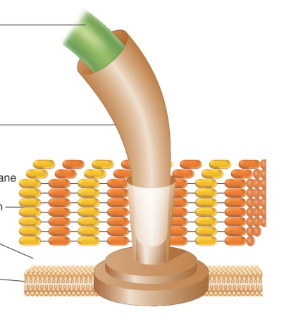
which one is this?
gram positive
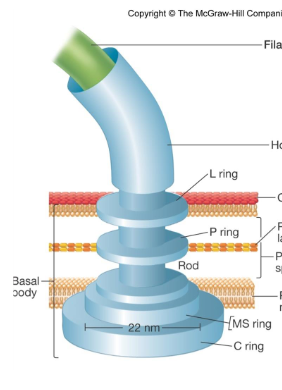
which one is this?
gram negative
Rubisco function
critical enzyme responsible for carbon fixation in plants
phosphoglyceric acid PGA
bridging energy production and carbon assimilation
which enzymes drive calvin cycle?
RuBisCO and PRK
what does rubisco do in the calvin cycle?
it is a CO2 acceptor
what does PRK do in the calvin cycle
responsible for regeneration
assimilatory sulfate reduction involves the formation of _________
PAPS
first mechanism to cope with O2 environments
rapid removal of O2 by respiration
second mechanism to cope with O2 environments
conformational protection
third mechanism to cope with O2 environments
production of O2 retarding slime layers
fourth mechanisms to cope with O2 environments
heterocysts
the first stop of the pathway of nitrogen fixation
electron donor
the second step of the pathway of nitrogen fixation
dinitrogenase reductase
Cilia are thinner than flagella.
False, flagella is thinner
where does growth occur in flagella?
base
Counterclockwise movement is flagella indicates…
run - forward motion
Clockwise motion in flagella indicates what?
tumble - rotation that disrupts forward motion
what is not involved in the stator in flagellar movement?
FliG protein
What is not involved in the composition of the rotor in flagellar movement?
MotA
when are attractants present?
directed movement
the third step of the pathway of nitrogen fixation
dinitrogenase
the enzyme that does NOT make up nitrogenase enzyme complex
dinitrocarboxylase
which is used to isolate individual colonies from mixed cultures?
streak plate
which one pertains to enumerating bacteria and evenly distributing the sample?
spread plate
net reaction of Aerobic respiration
glucose + 6O2 + 38ADP + 38Pi → 6CO2 + 6H2O + 38ATP
which of the following does not affect enzyme activity?
position of substrate in active site
electron movements are
exergonic
how many electrons are consumed in nitrogen fixation?
8
which one is not a way to perform viable plate counts?
streak plating
NADH dehydrogenases
active site binds NADH, accept two electrons and two protons that are transferred to flavoproteins, regenerating NAD+
net yield of the citric acid cycle
3NADH, NADPH, GTP, FADH2
O2 is a terminal electron acceptor for anaerobic respiration
False, only NO2-, SO4 2-, and CO3 2-
NO2- is a terminal electron acceptor of anaerobic respiration
True
terminal acceptor in aerobic respiration
O2
chemolithotrophy is typically…
aerobic
chemolithotrophy
uses inorganic chemicals as electron donors
oxidation
removal of electrons from an atom or molecule
electron donor
substance that is oxidized
reduction
addition of one or more electrons to a molecule
electron acceptor
substance that is reduced
catabolism
to obtain energy
anabolism
to make cellular material
the metabolic requirements
water, carbon, free energy, and reducing power
exergonic reactions with _____, ________ free energy
-G; release
endergonic reactions with ________, ________ free energy
+G; require
catabolic pathways
exergonic cellular processes that generate free energy
Bacteriocins
proteins that inhibit or kill closely related species or different strains of the same species
Rhizobia
require plasmid-encoded functions to fix
what comes first?
replication
which one describes DNA participation in protein synthesis?
transcription
what process describes the determination of amino acids?
Translation
semiconservative replication
each of the two new daughter DNA molecules consists of one old parental strand and one newly synthesized strand
Conservative replication
the resulting daughter DNA molecules consist of one all old molecule and one all new molecule
Which replication is the most used?
semiconservative replication
replication always proceeds from ______ end to the ______ end
5’; 3’
DNA polymerase
catalyze polymerization of deoxynucleotides
DNA gyrase
replaces supercoils ahead of replisome
how is DNA synthesis initiated?
double helix must be unwound
DNA synthesis begins at the…
origin of replication
DNA synthesis is ________ in prokaryotes
Bidirectional
replisome
large replication complex of multiple proteins
replisomes are facilitated by
FtsZ
which one is required for DNA replication?
DNA polymerase
Wild-type strain
a reference strain or a strain isolated from nature
mutations that change only a ______ base pair
single
which one is the stop codon
UAG
Frameshift mutation
deletions/insertions of one to two base pairs
which one is NOT a type of reversion
third party revertant
spontaneous mutations
arise without exposure to external agents
Chemical mutagens do NOT include what?
UV exposure
non-ionizing radiation
UV exposure leads to pyrimidine dimers
which one is more powerful?
ionizing radiation
which one is used for mutagenesis
non-ionizing radiation
Direct reversal
mutated base is still recognizable and can be repaired without referring to other strand
selection
detection through the selection of an altered phenotype
first step of incorporation of new DNA
transformation
lipases
break down lipid material to fatty acid and glycerol components
E. coli uses __________ as terminal reductase
nitrate reductase
chemoorganotrophs depend on
oxidative phosphorylation
chemolithotrophs use ______ as carbon sources
CO2
chemolithotrophy are typically _________ so they also _______ electron donors for anabolic processes
autotrophs; need
which one is not obtaining reducing power?
synthesis of glycolysis
cytoplasmic hydrogenase provides reducing power directly from ___________
inorganic molecules
what is the first stage of microbial growth?
Lag
net reaction of reverse citric acid cycle
3CO2 + 12H + 5ATP -> C3H6O3PO3^2- + 3H2O