Sound: Physics, Perception, Acoustics
 Call Kai
 Learn
Learn Practice Test
 Spaced Repetition
 Match
Match Flashcards
 Knowt Play
1/43

There's no tags or description
Looks like no tags are added yet.
Name | Mastery | Learn | Test | Matching | Spaced | Call with Kai | Chat |
|---|
No analytics yet
Send a link to your students to track their progress
44 Terms
acoustics
the study of physical properties of sounds in the environment, how they travel through air, and how they are affected by objects in their environment
psychoacoustics
the study of how we perceive sounds
pitch and frequency
sound
is a pressure wave moving through a medium (substance like air or water)
movement of air molecules from sound source
sound pressure level
0 dB SPL
other elastic mediums sound can travel through
water/liquid, metal, bone/skin/tissue, and wood
velocity
speed of a sound wave
impacted by elasticity and density of medium its going through
wavelength
distance a sound wave travels in one cycle
pure tones
one single isolated pitch also known as a “simple sound”
in tuning forks and audiometers
complex sounds
two or more pitches combined
everything other than pure/simple sounds like music, speech, ringtones, etc
transverse wave
a wave where the particles of the medium vibrate perpendicularly to the direction the wave is traveling

longitudinal wave
a wave where the particles of the medium oscillate parallel (back and forth) to the direction that the wave’s energy is traveling (movement in one direction)
forms compressions and rarefactions

longitudinal waves
are sound waves transverse waves or longitudinal waves?
properties of sound
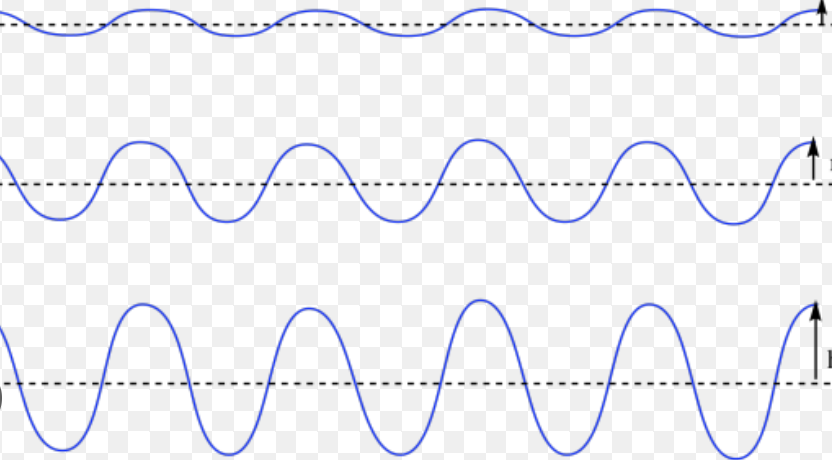
four physical parameters describing simple harmonic motion (pure tone) as a function of time: frequency, amplitude, period, phase
frequency
the number of complete vibratory cycles per unit of time

amplitude
a derived unit of measurement describing an object’s distance from rest to maximal displacement
period
amount of time needed to complete one cycle of vibration (B and E in the picture)

phase
describes the relative timing of compressions and rarefactions of waves (i.e., how cycles relate to each other)
compression and rarefaction
are the points of maximum displacement in a sound wave
pitch/frequency
the number of cycles per second expressed in hertz
includes subsonic, supersonic, infrasonic, and ultrasonic
loudness
amplitude of the cycles expressed in decibels
larger amplitude = louder sounds
subsonic
type of pitch/frequency wave that travels slower than the speed of sound
supersonic
type of pitch/frequency wave that travels faster than speed of sound
infrasonic
type of pitch/frequency that is below frequencies that humans can hear
ultrasonic
type of pitch/frequency that is above frequencies that humans can hear
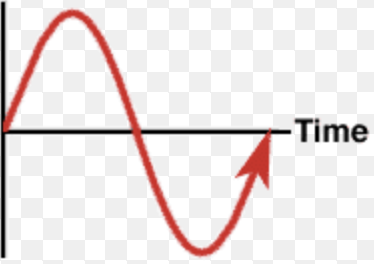
cycle of a wave
compression
when the vibrating object moves in one direction, the air molecules are pushed together, causing an increase in the density of air molecules (more molecules per volume)

rarefaction
when the vibrating object moves in the opposite direction, the air molecules are pulled apart, causing a decrease in the density of air molecules

compressions
are the peaks on a sound wave compressions or rarefactions?
rarefactions
are the troughs in a sound wave compressions or rarefactions?
pitch/frequency
equivalent to cycles per second (cps)
low frequency sounds = longer period and high frequency sounds = shorter periods
perceived as pitch
20 Hz to 20,000 Hz
what frequency range is it that humans can hear?
125—8000 Hz
what frequency range are human ears most sensitive to? which is also the range tested on audiograms
intensity
is a physics measure and is objective information
loudness
is a perceptual phenomenon and is very subjective
is perceived (what is for someone could be different for someone else)
decibel (dB)
units of measurement based on the physical properties of sound waves
1/10 Bel
dB SPL (Sound Pressure Level)
used in measuring hearing aid performance/function
dB IL (Intensity Level)
used in electrical measurements/calibration of audiometers
dB HL (Hearing Level)
used on hearing tests/audiograms
each frequency calibrated to “human 0”
logarithmic/exponential scale
dB SL (Sensation Level)
refers to the level above threshold, used for speech perception testing
no
does 0 dB mean the absence of sound?
yes
can some people hear at negative dB levels?
makes numbers more manageable
why is a logarithmic scale used versus a linear scale when measuring relative intensity?
ratio scale
a scale in which each value is related to a specified reference value so that equal intervals on the scale are equal ratios
linear scales are turned into these
audiograms
inverse graph that measures frequency vs intensity
normal hearing is at the top and deafness is at the bottom