PTE second half
 Call Kai
 Learn
Learn Practice Test
 Spaced Repetition
 Match
Match Flashcards
 Knowt Play
1/10

There's no tags or description
Looks like no tags are added yet.
Name | Mastery | Learn | Test | Matching | Spaced | Call with Kai | Chat |
|---|
No analytics yet
Send a link to your students to track their progress
11 Terms
Why is documentation important
Our guide to clinical decision making (diagnosis, prognosis, treatment plan)
Communication between disciplines and care providers
Provides record of services provided
Improves consistency in care
Third party payment (justifies need for care)
Components of examination
Reason for referral (pt interview)
Activity or functional assessment
Tests and measures
Assessment statement (diagnosis, prognosis, need for PT)
Plan of care
Order of patient client management model
Examination (reason for referral, activities, impairments)
Evaluation (assessment)
Diagnosis/prognosis (assessment)
Intervention (goals)
Outcomes (plan of care)
ICF model
Health condition (reason for referral)
Body structure and function (tests and measures), activity, participation (reason for referral)
Environmental factors, personal factors (both contextual factors and fall under reason for referral)
What kind of information do we have in movement assessment + examples
Qualitative information (quality of the movement)
Were they successful
Typical or atypical
Optimal or suboptimal
Quantitative information (time it takes)
When do you create your hypothesis
Between examination and evaluation
Human movement systems chart from inside to outside
Cardiovascular, pulmonary, endocrine
Musculoskeletal, nervous
Integumentary
Also communication/cognition/learning style (not on the chart but important)
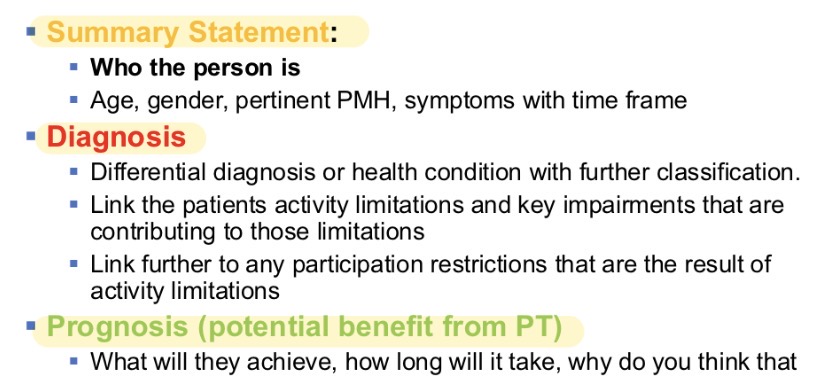
What does assessment statement contain
History and impact of contextual factors
Diagnosis (both process and product of that process)
Statement of prognosis (I think with pt we can restore…)
Process vs product
Process: the investigation or analysis of the cause or nature of the condition
Product: statement or conclusion from the analysis that links what we found to their activity or participation limitations
Purpose of the assessment section
Summary of eval and clinical judgement of the condition
Diagnosis which could confirm, extend, or question referral diagnosis. Link everything together
Justification of necessity of PT (PROGNOSIS)
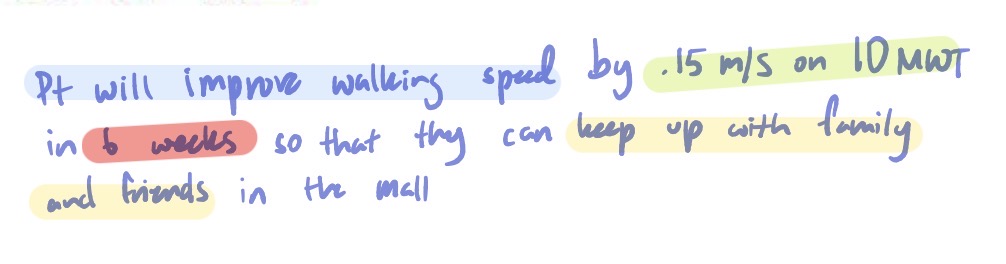
SMART goal
Specific
Measurable
Attainable
Relevant
Time based