Audition - Cochlear Physiology
 Call Kai
 Learn
Learn Practice Test
 Spaced Repetition
 Match
Match Flashcards
 Knowt Play
1/107

There's no tags or description
Looks like no tags are added yet.
Name | Mastery | Learn | Test | Matching | Spaced | Call with Kai | Chat |
|---|
No analytics yet
Send a link to your students to track their progress
108 Terms
What are the three main theories for how the cochlea analyzes sound?
1. Place theory by Helmholtz and later by Bekesy
2. Frequency theory by Rutherford
3. Place-volley theory by Waver
Which theory is the one currently accepted?
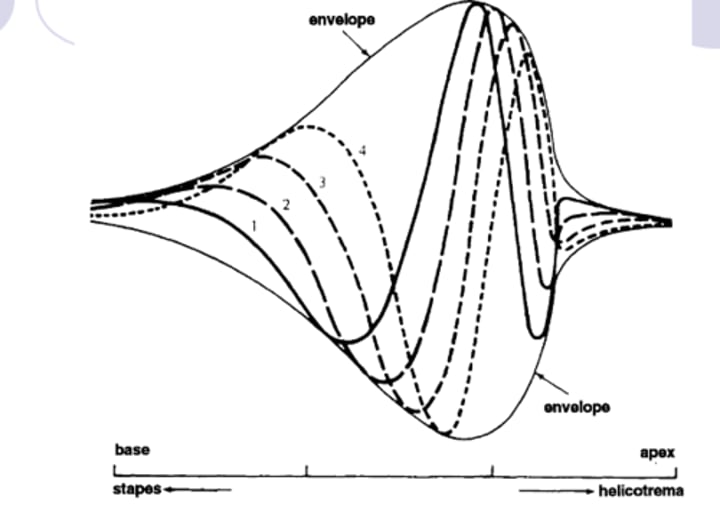
Currently, the place theory is what is accepted, which suggests that the BM vibrates as a travelling wave from base to apex (longitudinal direction). There is frequency selectivity along the BM, in that the basal end responds to the high frequencies and the apical end responds to the low frequencies
For the place/resonance theory, who had proposed it and what was study was it based on?
- Helmholtz
- based on his study on resonators. He thought that the pillar cells in the rod of Corti may be the resonators. (This is wrong)
What direction does the travelling wave move?
starts in the basal end and moves to the apex
What happens to amplitude of the travelling wave as it goes from basal to apex?
- amplitude increases
- peaks at a certain location
- then descends over the peak
Where is the peak location of amplitude of a travelling wave?
The peak location is determined by the frequency of the signal. It is near the base for a high frequency sound and near the apex for a low frequency sound.
What is meant by the travelling wave being asymmetric?
The travelling wave is shallow at the high frequency side of the peak, with a steeper slope over the peak (on the low frequency side)
What is the relationship of the travelling frequency to the signal frequency?
The travelling frequency is much smaller than the signal frequency
What is the relationship of the travelling wave of a low frequency tone to the basilar membrane?
It will cover a larger distance on the BM (have a wider envelope), it will have a slower speed, and it will peak at the apical region.
Why is the relationship of the travelling wave and low frequency tones important?
- For temporal processing
- Neurons innervating the high frequency region are better synchronized.
How was it discovered that the peak amplitude drops after the peak location? (what was one of the limitations of the research process)?
It was discovered that the peak amplitude drops after the peak location from Bekesy's work with microscopic observation of BM vibration using metal particles (placed on the BM) used for light reflection. A larger vibration of the BM would cause more reflection. This was only limited to the apical turn, because it can be easily accessed without damaging the structure.
What are 3 major discoveries from Bekesys work?
1) travelling wave
2) peak location change with frequency
3) asymmetric envelope
What is the cause of the wave slowing down?
The increase of mass (the BM at the apex takes longer to vibrate). Larger the mass, the slower the response (larger mass at the apical end!)
The wave slows down corresponding to the big phase lag (this means time delay)
What is another way to say this "slowing down" of the wave concept?
phase lag
What kind of wave form are the periodic signals measured in?
sine waves
What are two reasons that refute the claim that the travelling wave occurs because the signal input is at the basal turn at the stapes?
1) Sound vibrates the whole cochlea at almost the same time (the speed of sound in water is very fast). This means that the acoustic force is applied to the whole BM at almost the same time.
2) No matter where you stimulate the cochlea from, it will always travel from base to apex.
What is the reason the BM vibration travels?
The BM vibration travels due to mass and stiffness difference along the BM
At the apex, the BM has a larger mass and smaller stiffness, so it responds slower
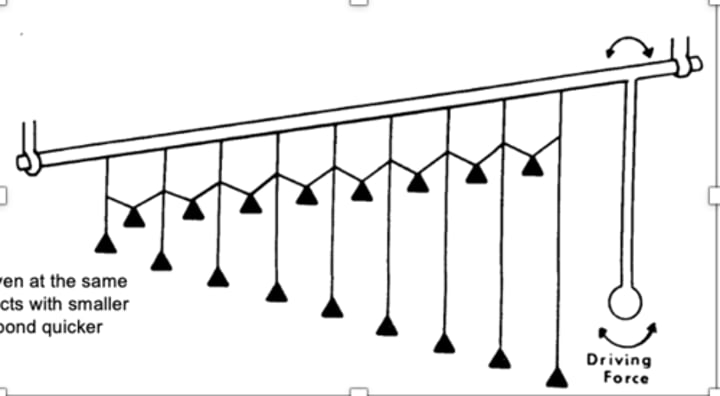
Describe the pendulum analogy as it relates to the vibration:
In the pendulum theory, the driving force is applied through the solid bar. Therefore, it doesn't matter where the force is applied. All the pendulums (i.e., the whole cochlea) is driven simultaneously. Vibration travels because the parts with less mass respond quicker. To relate it to the cochlea, we have our mass shifting (more mass at the apex).
What 3 main changes occur from base to apex?
1) Increase in BM width
2) Slight decrease in thickness
3) Increase in OC size and height of HCs
What do the 3 main changes that occur from base to apex result in?
1 and 2 result in a decrease in stiffness
1 and 3 result in an increase in mass
As a result, there is a shifting in resonant frequency from high to low from base to apex
How would you describe the width and duration of an impulse signal?
Impulse is very short in duration
Very wide in spectrum
What are the 3 limitations to Bekesy's study of the travelling wave?
1) used dead cochlea
2) poor sensitivity of equipment (therefore he needed to use high intensity of sound)
3) only the passive component of BM vibration was observed
Why is the limitation of only observing the passive component of the BM important?
Bekesy failed to detect the active component (the contribution from the OHCs) of BM vibration. This is because he used a dead cochlea (the active component therefore wouldn't exist), and his equipment had poor sensitivity. Therefore, he needed to use a high intensity sound (>120 dB). The active component wouldn't work for sound that loud. This limitation is critical because the cochlea alone doesn't have enough capacity to code sound frequencies across the human hearing range (20-20000 Hz). People think that the active component is a large contributor to this.
What is the discrepancy of the auditory nerve and the basilar membrane?
The auditory nerve fibre responses are sharply tuned (i.e. they are only responsive to a very narrow frequency range) but not BM vibration
How is the active component of the cochlea is different than the passive?
The active component greatly improves frequency selectivity, as well as the sensitivity of the cochlea to sound. It depends on the OHCs.
What is the implication of the asymmetrical envelope?
A low frequency sound will cause vibration over a long distance extended to the high frequency region. While a high-frequency sound will vibrate a limited area, there will be less extension toward the low frequency region (basal turn). A low frequency sound will therefore mask high frequency signals because of the asymmetrical envelope.
Working principle of a sensory organ:
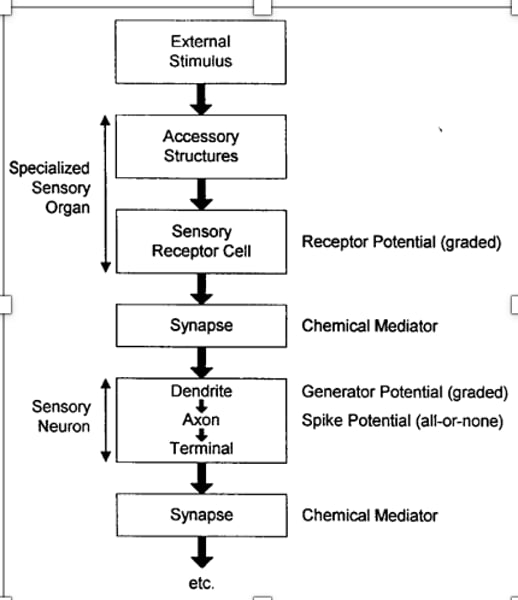
What is the basic function of a receptor as it applies to a sensory organ in general?
Transduction or conversion - converting one type of signal to receptor potential
What is meant by specificity?
How ears are receptive to sound, for example. Or, how eyes are receptive to light
What determines specificity?
Determined by the type of receptor cell and accessory (or auxiliary) structure
Can receptors respond to other stimuli?
One receptor is sensitive to ONLY one type of stimulus
A receptor can respond to other stimuli, however, the sensitivity is much lower (requires a higher strength)
What is the difference between an action potential and a receptor potential?
Receptor potential is proportionally corresponding to the strength of the stimuli (graded)
Action potential is all or none, they either fire or do not fire
What does the receptor potential in the inner hair cell vs the outer hair cell lead to?
IHCs - neurotransmitter release and action potential at the type I SGN
OHCs mobility (positive feedback to the OC) and an action potential at type II SGN (we don't know what info is actually delivered to the brain).
Which type of Spiral Ganglion neuron does the action potential occur with respect to the IHC and OHC?
Type 1 SGNs
What is the overall difference in the inner hair cells role and the outer hair cells role in the cochlea, one sentence each?
The role of the IHCs is the main information pathway in the cochlea.
The OHCs provide positive feedback (active, mechanical amplification).
What are the five main steps (in brief) of the inner hair cell acting as an information pathway in the cochlea?
1) BM vibration
2) deflection of stereocilia of IHCs
3) receptor potential of IHCs
4) action potentials of type 1 SGNs
5) SGN to CAS
What are the four main steps for the outer hair cells role?
1) BM vibration
2) Deflection of stereocilia of OHCs
3) receptor potential - not sure what signal will go from OHCs to brain
4) OHC motility (mechanical amplification)
How does OHC motility related to the IHC?
The OHC motility provides feedback to the IHCS, as an enhancement to IHC stereocilia
What is OHC motility responsible for as it relates to sound? What happens if this is damaged?
Responsible for the high sensitivity to sound
Without normal function of OHCs, we cannot hear soft sound. OHC damage is the major reason for SNHL.
What is the difference between the micromechanics and macro mechanics (as it relates to the ear)?
Micromechanics refers to the Organ of Corti vibration (the stimulation of HCs leading to the deflection of hair bundles (stereocilia)).
Macromechanics refers to the traveling wave and the radial vibration of the BM.
What is the difference in movement of the stapes and basilar membrane vibration?
BM vibration occurs up and down
Stapes vibrates in and out against the oval window
What are the two factors that makes the BM vibrates up and down?
Different dimensions between the SV and the ST, and different flexibility between the OW and the RW (the RW is more flexible).
Describe this using the condensation and rarefaction phases as it relates to the movement of the BM up and down?
The oval window is pushed in (condensation), which causes the BM to be pushed down. When the oval window is drawn out laterally (rarefaction), the BM is pushed up.
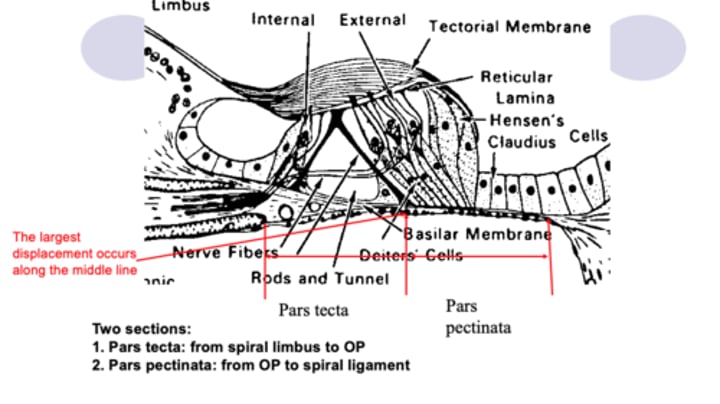
What are the two sections along the BM called? Where does the largest displacement occur?
The pars tecta (from spiral limbus to OP) and the pars pectinata (from the OP to the spiral ligament). The largest displacement occurs along the midline (at the bottom of the outer pillar cells). This point is the farthest away from the 2 fixed sides (divides the BM into 2 parts in the radial direction).
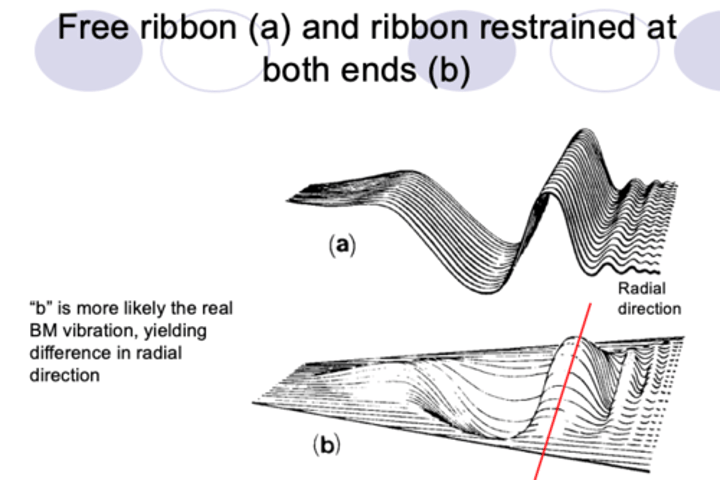
How could you use the ribbon analogy to describe the vibration?
Think of the BM as a ribbon restrained at each end, and along each side. Due to the restraint along the sides, the ribbon cannot vibrate freely.
Which direction does the vibration amplitude change? What is another word to describe this?
There is a change of vibration amplitude in the radial direction. Another word to describe this is "shearing."
What is one factor keeping the organ of Corti a relatively rigid structure?
the rod of Corti
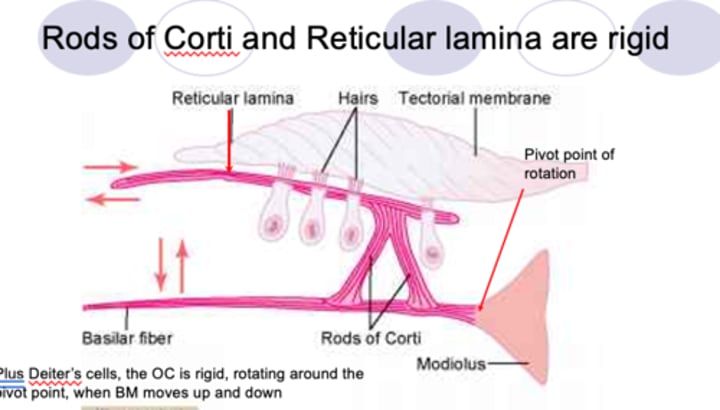
What leads to the shearing effect?
rotation causes shearing between the TM and the reticular lamina
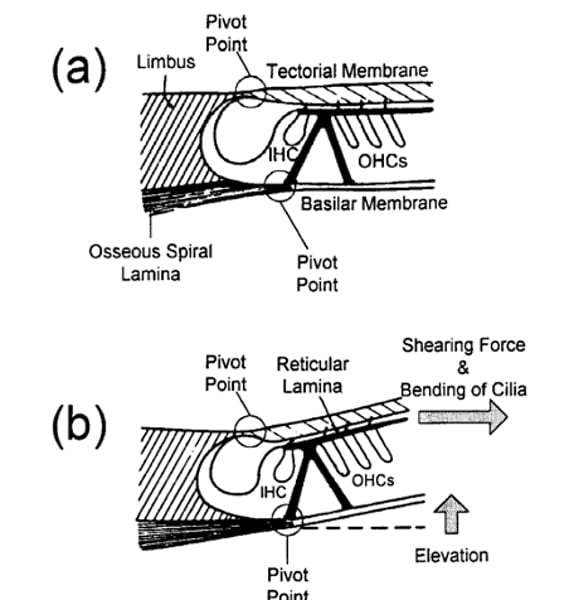
How are the stereocilia connected?
The tallest stereocilia of OHCs are connected with TM (tips are embedded into it), but rooted in cuticular plate, also a rigid structure
Describe how excitation occurs
The stapes moves out (rarefraction in external ear), BM displaces towards SV (BM moves up): stereocilia (hairs) bend laterally (towards lateral wall of SM) - the direction causes excitation
Describe how suppression occurs
Stapes move in (compression in external ear), BM displaces towards ST, hairs bend centrally (towards modiolus) - the direction causing suppression
Where does largest displacement occur in the Organ of Corti?
along the middle line (where softer part of BM is)
Provide the general description of transduction.
The process of a type of stimuli (acoustical in cochlea) to membrane potential of receptor cells (ex: HCs in cochlea)
Where does transduction occur? (i.e. which level as it relates to the bending of the hair cells)
at the level of the reticular lamina
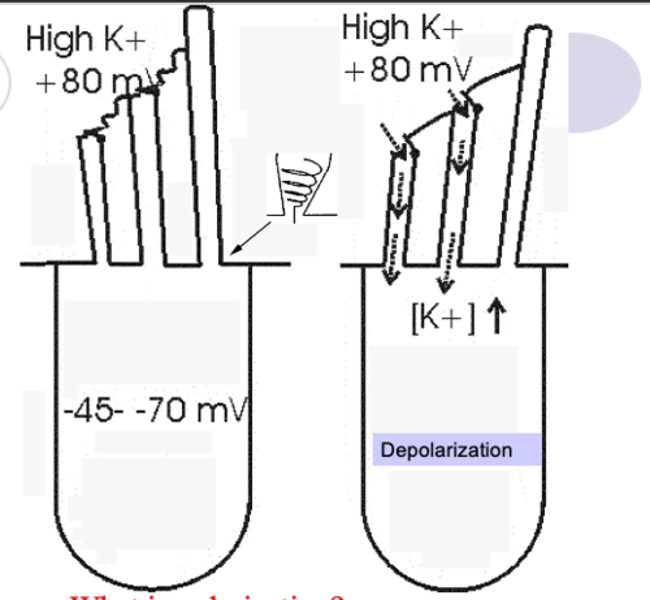
What happens when the stereocilia bends? (ie. What mediates transduction)
Trandusction is mediated by ion channels on hair cells that are controlled by the bending of the stereocilia
What is one requirement (in general) for transduction to occur?
Transduction requires special a biochemistry environment in the cochlea
What is the composition of perilymph (ie in general, high and low in what)? What is it similar to?
High in sodium, low in potassium. It's similar to CSF.
What is endolymph high in? What does this cause?
Endolymph is high in potassium and low in sodium. The high K in Endolymph causes the formation of endocochlear potential. Endolymph is responsible for transduction.
What are the borders around the endolymph?
Tight junctions along Reissner's membrane, the stria vascularis and along the reticular lamina.
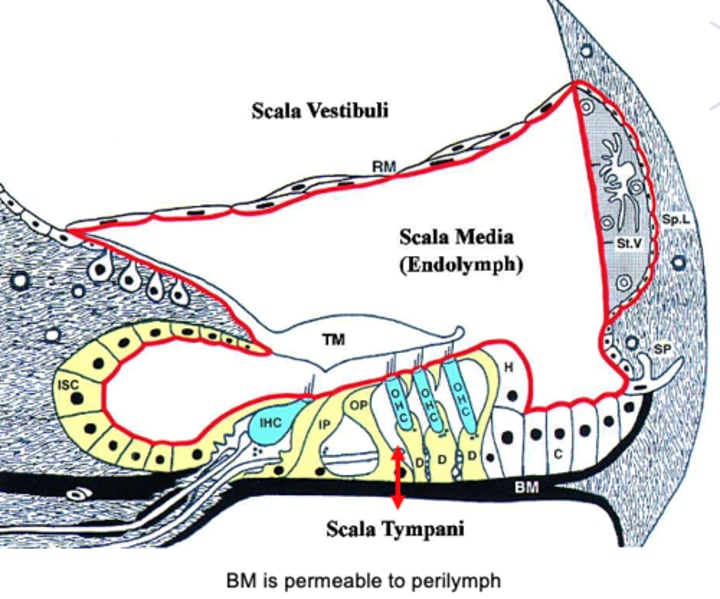
What are the bodies of hair cells submerged in? What are stereocilia submerged in? (What are the top of HC submerged in?)
The bodies of the HCs are submerged in perilymph (or more specifically, Corti fluid, which is similar to perilymph). The stereocilia (and tops of the HCs) are submerged in endolymph.
How are perilymph and endolymph kept separate?
Perilymph and endolymph are separated along reticular lamina by tight junctions.
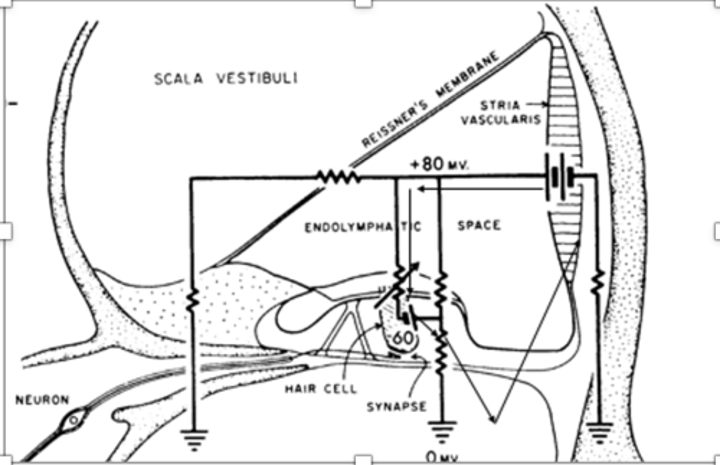
What is the mV of the scala media? What is there a high concentration of?
SM: high K. +80 mV
What is the mV inside the hair cells? What is there a high and low of?
Also high K, but low sodium. -60 mV.
What is the total difference across the SM and hair cell gradient?
140 mV
What is the total difference across the SM and hair cell gradient called? What does it lead to?
This is a potential difference. It drives K from SM to HCs, if the MET channel is open.
What are the two main causes of ion movement?
Differences in voltage and concentration.
What are ion channels?
Pores formed by membrane proteins, allowing ions to pass. This results in the control and change of the membrane potential and other consequences.
What is ion current?
Ion current is the current carried by ions, involved in signaling of neurons and other excitable cells.
What are five examples of how ion channels are categorized based on the way they are 'gated' (ie. Controlled closing and opening)?
Voltage, ligand, temperature, light, and mechanical force.
What is the carrier of transduction?
potassium
Bending of stereocilia laterally causes ____
opening of ion channels (K+)
Bending of stereocilia medially causes ____
closing of ion channels (K+)
What happens when the MET channel opens?
potassium will get into hair cells and the potential will be depolarized
What is the take home message of Davis's battery?
- That there are two energy pumps in the cochlea which provide energy for transduction (create the resting potential required for flow of K+ current)
- One pump is located in the SV for endocochlear potential and the other is located at the lateral wall of hairs cells (this one creates the intracellular potential of -60mV)
- this makes the overall potential difference of -140 mV which accounts for the current and sets the scene to allow for transduction
- Both channels are potassium, which are controlled by the bending of hair cells
Transduction occurs at the level of the ______
reticular lamina
What is the tip-link theory?
Transduction channels are located inside stereocilia and are controlled by the bending of hair
What kind of channels are involved in transduction?
MET channels (mechanical electrical channels)
How does the MET channel relate to K and other positive ions?
MET current is carried by K< although MET channels are open to all positive ions
Which factor mainly drives K?
voltage via MET channels (because the concentration difference is so small)
What are two reasons that K is favoured?
1. Downhill movement, requiring no energy, and then reduce noise (no other positive ions have such feature)
2. Less disturbing of intracellular environment due to high concentration of K inside Hair Cells
What is meant by standing current?
current without sound
What are the general steps of standing current?
K moves from stria vascularis (SV) to SM, into hair cells (through transduction current) and the out to perilymph (via K channels at the lateral wall of HCs), or supporting cells (via gap-junction) and then back to SV. One direction.
What is the voltage and concentration inside the SM>
The voltage inside the SM is +80mV and the concentration of potassium is 140mM (millimoles).
What is the voltage and concentration in the hair cells?
The voltage inside the ST is -60mV and the concentration of potassium is 137mM (millimoles).
What is the voltage and concentration in the ST?
It is 0 for both
What are the three types of links across the stereocilia? Describe each of them.
1) row-row this is a thicker connection that holds the stereocilia together by connecting the rows to the adjacent ones
2) side-side links are the connections between the sides of the stereocilia to each other in the same row (also a thicker connection)
3) tip-side (tiplink theory). This is the connection between the sides of the stereocilia and the tips of others in adjacent rows, and it is the connection responsible for the MET channel control.
What are two possible functions of these links?
row-row and side-side hold the stereocilia together
tip-side controls MET channels
What is the most fragile structure of the cochlea to noise? What is a consequence to this?
Links among/between the cilia, worsening in the efficiency of transduction
Describe the channel opening, tip links, cilia movement and neurotransmitter release in the following situations:
a. standing current
b. depolarization
c. hyperpolarization
a. Standing Current partial channel opening
b. Depolarization? Lateral bending of hair cells, increase in channel opening
c. Hyperpolarization medial bending of hair cells, decrease in channel opening
Where are the two roles of calcium seen?
Calcium channels open in repolarization and calcium leaves the cell in hyperpolarization
Describe the overall 8 steps of transduction (redundant question, but you should be able to visualize and say it from memory)
1) Influx of potassium leads to cell depolarization
2) Calcium channels open
3) Calcium increases
4) stereocilia bending medially
5) Potassium remains outside the cell leads to hyperpolarization
6) Calcium is let out
7) Potassium channels close at the lateral wall leading to repolarization
8) Repetition
What is transmission?
when an electrochemical release of neurotransmitters causes an action potential to fire in the spiral ganglion neurons
What is a spontaneous action potential (as it relates to transduction in this case)?
The baseline release of neurotransmitters resulting in an AP.
What increases the chance of Aps?
Lateral bending of stereocilia
Based on the three steps of signal processing in the cochlea, please respond:
a. Conduction involves the change in signal processing from:
b. Transduction involves the change in the signal processing from:
c. Transmission involves the change in the signal processing from:
a. Conduction involves the change in signal processing from: Mechanical to hydraulic mechanical (or macro to micro)
b. Transduction involves the change in the signal processing from: Mechanical to electrical
c. Transmission involves the change in the signal processing from: Electrical-biochemical (receptor potential) to an action potential of SGN
What can the role of OHC be summarized as?
OHC work as a mechanical amplifier
What are two traits of the healthy cochlea that was not identified by Bekesy
A healthy cochlea has: 1) a lower threshold (meaning the lowest sound level to created a response) 2) better frequency selectivity
What are the two sensitivities affected by the active mechanism of hearing? In what ways?
Improves sensitivity to sound (lowering threshold) and improves frequency selectivity.
The sensitivity to sound occurs by the gain change with sensitivity which is high gain at a low sound level and the resulting compression.
Improving frequency selectivity through most likely hair bundle motility.
What are the three main evidences that show the OHC role in amplification?
1) Motility of OHC in vitro was found to be less responsive to voltage change
2) in OHC lesion studies it was found that there was poor tuning and poor sensitivity
3) Otoacoustic emissions: Ears can produce sound this shows OHC functional generating mechanical force
What are the two types of OHC motility? Which type is seen in amphibians and not mammals?
- fast OHC body motility (main reason for amplification in mammals)
- slow OHC body motility (not related to amplification)