3 - Anticoagulation: Focus on Oral Therapy
 Call Kai
 Learn
Learn Practice Test
 Spaced Repetition
 Match
Match Flashcards
 Knowt Play
1/91

There's no tags or description
Looks like no tags are added yet.
Name | Mastery | Learn | Test | Matching | Spaced | Call with Kai | Chat |
|---|
No analytics yet
Send a link to your students to track their progress
92 Terms
What are the main indications for antithrombotic drugs?
Treat/prevent venous thromboembolism (VTE) → DVT, PE, thrombophilias.
Prevent arterial thrombosis and stroke → atrial fibrillation/flutter, mechanical heart valves, and other conditions
What is venous thromboembolism (VTE)?
Decreased self-regulation of the clotting cascade increases clot formation
Blood flow becomes impaired, which can lead to DVT or PE

What is Virchow’s Triad?
Changes in any of three factors increase the risk of thrombosis:
Hypercoagulability → increased tendency to form abnormal blood clots
Hemodynamic changes/stasis
Endothelial injury
Persistent risk factors for VTE?
Active cancer
Thrombophilias
Long-term immobility
Minor risk factors for VTE within 2 months of diagnosis?
General anesthesia <30 min
Hospital admission <3 days with acute illness
Bed confinement >3 days with acute illness
Prolonged car or air travel
Estrogen therapy, pregnancy, or puerperium
Leg injury with reduced mobility ≥3 days
Major risk factors VTE risk factors present within 3 months of diagnosis?
Surgery with general anesthesia >30 min
Hospital bed confinement with only “bathroom privileges” >3 days with acute illness
Cesarean section
Major trauma
What are the preferred treatments for VTE?
DOACs are preferred!!!
Rivaroxaban or apixaban → used alone
Dabigatran or edoxaban → used after 5–10 days of parenteral therapy
How is warfarin used to treat VTE?
Goal INR → 2.0–3.0
Use with LMWH/heparin for >5 days
What is the duration of initial treatment of VTE?
At least 3-6 months
Provoked by major / minor transient risk factors
When is extended/indefinite VTE therapy recommended after 3–6 months?
Ongoing permanent risk factors
Unprovoked VTE with no reversible risk factors
Recurrent VTE episodes
Based on bleeding risk
What is the role of warfarin in treating thrombophilias?
Preferred over DOACs for → antiphospholipid antibody syndrome (APS)
May be an option for all thrombophilias
INR goal is indication-specific, usually 2.0–3.0
What is the role of DOACs in treating thrombophilias?
No official guideline recommendations for thrombophilias
May have a role in treating most thrombophilias
NOT recommended for APS!!!!
Why does atrial fibrillation (AF) increase stroke risk?
Irregular atrial contraction causes blood pooling
Blood pooling can cause clot formation, which can embolize and cause a stroke
Artial fibrilation?
Most common cardiac rhythm disorder
Risk increases with age, especially >60 years
About 10% prevalence in people >80 years
Uncommon if <50 years.
More common in men than women
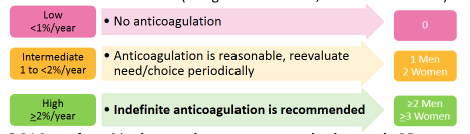
How is stroke risk assessed in atrial fibrillation/flutter?
Afib/flutter increases risk for stroke
Oral anticoagulation is used for stroke prevention
DOACs preferred unless moderate to severe mitral stenosis or mechanical heart valve
If warfarin used → range 2-3

CHA2DS2-VASc?
CHA2DS2-VASc is used to assess stroke risk
Low <1%/year → no anticoag → 0
Intermediate 1-2%/year → anticoag is reasonable, reevaluate need/choice periodically → 1 men, 2 women
High >2%/year → Indefinite anticoag is recommended → >2 men, >3 women
What are the two types of prosthetic heart valves?
Mechanical
Bioprosthetic
How do mechanical and bioprosthetic valves differ?
Mechanical → more thrombogenic, durable, last 20–30 years, require lifelong warfarin
Bioprosthetic → lower thrombogenicity, limited lifespan; 10–30% fail within 10–15 years
Mechanical and bioprosthetic valves preferences?
Mechanical valves are → generally preferred in younger patients who can take lifelong warfarin
Bioprosthetic valves are → generally preferred in older patients or those unable to take lifelong anticoagulants
Anticoag for heart valve replacement?
Mechanical → require lifelong warfarin
Bioprosthetic → 3-6 months aspirin 75-100mg/d OR warfarin (INR 2.5)
Never DOACs
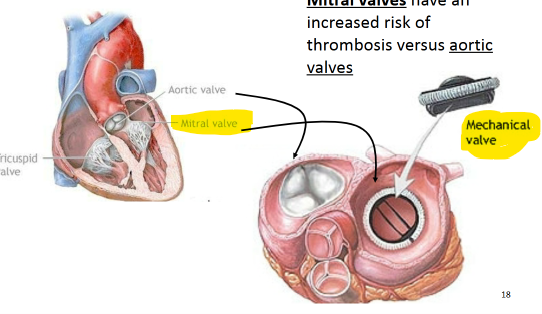
Which heart valve position has a higher risk of thrombosis?
Mitral valves have a higher risk of thrombosis than aortic valves
Mechanical
Aortic mechanical valve with no other risk factors?
Duration of Warfarin → Indefinite
INR Range → 2-3
Aortic mechanical valve with risk factors?
Duration of Warfarin → Indefinite
INR Range → 2.5 - 3.5
Mitral mechanical valve?
Duration of Warfarin → Indefinite
INR Range → 2.5 - 3.5
On-X aortic mechanical valve?
Duration of Warfarin → Indefinite
3 months → 2-3 and ASA 81 mg
Ongoing → 1.5 - 2 and ASA 81 mg if no other risk factors
When should aspirin be added to warfarin for a mechanical mitral valve?
If there is another indication for aspirin AND bleeding risk is low
Consider adding aspirin 75–100 mg/day to warfarin
What are the key treatment principles for DVT/PE?
DOACs are preferred
If using warfarin → INR 2.0–3.0
Treatment lasts at least 3 months
Extended therapy may be needed depending on whether the VTE was unprovoked or caused by persistent/transient risk factors
When is anticoagulation recommended for AFib/flutter?
Recommended if CHA2DS2-VASc → >2 in men or >3 in women
DOACs are preferred unless mechanical heart valve or mitral stenosis
If using warfarin → INR 2.0–3.0 and maintain TTR >70%
What is the anticoagulation treatment for mechanical heart valves?
Warfarin ONLY
INR depends on valve position and risk factors
Aortic valve without risk factors → 2.0–3.0
Mitral valve or aortic valve with risk factors → 2.5–3.5
Duration → indefinitely
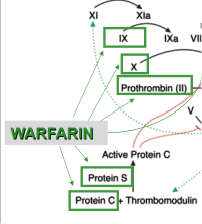
How does warfarin work?
Interferes with conversion of vitamin K.
Decreases production of vitamin K-dependent clotting factors II, VII, IX, and X.
Also decreases protein C and S
Indications of warfarin?
Effective for numerous anticoagulation indications
Universal anticoagulant for ALL indications and ages even if not labeled for use
Challenging to manage because it requires monitoring and dose adjustments
Brand names of warfarin?
Jantoven
Used to be called coumadin
Pharmacologic properties of warfarin?
Racemic mixture of 2 enantiomers: (S)- and (R)-warfarin.
(S)-warfarin is → 3x more potent than (R)-warfarin
Nearly 100% oral bioavailability
99% protein bound
How is warfarin metabolized?
Metabolized by CYP450 enzymes.
(S)-warfarin → CYP2C9 and CYP3A4
(R)-warfarin → CYP1A2 and CYP3A4
Extensive drug interactions can occur
Eliminated primarily through urinary excretion
How does dabigatran work?
Directly inhibits thrombin (Factor IIa)
Inhibits both clot-bound and circulating thrombin
Prodrug → dabigatran etexilate is converted to dabigatran by plasma esterases
What are the indications for dabigatran?
Stroke and systemic embolism prevention in non-valvular AF
Treatment and prevention of recurrent DVT/PE in adults and pediatric patients 8–17 years
VTE prevention after total hip replacement surgery
How does apixaban work?
Oral, direct selective Factor Xa inhibitor
What are the indications for apixaban?
Stroke and systemic embolism prevention in non-valvular AF
Treatment of DVT and PE
Reduces recurrence of DVT and PE after >6 months of therapy
VTE prevention after total hip or knee replacement surgery
How does rivaroxaban work?
Oral, direct, selective Factor Xa inhibitor
First approved oral Factor Xa inhibitor
What are the indications for rivaroxaban?
Stroke/systemic embolism prevention in non-valvular AF
Treatment of DVT/PE and reduction of recurrence after 6 months → of DVT and PE in adults and PEDs
VTE prevention after total hip or knee replacement
Reduces major cardiovascular events in chronic CAD or PAD when used with aspirin
VTE prophylaxis in acutely ill medical patients at moderate-to-high VTE risk
VTE prophylaxis in PEDs patients after the Fontan procedure
What is the adult VTE treatment regimen for apixaban?
10 mg BID for 7 days.
Then 5 mg BID through 6 months.
Then 2.5 mg BID after 6 months → optional reduced dose
20 - 10 - 5
What is the adult VTE treatment regimen for rivaroxaban?
15 mg BID for 21 days.
Then 20 mg daily through 6 months
Then 10 mg daily after 6 months → optional reduced dose
30 - 20 - 10
What is the adult VTE treatment regimen for dabigatran?
Use a parenteral anticoagulant for 5–10 days first
Then dabigatran 150 mg BID
What are the additional dosing considerations for dabigatran in adult VTE?
Recurrence reduction → 150 mg BID after previous treatment
Other → 75 mg BID with a P-gp inhibitor + CrCl 30–50 mL/min
Renal dosing of dabigatran?
Avoid P-gp inhibitor
Avoid CrCl <30ml/min
What are the additional dosing considerations for apixaban in adult VTE?
Recurrence reduction → 2.5mg BID after >6 months
Other → 2.5 BID if → strong dual P-gp/CYP3A4 inhibitors
Renal dosing of Apixaban?
No dose adjustment !
What are the additional dosing considerations for Rivaroxaban in adult VTE?
Recurrence reduction → 10mg daily with or without food, after 6 months
Renal dosing of Rivaroxaban?
CrCl <15 → AVOID!!
What is dabigatran dosing for AFib?
Normal → 150 mg BID
CrCl 15–30 → 75 mg BID
CrCl <15 or dialysis: Avoid!!
Renal elimination → 80%!!!
What is apixaban dosing for AFib?
Normal → 5 mg BID
2.5 mg BID if ≥2 of the following
Age >80 years
Body Weight <60 kg
SCr >1.5 mg/dL
When administration specifics of Warfarin?
With or without food
Crushing allowed
Generally in evening → for adjusting for INR
When administration specifics of Dabigatran?
With or without food
Swallow WHOLE
MUST be in OG bottle/blister pack
Not in MED BOXES
When administration specifics of Apixaban?
With or without food
When administration specifics of Rivaroxaban?
Afib → evening meal
VTE → with heaviest meal
Crushing allowed
What factors should be considered when choosing an anticoagulant?
Indication
SCr/BUN and CBC
Age
Weight/BMI
Other medications
Dietary intake
Adherence/pill box use
Once vs twice daily dosing
INR control if on warfarin
Cost/insurance
When should anticoagulation be initiated?
Initiate immediately after diagnosis of the indication
What factors should be considered when initiating warfarin?
Previous stable warfarin dose
Age, weight, diet, alcohol
Interacting medications
Baseline INR (usual 0.9–1.1)
Ethnic background
Pharmacogenetic-based dosing
Why is warfarin dosing challenging?
Narrow therapeutic window
Large variability in dose response
No standardized dosing
Multiple factors affect therapy
How quickly does warfarin take effect?
Initial INR effects → 2–7 days
When is a <5 mg warfarin starting dose used?
Consider in patients with increased sensitivity/risk →
Age >60
Debilitated or malnourished
Heart failure or liver disease
Recent major surgery
Interacting medications, such as amiodarone
When is a 5 mg warfarin starting dose used?
Standard starting dose for most patients
When can 10 mg x 2 days be used for warfarin?
May be used in healthy outpatients
10 mg/loading doses are generally not preferred
Rapid decreases in Protein C and S can cause a temporary procoagulant effect
Heparin/LMWH may be discontinued prematurely
How is INR monitored when starting warfarin?
Check INR 2–5 days after starting
Monitor about 2x/week for 1–2 weeks
INR may increase 0.1–0.2/day during the first week
Steady state → about 10–14 days
How often should INR be monitored once warfarin is stable?
Monitor periodically
4 weeks → Stable patients → monitoring can be extended up to 12 weeks if consistently stable for >3–6 months.
<2 weeks → Unstable patients → monitor more frequently after dose changes, abnormal INRs, or other factors
What is the most common adverse effect of warfarin?
Bleeding
Common bleeding sites: nose/pharynx, soft tissue, GI tract, urinary tract, intracranial, and thoracic
Warfarin is the 2nd most common drug implicated in ER visits
What should be assessed when monitoring warfarin therapy?
Current warfarin dose
Missed or extra doses
Changes in vitamin K intake
Alcohol use
Drug interactions
Changes in health: fever, diarrhea, nausea, vomiting
Signs/symptoms of bleeding or thromboembolism
Fall risk
Whether changes are consistent or temporary and when they occurred
What is important about dietary vitamin K when taking warfarin?
Vitamin K diet consistency is key
High vitamin K foods → green leafy vegetables, green tea, canola/soybean oils.
High-vitamin K supplements → SlimFast, Boost, Ensure, enteral nutrition
Also found in multivitamins and Viactiv calcium chews
Consider seasonal changes in produce availability
What can increase INR?
Alcohol binge
Medication changes
Decreased dietary K
Acute illness, persistent fever, and/or diarrhea
Signs of bleeding
Significant weight loss
What can decrease INR?
Missed doses
Medication changes
Increased dietary K
New vitamins, slimfast, boost, ensure, viactiv calcium
Weight gain, increased activity
How is a high INR managed if the patient is NOT bleeding?
Decrease dose 5–15% and/or hold doses
>1 point above range → hold 1 dose
>2 points above range → hold 2 doses
INR >4.5 or bleeding: follow warfarin reversal protocol
Recheck INR in <2 weeks
How is a low INR managed?
Missed dose → give a boost and/or resume normal dose.
Consistent change/unknown cause → increase dose 5–15% and/or give an extra ½ to 1 dose
INR <1.8 → may increase thrombus risk; bridging is generally not advised
Recheck INR in <2 weeks
How is excessive warfarin anticoagulation managed when there is NO bleeding?
INR <4.5 → Omit or lower dose; no change if minimally above range.
INR 4.5–10 → Omit 1–2 doses, then resume at a lower dose when INR is therapeutic. Avoid routine vitamin K
INR >10 → Hold warfarin and give oral vitamin K
Monitor INR more frequently
How is major bleeding managed in a patient taking warfarin?
Hold warfarin
Rapid reversal with 4-factor PCC instead of FFP
Give vitamin K 5–10 mg IV
Evaluate/admit for reversal as necessary
What are the types of warfarin drug interactions?
Pharmacokinetic:
Absorption: bile acid sequestrants
Protein binding: valproic acid, phenytoin
Metabolism: CYP450 induction or inhibition
Pharmacodynamic:
Changes in clotting factor synthesis/degradation
Platelet inhibition
Other: antibiotics, herbal/natural products
How does CYP450 induction affect warfarin?
Decreases INR
Induces CYP2C9, which metabolizes (S)-warfarin
Increases warfarin metabolism → decreases INR
After stopping the inducer → INR increases
Onset → gradual, few days to 1–2 weeks
Dissipation → 1–2 weeks
Inducers of CYP2C9 with warfarin?
Rifampin
Nafcillin
Dicloxacillin
Carbamazepine
Phenytoin
Barbiturates
How does CYP450 inhibition affect warfarin?
Increases INR
Inhibits warfarin metabolism → increases INR
CYP2C9 inhibition has the strongest effect
Onset → immediate once sufficient drug levels are reached.
Dissipation depends on the inhibitor's half-life.
More common than induction interactions
Inhibitors of CYP2C9 with warfarin?
TMP-SMX
Metronidazole
Azole antifungals
Amiodarone.
All require an empiric warfarin dose decrease!!!
How do certain drugs affect warfarin by changing clotting factor synthesis or catabolism?
Levothyroxine → Increases catabolism of clotting factors → increases INR
Salicylates (Pepto-Bismol, aspirin >2 g/day) and quinidine → Decrease production of clotting factors → increases INR
Propylthiouracil/methimazole → Decrease thyroid hormone → decrease catabolism of clotting factors → decreases INR
How do drugs that inhibit platelet function affect warfarin therapy?
Increase bleeding risk, especially GI bleeding
Examples → NSAIDs, aspirin, clopidogrel, ticlopidine, ticagrelor, prasugrel
Salsalate → Minimal platelet effects and less likely to cause gastric erosions.
Acetaminophen → Preferred analgesic; >2 g/day may affect INR!!
These drugs have no direct effect on INR
How do antibiotics affect warfarin and INR?
Safe → Most penicillins and cephalosporins.
Increase INR → Ciprofloxacin, metronidazole, sulfamethoxazole/trimethoprim
Decrease INR → Dicloxacillin, nafcillin, rifampin
All interfere in some way
How do herbal and natural products affect warfarin therapy?
Increase INR → CBD
Decrease INR → Coenzyme Q-10, St. John’s Wort, green tea
Increase bleeding → Garlic, ginkgo, ginseng
Patients may not report these products, so always ask and investigate
How should warfarin drug interactions be managed?
Educate patients to call when starting or stopping high-risk medications
Take a thorough medication history: prescription, OTC, and herbal products
Avoid interacting drugs when possible
Anticipate INR changes and adjust warfarin dose appropriately
Monitor INR frequently
Check drug interaction sources when unsure
What should patients know about anticoagulant therapy?
Dose, INR, and adherence
Drug interactions
Diet → consistent vitamin K with warfarin; rivaroxaban with food
Limit alcohol
Lab monitoring
Pregnancy risks with warfarin
Report bleeding, thrombosis, illness, or weight changes
Tell all healthcare providers
What are key points about warfarin therapy?
Used for many thrombosis indications
INR range and duration depend on indication
Narrow therapeutic window requires close monitoring
Many factors affect INR and dose
Can be life-saving but dangerous if not monitored
Patient education is key
Which DOACs can be used for VTE in obesity?
Apixaban and rivaroxaban → Safe/effective
Avoid → Dabigatran, edoxaban, betrixaban
After bariatric surgery → Avoid initially; consider after 4 weeks
Which anticoagulant can be used for AF in severe obesity?
BMI >40 → DOACs are reasonable over warfarin
After bariatric surgery → Warfarin may be reasonable due to absorption concerns
Q: What drugs interact with dabigatran?
P-gp inhibitors: decrease dose or avoid
Dronedarone, oral ketoconazole
P-gp inducers: Avoid
Rifampin
Carbamazepine, phenytoin, St. John’s wort
What drugs interact with apixaban and rivaroxaban?
P-gp/CYP3A4 inhibitors: Avoid
Itraconazole, ketoconazole, ritonavir
P-gp/CYP3A4 inducers: Avoid
Carbamazepine, phenytoin, rifampin, St. John’s wort
When switching from warfarin to a DOAC, when should the DOAC be started?
Rivaroxaban → Start when INR <3.0
Edoxaban → Start when INR <2.5
Apixaban → Start when INR <2.0
Dabigatran → Start when INR <2.0
What is included in ongoing DOAC management?
Education → Adherence, bleeding, diet (rivaroxaban), stroke/VTE, procedures, reversibility, cost
Follow-up → 2–4 weeks, 3 months, then every 3–6 months (high-risk) or 6–12 months (low-risk)
Monitoring → Renal function, CBC, and LFTs at baseline and periodically/annually