Tariff diagram
 Call Kai
 Learn
Learn Practice Test
 Spaced Repetition
 Match
Match Flashcards
 Knowt Play
1/4

There's no tags or description
Looks like no tags are added yet.
Name | Mastery | Learn | Test | Matching | Spaced | Call with Kai | Chat |
|---|
No analytics yet
Send a link to your students to track their progress
5 Terms
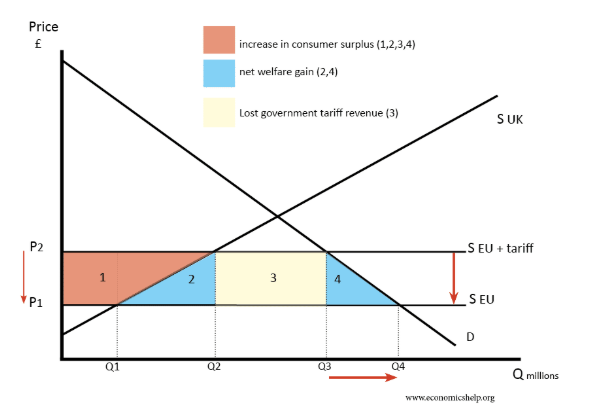
Tariff diagram
The removal of tariffs leads to lower prices for consumers (Prices fall from P1 to P2)
This fall in prices enables an increase in consumer surplus of areas 1 + 2 + 3 + 4
Imports will increase from Q3-Q2 to Q4-Q1
The government will lose tax revenue of area 3. Tax revenue from imports was T (P1-P2) × (Q3-Q2)
Domestic firms producing this good will sell less and lose producer surplus equal to area 1
However, overall there will be an increase in economic welfare of 2+4 (1+2+3+4 – (1+3)
The magnitude of this increase depends upon the elasticity of supply and demand. If demand elastic consumers will have a big increase in welfare
Essentially, removing tariffs leads to lower prices for consumers – so the price of imported food, clothes and computers will be lower. When the UK joined the EEC – the price of many imports from Europe fell.
Tariffs
A tax placed by the government on imports
They raise the price for consumers, lead to a decline in imports, and can lead to retaliation by other countries
Analysis of tariffs benefits (Domestically)
Tariffs may be imposed to protect the domestic industry from cheap imports, by increasing the price of imports, tariffs encourage consumers to switch to domestic alternatives, allowing protected firms to increase their market share
Domestic output (aggregate demand) is likely to increase ( Y = C + I + G + (X-M) ), as imports fall due to it not being price-competitive for consumers
This may lead to the protection of jobs. This is because domestic firms face less competition due to lower demand for foreign goods, so as domestic goods demand increases, there is an increase in derived demand for labour. So firms may hire more workers or avoid redundancies. This leads to lower cyclical unemployment in protected industries as there is increased business confidence and potential stabilisation of employment in declining sectors
Tariffs can help developing economies by protecting infant industries that are not yet able to compete with established foreign firms. As output increases, firms can exploit economies of scale, lowering their long-run average costs and improving efficiency over time. This may allow them to become internationally competitive, supporting industrialisation and export diversification. The expansion of domestic industries also increases the derived demand for labour, helping to reduce unemployment and shift the economy away from reliance on primary sector production, contributing to long-term economic development
Evaluation of Tariffs (domestically - Retailiation)
Tariffs can trigger retaliation from other countries, which significantly reduces their effectiveness as a protectionist policy. While domestic firms may initially benefit from reduced foreign competition, these gains are often short-lived. Retaliatory tariffs imposed by trading partners make exports more expensive and less competitive, harming domestic firms that rely on international markets. In addition, many firms depend on imported raw materials and components, so tariffs can increase production costs and reduce overall efficiency. As a result, the long-term impact on domestic businesses is often negative, particularly in economies that are highly integrated into global trade.
The effects are even more severe for developing countries and the wider global economy. Developing nations, which often depend heavily on exports, are especially vulnerable to reduced market access and falling export revenues, limiting their economic growth and development. On a global scale, retaliation leads to reduced trade flows, higher prices for consumers, and increased economic uncertainty, which can discourage investment. Although tariffs may be justified in protecting strategic industries, the risk of retaliation typically results in a net welfare loss, making economies less efficient and slowing overall growth.
Evaluation of Tariffs (domestically - Elasticity of demand)
The extent to which tariffs affect prices largely depends on the price elasticity of demand for imports. If demand is price inelastic, firms are able to pass most of the tariff onto consumers in the form of higher prices, as consumers are relatively unresponsive to price changes. This increases revenue for domestic firms competing with imports, as foreign goods become less competitive. However, if demand is price elastic and firms have sufficient profit margins, exporters may absorb some of the tariff to remain competitive, reducing the burden on consumers. Despite this, in most cases consumers bear a significant proportion of the tariff, meaning domestic firms may still face higher input costs (the costs a firm pays for the resources it uses to produce goods or services) if they rely on imported materials, limiting the overall benefit of protection.
For developing economies and the global economy, elasticity plays a key role in determining the scale of impact. Developing countries that export goods with elastic demand are particularly vulnerable, as tariffs will lead to a large fall in quantity demanded, significantly reducing export revenues and economic growth. On a wider scale, if tariffs are largely passed onto consumers, this contributes to inflation and reduces real incomes, lowering overall demand in the economy. While some domestic industries may gain from reduced foreign competition, the combination of higher prices, reduced trade volumes, and inefficiencies means that tariffs—especially when demand is elastic—are likely to result in a net welfare loss for the global economy.