Week 5 & 6: Cardiovascular System (inc. practical)
0.0(0)
Studied by 4 people View linked note
 Call Kai
 Learn
Learn Practice Test
 Spaced Repetition
 Match
Match Flashcards
 Knowt Play
Card Sorting
1/13

Earn XP
Description and Tags
Last updated 5:45 PM on 5/22/22
Name | Mastery | Learn | Test | Matching | Spaced | Call with Kai |
|---|
No analytics yet
Send a link to your students to track their progress
14 Terms
1
New cards
At rest, the heart rate is most affected by which of the following? 1.Circulating epinephrine
2.Parasympathetic (vagal) nervous innervation
3.Sympathetic nervous system
2.Parasympathetic (vagal) nervous innervation
3.Sympathetic nervous system
Parasympathetic (vagal) nervous innervation. At rest, the vagal effect predominates (vagal tone), and the heart beats more slowly than it would in the absence of any autonomic activity
2
New cards
During moderate exercise, the heart rate is most affected by which of the following?
1.Decreased levels of circulating epinephrine
2.Increased parasympathetic (vagal) nervous innervation
3.Increased sympathetic nervous innervation
1.Decreased levels of circulating epinephrine
2.Increased parasympathetic (vagal) nervous innervation
3.Increased sympathetic nervous innervation
Increased sympathetic nervous innervation. During exercise, vagal activity diminishes and sympathetic activity increases
3
New cards
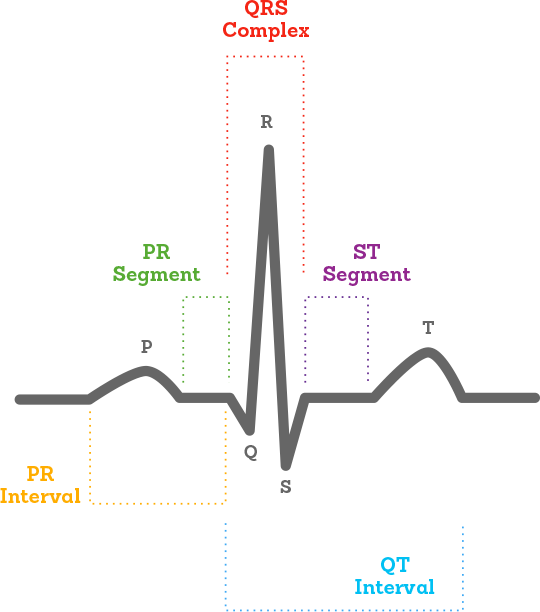
The RR interval is the time elapsed between two successive R-waves of the QRS signal. How did the RR interval and the heart rate change during exercise?
1.RR interval decreases, heart rate decreases
2.RR interval decreases, heart rate increases
3.RR interval increases, heart rate decreases
4.RR interval increases, heart rate increases
1.RR interval decreases, heart rate decreases
2.RR interval decreases, heart rate increases
3.RR interval increases, heart rate decreases
4.RR interval increases, heart rate increases
RR interval decreases, heart rate increases
4
New cards
Which of the following is altered the most in conditions where heart rate is increased?
1.PR interval
2.QRS interval
3.T wave duration
4.TP segment
1.PR interval
2.QRS interval
3.T wave duration
4.TP segment
TP segment. Tg segment is altered most when HR is increased. A decreased TP segment reflects a decreased ventricular filling time, which occurs when the HR is increased.
5
New cards
Which component of the electrical conduction system is the "pacemaker"?
1.AV node
2.Bundle of His
3.Purkinje fibers
4.SA node
1.AV node
2.Bundle of His
3.Purkinje fibers
4.SA node
SA node. The SA node generates cardiac APs at a greater frequency than other cardiac muscle cells
6
New cards
What does an ECG measure?
1.An individual cardiac action potential.
2.Mechanical events in the heart.
3.The collective electrical activity of the heart.
4.The movement of the cardiac muscles.
1.An individual cardiac action potential.
2.Mechanical events in the heart.
3.The collective electrical activity of the heart.
4.The movement of the cardiac muscles.
The collective electrical activity of the heart.
7
New cards
Cause of an atrial flutter?
Type of abnormal heart rhythm, when the signal from the SA node travels rapidly in a continuous loop around the atria
8
New cards
How would these periods change during exercise?
P wave
PR interval
QRS complex
T wave
QT interval
P wave
PR interval
QRS complex
T wave
QT interval
During exercise, an increase in HR would correspond to a shorter cardiac cycle. the RR interval (time between 2 successive R waves) decreases. Most reduction happens at the TP interval (time between the T wave of 1 beat and the P wave of the next beat)
9
New cards
What are each of the lead's of the Einthoven's triangle?
Lead I: LA–RA
Lead II: LF–RA
Lead III: LF–LA
Lead II: LF–RA
Lead III: LF–LA
10
New cards
Which of the Einthoven's triangle lead is most closely aligned with the direction of ventricular depolarisation?
Lead II has the largest R wave, and also shows the P and T waves as positive.
11
New cards
Which region of the heart generates electrical activity the fastest?
SA node
12
New cards
Why is it important that there is slower conduction of the electrical signal through the AV node (and its extension, the bundle of His)?
1.The delay allows the atria to contract completely before ventricular contraction begins.
2.The delay allows the left atrium to contract completely before the right atrium starts to contract.
3.The delay gives time for the blood to travel from the ventricles to the atria.
1.The delay allows the atria to contract completely before ventricular contraction begins.
2.The delay allows the left atrium to contract completely before the right atrium starts to contract.
3.The delay gives time for the blood to travel from the ventricles to the atria.
The delay allows the atria to contract completely before ventricular contraction begins.
13
New cards
When a wave of depolarisation travels toward a positive electrode, how is this represented on an ECG tracing?
1.Downward from the baseline
2.No change from the baseline (horizontal)
3.Upward from the baseline
1.Downward from the baseline
2.No change from the baseline (horizontal)
3.Upward from the baseline
3.Upward from the baseline
14
New cards
When a wave of repolarization travels toward a negative electrode, how is this represented on an ECG tracing?
1.Downward from the baseline
2.No change from the baseline (horizontal)
3.Upward from the baseline
1.Downward from the baseline
2.No change from the baseline (horizontal)
3.Upward from the baseline
Downward from the baseline