PHGY 215 mod 1
 Call Kai
 Learn
Learn Practice Test
 Spaced Repetition
 Match
Match Flashcards
 Knowt Play
1/124

There's no tags or description
Looks like no tags are added yet.
Name | Mastery | Learn | Test | Matching | Spaced | Call with Kai | Chat |
|---|
No analytics yet
Send a link to your students to track their progress
125 Terms
Define homeostasis
Ability of a cell/organism to regulate + maintain its internal environment regardless of the influences of the external environment
Define set point
the range or point at which a physiological state tends to stabilize
optimal conditoin
3 components of homeostatic control + purpose of homeostatic control
components
sensor
integrator
effector
purpose
maintenance of a set point
describe the 3 components of homeostatic control
sensor: responsible for detecting environmental variable
integrator: compares the variable being detected to its set point
effector: the effector is responsible for initiating the changes to restore the variable back to the set point
2 types of homeostatic regulation
Intrinsic regulation (local/autoregulation)
extrinsic regulation
describe intrinsically controlled homeostasis
sensor, integrator, effector located within tissue
regulates own internal environment
describe extrinsically controlled homeostasis
regulatory mechanisms outside of tissue/organ
regulates / used more than intrinsic
describe negative feedback
used my majority of homeostatic control
change in environment → effector initiates response in opposite direction → restoring set point
how is blood glucose is regulated
Negative feedback
Homeostasis (concentration of glucose in blood is regulated to maximize its energy making potential)
Imbalance (after meal, blood glucose rise)
Response (insulin is released by the pancrease in response to high blood glucose levels)
Effect on tissue (insulin lowers blood glucose by increasing body cells ability to uptake glucose from blood)
Effect on liver (insulin also upregulates livers ability to convert glucose and store it as glycogen)
blood glucose
regulated variable
sensor
integrator
effector

example of one negative and one positive feedback
negative
blood glucose
positive
temperature
describe positive feedback
occurs when the effector causes changes that amplify the initial signal
not homeostatic
Describe one full example of positive feedback
body temperature
1. Brain stimulates the pituitary gland to secrete oxytocin
2. oxytocin is carried in the bloodstream to the uterus
3. Oxytocin stimulates uterine contractions which push the baby towards the cervix
4. The head of the baby pushes against the cervix
5. the nerve impulses from the cervix are transmitted to the brain

match

roles of the plasma membrane
regulating internal fluid composition (it controls what goes in and out of a cell)
allows nutrients to enter cells and allows waste products to leave
cell to cell communication
joins cells together to form tissues and organs
3 primary functions of the plasma membrane
Ensures the cells survival
Maintainb homeostasis
Function cooperatively + in coordination w/ surrounding cells
Different components of the plasma membrane
Phospholipids
Cholesterol
Membrane proteins
Ion channels
Carbohydrate chains
identify the components of a phospholipid
polar head
negatively charged phosphate group
2 non-polar fatty acid tails
Describe cholesterol role
tucked in between phospholipids
prevents fatty acid chains from packing too tightly together + forming rigid structures
keeps membrane fluid
Describe membrane proteins location
inserted into phospholipid membrane
associated w the inner side + outer side
can pass all the way through plasma membrane
describe membrane protein function
maintain cell structure
regulate cell function
allow transport across the cell membrane
facilitate signalling
Describe ion channels
span the entire lipid membrane
permits the entry/exit of ions
describe what carbohydrate chains attach to + what they can turn into
short chains of carbohydrate can attach to proteins or the bilayer forming glycoproteins / glycolipids
Function of carbohydrate chains
stabilizes membrane structure
acts as cell surface receptors
participate in transportation acorss the cell membrane
2 clinical disorders of the plasma membrane
Cystic fibrosis
Alzheimers disease
Describe cystic fibrosis
a defect in chloride ion channel
involved in controlling the amount of fluid and mucous within the lungs
patients experience a build up of fluid in the lungs making breathing difficult
Alzeimer’s disease
Results in oxidative stress
condition that leads to the alteration and degredation of phospholipids within neurons
reduction in phospholipids compromises membrane integrity → impacts neural function
results in membrane loss and reduced cognitive function
describe Fluid Mosaic Model
Fluid: Phospholipid bilayer is viscous; phospholipids can move laterally → membrane is fluid + flexible.
Mosaic: Proteins and other molecules are embedded throughout the lipid bilayer, creating a mosaic and carrying out various functions.
3 means in which cells adhere to each other
extracellular matrix
cell adhesion molecules
cell junctions
3 major protein fibers found in the ECM (interstitial fluid)
Collagen
Elastin
Fibronectin
Describe the ECM
network of fibrous protein s
surrounds all cells in tissues + keeps them in place
The majority of ECM is secreted by what?
fibroblasts located within the interstitial space
What are cell adhesion molecules (CAM)
Transmembrane proteins that help cells stick to other cells or the ECM
What do the intracellular and extracellular sides of cell adhesion molecules interact with?
Intracellular: cytoskeleton
Extracellular: other CAMs or ECM
What are the 4 main Cell Adhesion Molecules families?
Cadherins, selectins, NCAMs, integrins
What is the main function of desmosomes?
Strongly anchor adjacent cells together and provide mechanical strength/stretch.
What are desmosomes made of?
Plaques + cadherin-containing glycoprotein filaments that connect neighboring cells.
What do desmosomes connect to inside the cell?
Cytoskeletal proteins/filaments, forming a strong network through tissues.
What is the main function of tight junctions?
Form a tight seal between adjacent cells to prevent substances from passing between cells.
Where are tight junctions mainly found?
Epithelial tissues, where they create selective barriers between compartments.
What is a “kiss site”?
The point where junctional proteins from neighboring cells meet.
What forms a connexpn ( half a gap junction? )
six connexin protein subunits
what happens when connexons aligns with a connexon of an adjacent cell?
forms a tunnel that connects their intracellular spaces and allows them to communicat directly
what can pass through gap junctions?
small water soluble substances
How do cells communicate thorugh gap junctions?
Tunnels open and close as needed to control cell to cell comomunication
where are gap junctions common?
cardiac and smooth muscles
function of gap junctions
spread waves of excitation (electrical activity)
allows spread of secondary messengers between connected cells
“communication junctions”
define what it means for a membrane to be permeable
substance can freely corss the membrane
define what it means for a membrane to be impermeable
substance cannot corss the membrane
what is the permeability of a plasma membrane
semi permeable
some substance may pass freely
others cannot
factors which determine membrane permeability
size + solubility
describe how molecule size determines membrane permeasbility
small substances (ex. ions) → enter membrane through ion channels
larger substances (ex. glucose) → transport protein
describe how molecule solubility determines membrane permeability
lipophilic → easily cross
uncharged or nonpolar
Lipophobic → cannot pass unaided
charged or polar substances
passive transport examples
diffusion
facilitated diffusion
active transport examples
carrier mediated
vesicular transport
describe diffusion
molecules spread from areas of high density to areas of low density
down a concentration gradient
what is dynamic equilibirum
concentration gradient no longer exists
movement of substances are said to be in a steady state
no net movement
Diffusion in the presence of a permeable membrane
net diffusion pasively down its concentration gradient across the membrane until equilibrium has been achieved
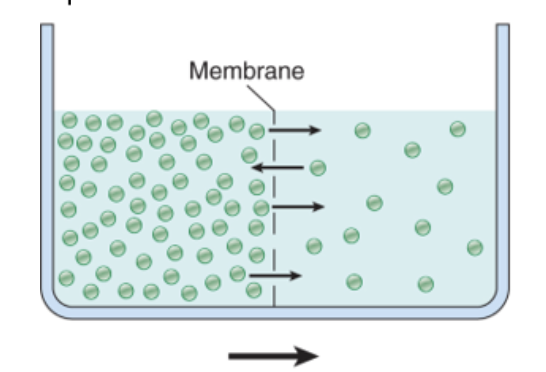
Diffusion in the presence of a impermeable membrane
no diffusion will occur
concentration gradient remains in place

what are aquaporins
specific membrane proteins
channels that allow water molecules to freely pass
what is osmosis?
net diffusion of water
water moving down its concentration gradient by diffusion

when does osmosis occur + finish
when a membrane seperates pure water from a solution of non-penetrating solute
finishes when both water and solute are equally distributed acorss the membrane

what is osmotic pressure + describe when its greater
underlying force that moves water down its concentration
greater the gradient → greater the osmotic pressure
Describe hydrostatic pressure + describe when its greater
force created by a given volume of water
greater the volume → greater the hydrostatic pressure
what happens when osmotic pressure is equal to net hydrostatic pressure
no net movement of water even though a concentration gradient still exists
how do large, lipophobic molecules cross the plasma membrane?
facilitated diffusion
carrier mediated transport
vesicular transport
what type of transport is carrier mediated transport
can be either facilitated diffusion or active transport
describe facilitated diffusion
does not require energy
uses a carrier to assist in the transport of a substance down its concentration gradient
identify and describe an Example of facilitated diffusion
transport of glucose into cells
glucose carrier proteins bind extracellular glucose and transports it into the cell
identify and describe an example of active transport
Na K ATPase pump
transports Na+ out of cell
brings K+ in to cell
Go into depth about carrier mediated transport: facilitated diffusion (4 steps)
binding site faces high concentration
solute binds
carrier changes shape → faces low concentration
solute released → carrier returns to original shape
High → low, no ATP
Go into depth about carrier mediated transport: facilitated diffusion: active transport
Inside: 3 Na⁺ bind → ATP phosphorylates pump.
Shape changes: 3 Na⁺ released outside.
Outside: 2 K⁺ bind → pump dephosphorylates.
Shape changes back: 2 K⁺ released inside.
Repeats: 3 Na⁺ OUT, 2 K⁺ IN, 1 ATP
key: na+ moves in , K+ moves out
both against their concentration gradients
3 characteristics of carrier mediated transport
Specificity: Carrier recognizes specific substances; related substances may share a transporter.
Saturation: Limited number of carriers → reaches a transport maximum (Tm).
Competition: Related substances using the same carrier compete → each cannot reach its individual Tm.
types of vesicular transport
exocytosis
endocytosis
3 classifications of endocytosis
pinocytosis
receptor mediated endocytosis
phagocytosis
Describe pinocytosis
cell membrane engulfs + internalizes a small drolet of extracellular fluid
How does the vesicle form during pinocytosis?
→ Coat proteins deform the inner plasma membrane
→ form an endocytic pouch
→ dynamin pinches it off
→ internalized vesicle forms.
what type of transport is pinocytosis
non-selective endocytosis
the vesicle will contain whatever substances were close to the membrane at the time
3 steps of pinocytosis
Solute molecules and water molecules are outside the plasma membrane
membrane pockets inward, enclosed solute molecule and water molecules
pocket pinches off as endocytic vesicle containing sample of ECF

3 stps of receptor mediated endocytosis
Substances attach to membrane receptors
membrane pockets inward
pocket pinches off as endocytic vesicle containing target molecule
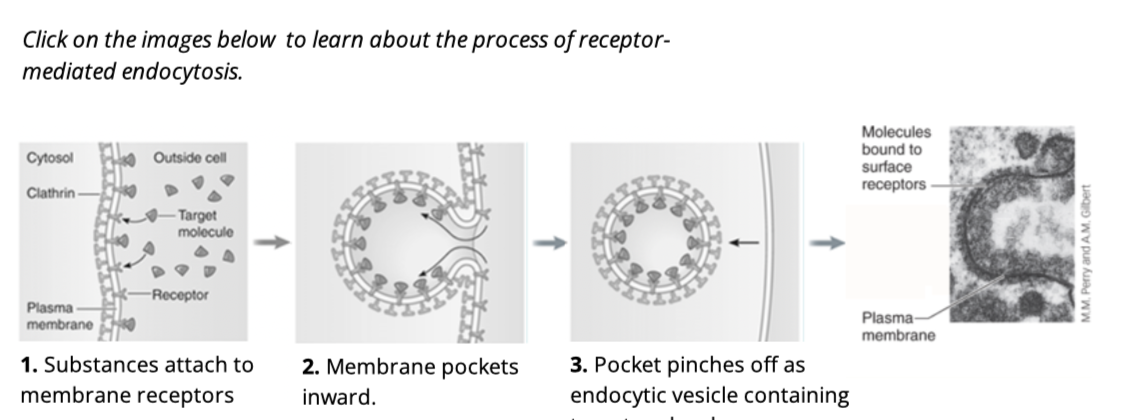
difference between receptor mediated endocytosis + pinocytosis
the trigger to create a vesicle is dependent upon the binding of a substance to a specific receptor on the cell surface
what does phagocytosis involve
The internalization of large multimolecular particles and only occurs in a few specialized cell types (ex. white blood cells)
Process of phagocytosis
Pseudopods begin to surround prey
pseudopods close around prey
prey is enclosed in endocytic vesicle that sinks into cytoplasm
lysosome fuses with vesicle, releasing enzymes that attack material inside vesicle

What uses exocytosis?
materials produced by endoplasmic reticulum + golgi complex, which are destined for the plasma membrane or beyond
what is the purpose of exocytosis
releases large polar molecules
enables a cell to move proteins (ex. carrier proteins, ion channels, receptors)
what happens when the vesicle membrane fuses with the plasma membrane?
any protein in the vesicle membrane becomes part of the plasma membrane
Summar steps of exocytosis
secretory vesicle formation
budding from golgi
uncoating
docking at plasma membrane
exocytosis
Exocytosis steps
→ Golgi sorting markers recognize proteins with the correct sorting signals
→ coatomer curves the membrane and forms a bud → bud pinches off
→ vesicle uncoats, exposing v-SNAREs
→ v-SNAREs bind matching t-SNAREs on the target plasma membrane
→ vesicle fuses and releases contents outside the cell.
what is an electrochemical gradient
a gradient that consists of an electrical and chemical gradient across a membrane
What is a membrane potential?
A difference in electrical charge across the plasma membrane caused by unequal distributions of cations (+) and anions (-)
Which cells use membrane potential?
excitable cells
neurons + muscle cells
What is Ohm’s Law in excitable cells?
V = IR
V = membrane potential (voltage)
I = ionic current (ion movement across membrane)
R = membrane resistance to ion movement
→ Higher V → higher I; higher R → lower I.
4 types of ion channels
Voltage-gated
chemically gated
mechanically gated
thermally gated
describe voltage-gated + steps
voltage gated ion channels open + close in response to changes in membrane potential
closed at resting potential
open in response to nerve impulse
inactivated for a brief period following activation
When do chemically gated channels open
open when a specific chemical messenger interacts w/ it
Where are chemically gated ion channels found?
Dendrites of neurons
when do mechanically gated ion channels open?
In response to mechanical deformations such as stretch
example of where mechanically gated ion channel is found
found in chcolea of the year
what do thermally gated ion channels respond to?
respond to changed in temperature
where are thermally gated ion channels present in?
specialized neurons that project to the skin to act as temperature detectors