IV Fluids
 Call Kai
 Learn
Learn Practice Test
 Spaced Repetition
 Match
Match Flashcards
 Knowt Play
1/19

There's no tags or description
Looks like no tags are added yet.
Name | Mastery | Learn | Test | Matching | Spaced | Call with Kai | Chat |
|---|
No analytics yet
Send a link to your students to track their progress
20 Terms
What are crystalloids?
Fluids that contains crystal-forming elements (electrolytes) that easily pass through vascular endothelial membrane barriers
What are colloids?
Fluids that contain both large
organic marcomolecules and
electrolytes
What is the composition of blood and blood products?
RBC's are similar to colloids
because they stay in vascular
space
What are types of isotonic crystalloids?
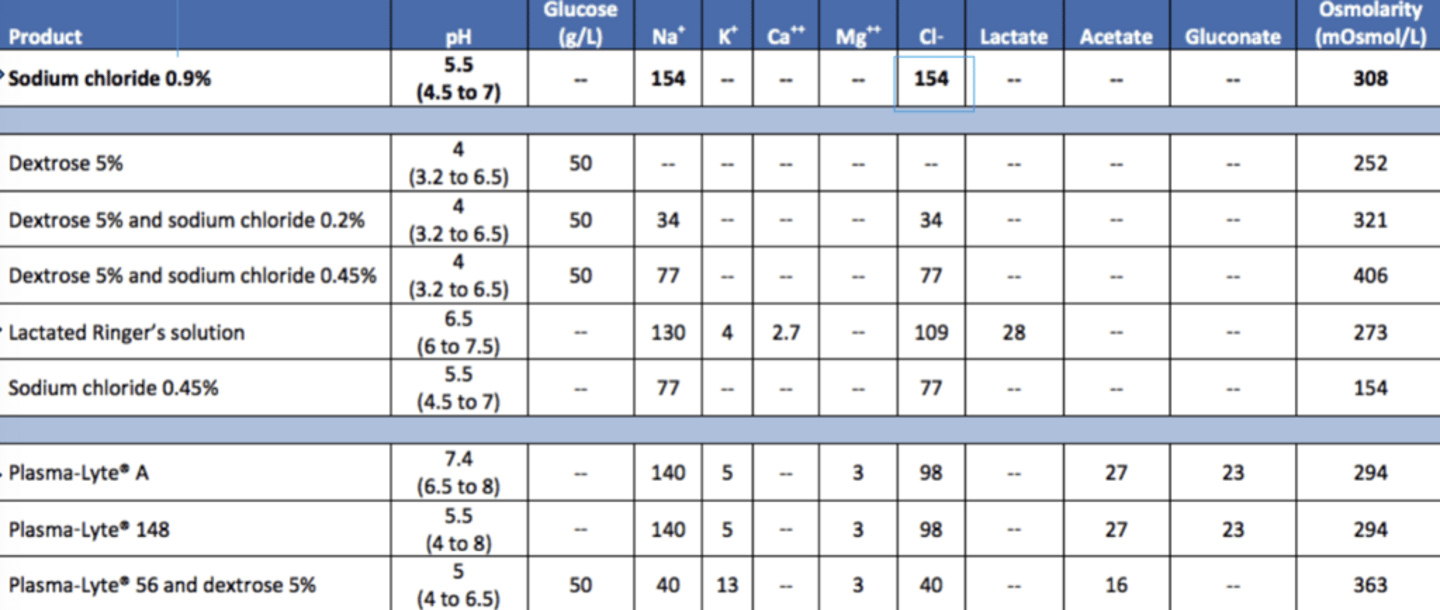
Normal Saline (0.9% NS), Lactated Ringer's (LR), and Plasma-Lyte
only ones will be given as a bolus
What is in Lactated Ringer's solution (LR)?
Lactate, K+, Ca2+, NaCl
What is in Plasma-Lyte?
contains less chloride and provides the most physiologic solution
When are isotonic crystalloids used?
treatment of dehydration and hypovolemia often given as IV boluses
Which type of fluid is preferred for large volume resuciation
balanced crystalloids like LR or Plasma-Lyte
What is a type of hypertonic crystalloid?
3% NS
When is 3% NS used?
life-threatening hyponatremia
What are the types of Hypotonic Crystalloids?
0.5 NS, 0.25 NS, and D5W (5% dextrose in water) and D5 1/2 NS
When are 0.5 NS and 0.25 used?
Maintenance fluids that distribute throughout the total body water
When is D5W used?
hypoglycemia, starvation ketosis, hypernatremia (free water deficit), caution with diabetes
What are the types of colloids?
5% or 25% albumin
When are colloids used?
Liver disease, peritonitis, burns, malnourishment, surgical patients experiencing "third spacing"
What is the infusion amount for a bolus?
250-1L at a time
What are the general recommendations for maintenance fluids?
75ml/hr → low need/high risk
100ml/hr → standard
125ml/hr → high need/low risk
When might potassium be added to maintenance IVF?
reat hypokalemia or for maintenance fluids if the patient is NPO; caution with LR/Plasma-Lyte or kidney disease
What is the normal urine output for post-op patients?
0.5 ml/kg/hr
What is the Parkland formula for burn patients?
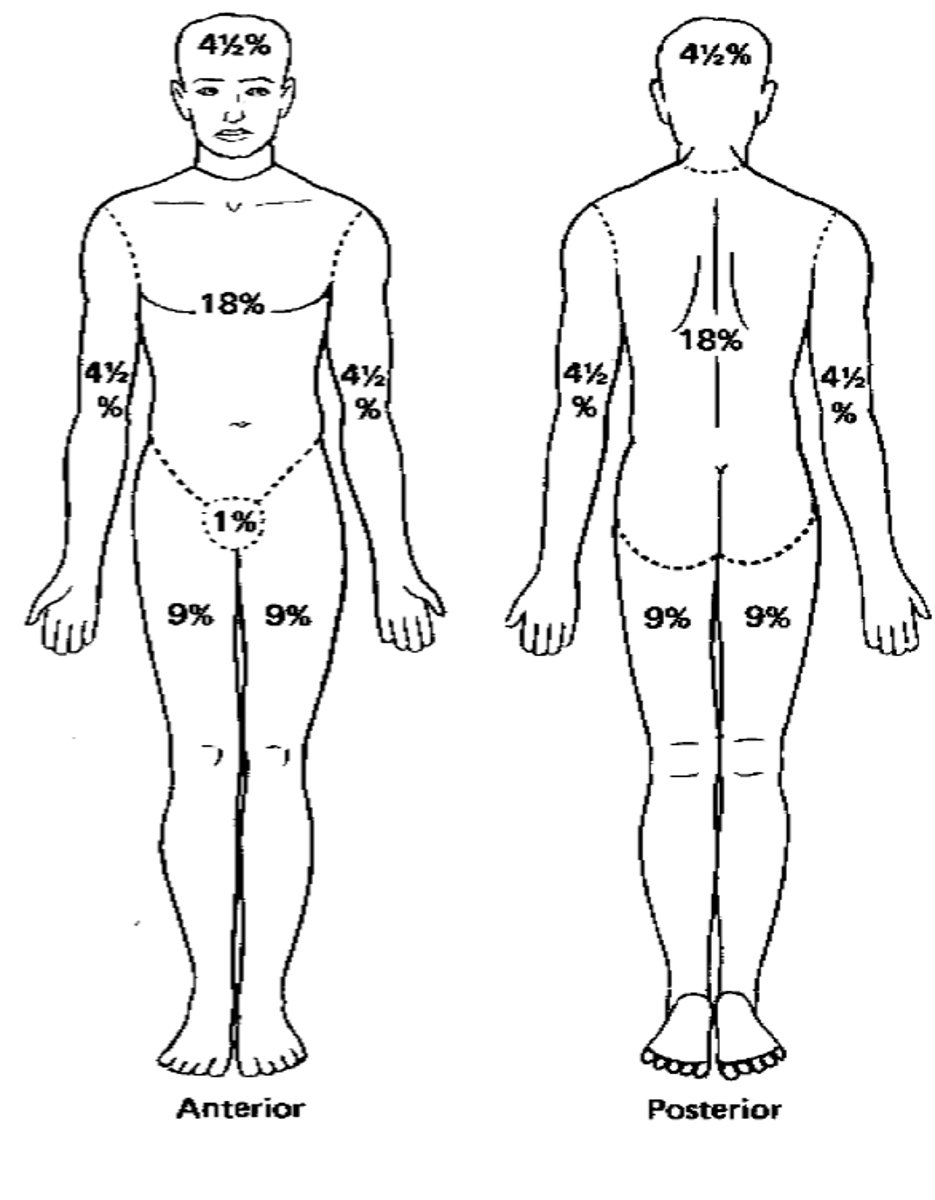
- (Percentage of 2nd & 3rd degree burns) x (body weight in kg) x 4 mL in the first 24hrs
- 1/2 in 1st 8 hours
- 1/4 in 2nd 8 hours
- 1/4 during 3rd 8 hours