Plants & Material Cycling Flashcards
 Call Kai
 Learn
Learn Practice Test
 Spaced Repetition
 Match
Match Flashcards
 Knowt Play
1/111

There's no tags or description
Looks like no tags are added yet.
Name | Mastery | Learn | Test | Matching | Spaced | Call with Kai | Chat |
|---|
No analytics yet
Send a link to your students to track their progress
112 Terms
Photosynthesis definition
Photosynthesis is a chemical reaction that takes place in chloroplasts in plant cells. Carbon dioxide and water react to produce glucose and oxygen.
The word equation for photosynthesis:
Carbon dioxide + water ——> glucose + oxygen
Chlorophyll role
Chlorophyll, found inside chloroplasts, absorbs sunlight energy for photosynthesis.
Where does the substance come from / how it is used:
Carbon dioxide
Water
Glucose
Oxygen
Carbon dioxide: Diffuses from air into leaves and then into leaf cells
Water: absorbed into roots from soil
Glucose: Used in respiration and some is converted into starch and stored in the leaves for fuel
Oxygen: diffuses out of leaf cells and out of leaves into the air
Tissues in a leaf with different adaptations
The upper epidermis has a waxy cuticle to prevent water loss
Palisade mesophyll tissue has leaf cells with many chloroplasts for photosynthesis
The spongy mesophyll tissue has air spaces for the diffusion of gases.
(cut-out text is mesophyll)
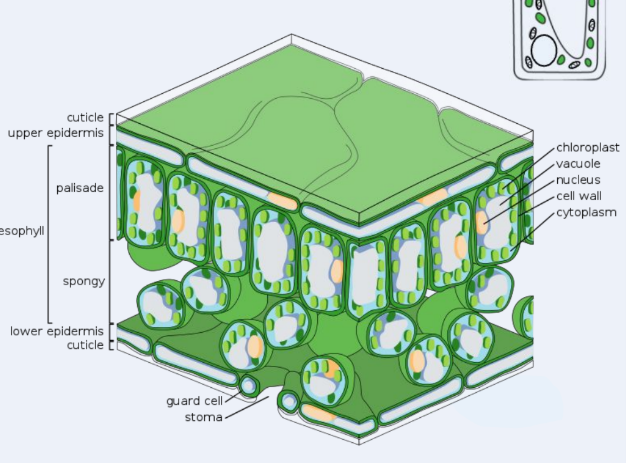
Gas exchange occurs through…
stomata
The stomata are opened and closed by…
guard cells
Photosynthesis happens in the … cells
palisade
Stomata are found on the … side of the leaf. Why?
bottom
To minimise water loss - not exposed to sunlight which would cause transpiration - while allowing efficient gas exchange for photosynthesis.
Active transport
the movement of substances from a low to high concentration, requiring energy from respiration
Active transport works against the concentration gradient
Active transport in root hair cells
Active transport is used in root hair cells to absorb mineral ions from the soil
Concentration of mineral ions in the soil is lower than inside the cell
Xylem definition
a type of tissue that forms vessels that transport water and minerals from the roots up the plant stem and into the leaves. They are hollow and strengthened with lignin.
Describe how the palisade mesophyll is adapted to its function.
Leaf cells contain many chloroplasts to carry out photosynthesis
Describe the function of the focussing wheels.
To move the stage to focus the image of the specimen
State a difference between the light microscope and the electron microscope.
Light microscope:
Visible light
Lower magnification
Lower resolution
Lower cost
Observe tissues and cells
Electron microscope:
Beam of electrons
Higher magnification
Higher resolution
Higher cost
Observe organelles in cells
Magnification equation

Transpiration definition
Transpiration is movement of water through a plant from where is absorbed at the roots to where it evaporates through stomata.
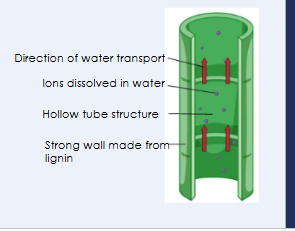
xylem structure
hollow for a fast upward flow and an unobstructed tube
Rate definition
Rate is the change in a quantity per unit time
Humidity definition
Humidity is the concentration of water vapour in the atmosphere
State the plant organs that make up the transpiration system
Roots, xylem and leaf (including stomata)
State the journey water takes from the soil, through the plant and out through the leaves
Soil 🡪 roots 🡪 xylem 🡪 spongy mesophyll 🡪 stomata 🡪 atmosphere
Explain how water moves through a plant
A continuous column of water is pulled up through the transpiration system as water is being lost to the atmosphere through stomata
Explain the effect of increasing temperature on the rate of transpiration
Increasing temperature increases the rate of transpiration
higher evaporation rate
An increase in temperature increases evaporation, so the rate of diffusion of water from inside the leaf to outside increases
State the effect of decreasing humidity on the rate of transpiration
Decreasing humidity increases the rate of transpiration
A decrease in humidity reduces the concentration of water molecules outside the leaf, so the rate of diffusion of water from inside the leaf to outside increases
State the effect of decreasing the amount of wind on the rate of transpiration
Decreasing the amount of wind decreases the rate of transpiration:
allows a thicker boundary layer of humid air to form around the leaf: acts as a barrier to water vapour diffusion
State the effect of increasing the light intensity on the rate of transpiration
Increasing the light intensity increases the rate of transpiration:
An increase in light intensity generally increases the number of open stomata, so the rate of diffusion of water from inside the leaf to outside increases
Explain how the action of guard cells can control transpiration
Guard cells change shape to open or close stomata. Water is lost through stomata during transpiration which means that the action of guard cells can control transpiration
A … shows the rate of transpiration
potometer
Explain how wind affects the rate of transpiration.
Wind increases the rate of transpiration
Because more wind moves water vapour away more quickly, so there is a greater concentration gradient and a greater rate of diffusion of water vapour out of the leaf
Explain how temperature affects the rate of transpiration.
Temperature increases the rate of transpiration
Because a higher temperature means that more particles have enough energy to evaporate from the leaf
Explain how humidity affects the rate of transpiration.
Humidity decreases the rate of transpiration
Because more humidity means there is a smaller concentration gradient and a lower rate of diffusion of water vapour out of the leaf
Explain how light intensity affects the rate of transpiration.
An increase in light intensity generally increases the number of open stomata, so the rate of diffusion of water from inside the leaf to outside increases
Describe how mineral ions and water are transported around a plant.
Mineral ions are absorbed into root hair cells from soil by active transport.
Water is absorbed into root hair cells from soil by osmosis.
Mineral ions dissolved in water are transported from roots through xylem vessels to the leaf.
As water evaporates through stomata the continuous column of water if pulled up so water and minerals can be transported around the plant.
What is lignin?
A molecule found in plants that strengthens xylem vessels.
Describe the transport of water through a plant from the soil to water vapour in the atmosphere.
Water enters xylem vessels - hollow tubes strengthened with lignin- after being absorbed into root hair cells from soil, by osmosis
Water is transported upwards through the xylem vessels because of the ‘pull’ from above caused by evaporation from leaves
water then moves into the spongy mesophyll cells where it is evaporated into the air spaces within the leaf
the water vapour in the leaf air spaces diffuses out of the leaf into the atmosphere through the stomata.
Compare the processes of boiling and evaporation.
Boiling and evaporation are similar because they both involve the change of state of water from a liquid to a gas.
However, boiling occurs in a liquid when particles have sufficient energy to overcome the forces between them whereas evaporation happens at the surface of a liquid as it boils.
Evaporation can occur over a large range of temperatures whereas boiling only happens at the boiling point.
Suggest why stomatal density is much lower in plants from hotter climates.
In hotter climates water evaporates at a greater rate. To prevent water from being lost there are less stomata which means that there is less opportunity for water vapour to diffuse out.
Define diffusion.
The movement of particles from a high concentration to a low concentration.
Describe the function of mitochondria.
To carry out aerobic respiration to release energy for the cell
Translocation definition
Translocation is the movement of dissolved sugars/food molecules to where they are needed through phloem tissue
Phloem definition
Phloem is a tissue that forms vessels to transport dissolved sugars and other nutrient molecules around the plant.
Substances in solution can be transported in both directions
adaptations of a phloem ves=el
Elongated cells
Pores in end walls
Hollow tube-like vessel to transport solution long distances. Pores to allow liquid to flow through in both directions.
describe difference between transpiration & translocation
Transpiration transports water and minerals whereas translocation transports dissolved sugars and nutrient molecules
Transpiration happens through xylem tissue where as translocation happens through phloem tissue
Transpiration only transports in one direction from roots to leaf whereas translocation transports dissolved sugars and nutrient molecules in both directions depending on where it is needed.
State where sugar molecules are produced in a plant
Sugar molecules are produced as glucose during photosynthesis which is carried out in the leaves.
Xylem adaptations
Hollow tube structure: allows water to flow with minimal resistance
Strong wall made from lignin: helps plant stand upright
Compare the structure of xylem and phloem.
Both form vessels, or tube-like structures with a hollow interior
Xylem vessels are hollow tubes strengthened with lignin, whereas phloem vessels have end walls containing pores
Compare the function of xylem and phloem.
Both transport solutions around a plant
Transpiration transports water and minerals whereas translocation transports dissolved sugars and nutrient molecules
Transpiration happens through xylem tissue whereas translocation happens through phloem tissue
Transpiration only transports in one direction from roots to leaf whereas translocation transports dissolved sugars and nutrient molecules in both directions depending on where it is needed.
Chlorophyll definition
A green pigment used to convert sunlight energy into chemical energy through the process of photosynthesis.
Photosynthesis definition
Photosynthesis is an endothermic reaction that requires light and takes place in chloroplasts in plant cells.
Uses of glucose
Reactant in respiration: essential because it releases energy for life processes
Storage as starch (e.g. in leaves or tubers)
Storage as oils/fats (e.g. in seeds)
Synthesis of cellulose for strengthening cell walls
Produce amino acids for protein synthesis. This requires nitrate ions from soil
Define synthesis.
Synthesis is producing a compound by a chemical reaction of simpler substances.
glucose chemical formula
C6 H12 O6
Testing a leaf for starch using iodine
Explain what this result for the starch test shows about photosynthesis.
Put the leaf in boiling water for 1 min
Transfer the leaf to boiling tube containing ethanol for 5 min
Dip the leaf in hot water.
Spread the leaf on a white tile.
Test with iodine solution.
If starch is present, the iodine will turn from orange to blue-black
Iodine has turned black in the areas where starch is present
This means that photosynthesis is happening in these areas because the product of glucose is stored as starch.
Explain how a leaf is well adapted to carrying out photosynthesis
A leaf has a large surface area to absorb light because light is required for photosynthesis.
A leaf has contains palisade cells which are packed with chloroplasts that carry out photosynthesis.
A leaf contains stomata and spongy mesophyll which means that gas exchange can happen. This means that the palisade mesophyll can obtain carbon dioxide which is a reactant of photosynthesis.
A leaf contains access to xylem vessels which means that the palisade mesophyll can obtain water which is a reactant of photosynthesis.
explain how genetic mutation could causes unique leaf patterns
Mutations can be random changes in the DNA code that may cause a new phenotype, such a unique leaf pattern.
State how to calculate the total magnification of a light microscope
Total magnification = Objective lens mag. x eyepiece lens mag
Describe how to focus the image seen in the eyepiece lens
Use the lowest magnification objective lens then place the lens close to the slide and move the stage downwards by turning coarse focussing wheel and then the fine focussing wheel until the image is clear
Describe what the stomatal density tells you about a leaf
The (average) number of stomata in a particular area
preparing the specimen method
Paint a thin, even layer of clear nail varnish on the under surface of one part of the leaf
When dry, stick a small piece of clear tape over the nail varnish
Peel the clear tape off gently
Stick the clear tape on a glass slide. Ensure it is smooth with no folds.
Use the microscope to observe the stomata
Once focussed, count the number of stomata seen in the frame. Only include those fully visible in the frame.
Describe how to observe a sample under a microscope.
Place the slide on the stage underneath the clips.
Use the lowest magnification objective lens to start.
Use the coarse focusing wheel to move the stage close to the objective lens.
Whilst looking in the eye piece lens, rotate the coarse focusing wheel away from you so the stage slowly moves down.
Rotate the fine focusing wheel to sharpen the image.
Change the objective lens to change the magnification.
label
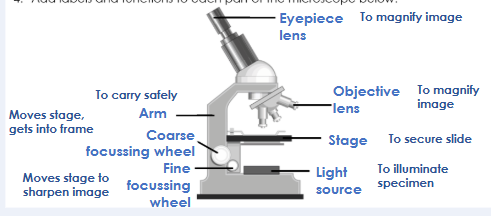
explain why there might be differences in stomatal density in different areas of a leaf
Stomatal density could be greater where xylem are positioned to make transpiration efficient.
Stomatal density could be greater where there are more palisade cells because more carbon dioxide is needed for photosynthesis.
Which axis does the independent variable go on?
X axis
Which axis does the dependent variable go on?
Y axis
Explain what is meant by the gradient of a graph.
The steepness of the line.
SI of time
Seconds (s)
Name the piece of equipment used to measure time.
Stopwatch, stopclock, clock
Bar charts and pie charts are used if the independent variable is…
categoric
Line graphs are used if both the independent variable and dependent variable are…
continuous
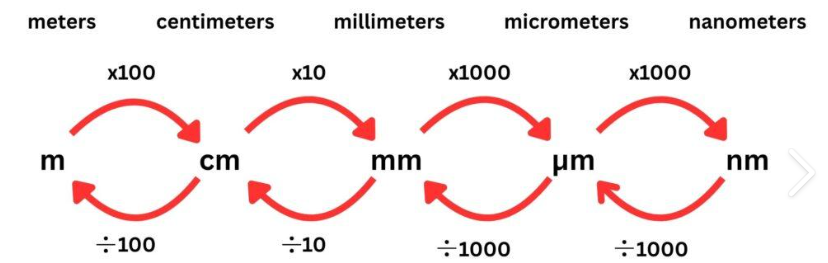
centimeters to next three units
The further from the light source…
the greater the area the same light intensity acts over
what does inverse square law mean
the intensity decreases with distance
limiting factor definition
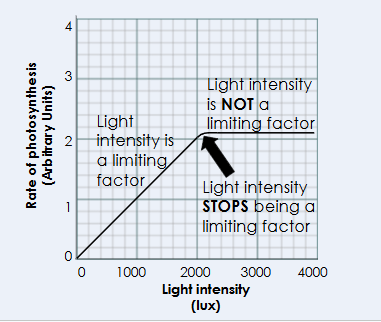
A limiting factor is a variable in the environment that when in limited supply stops the maximum rate of a process.
Limiting factors of the rate of photosynthesis are:
Carbon dioxide concentration
Light intensity
The amount of chlorophyll
Temperature
Graphs show limiting factors of photosynthesis – light intensity
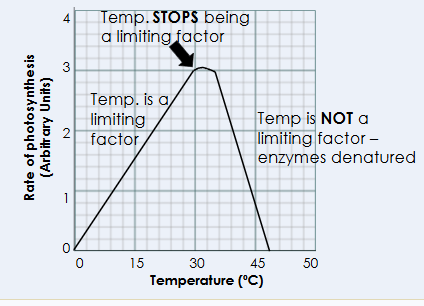
Graphs show limiting factors of photosynthesis – temperature
Photosynthesis is an enzyme-controlled reaction
Using greenhouses to maximise photosynthesis
Greenhouses are used by farmers to grow crops
Need the maximum rate of photosynthesis to grow more crops
Profit is the money gained when a product is sold for more than it cost to produce
Limiting factors are important in the economics of enhancing the conditions in greenhouses to gain the maximum rate of photosynthesis while still maintaining profit.
What would happen if we could keep increasing the carbon dioxide concentration and the light intensity, whilst providing the optimum temperature for photosynthetic enzymes?
The rate of photosynthesis would be limited by the amount of chlorophyll in the plant.
Between 1500 lux and 5000 lux, the photosynthesis rate increases proportionally. Explain why.
Light is required for photosynthesis to be carried out. A greater light intensity causes a greater photosynthesis rate.
light intensity unit
lux
define ‘rate of photosynthesis’
How much photosynthesis happens per unit time.
e.g. bubbles of oxygen per minute
State which substances can be synthesised from glucose.
Cellulose, amino acids, starch, fats
Tobacco Mosaic Virus
a viral disease of plants that causes a distinct ‘mosaic’ pattern of discolouration on leaves.
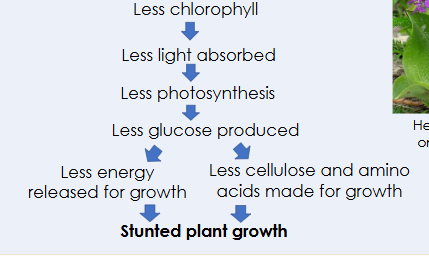
Rose black spot
Rose black spot is a fungal disease where purple/black spots form on leaves.
This means that leaves cannot absorb light for photosynthesis, so the plant has stunted growth
The fungus that causes rose black spot is spread by water and by wind
Fungicides are used to treat
Plant diseases can be detected by:
stunted growth
spots or discolouration on leaves
areas of decay
abnormal growths
the presence of pests.
Identification of the exact disease can be made by:
reference to a gardening manual or website
identifying microorganisms in a laboratory
using testing kits that contain monoclonal antibodies
Plant defences
Chemical defences: such as poison and antibacterial chemicals
Physical defences: prevent microorganisms from entering the plant so they don’t cause infection, eg. protective waxy cuticle on leaves which prevents microorganisms from entering. Each plant cell is surrounded by a strong cellulose cell wall which is another barrier to stop microorganism from entering the cell.
Mechanical defences: prevent herbivores & insects from eating plants, rather than preventing entry of microorganism. e.g. some plants have thorns, some have hairs that act as a deterrent, some have leaves that curl/droop
Explain why a tomato plant infected with tobacco mosaic virus has stunted growth
Cells infected with TMV do not produce as much chlorophyll.
Chlorophyll is required to absorb the light needed to carry out photosynthesis, therefore less photosynthesis is carried out in infected plants.
This means that there is less glucose made so less energy is released to grow.
Glucose is also used to synthesise cellulose and amino acids, which are both needed to build new cells. So with less glucose being produced there are less of the building blocks needed for growth.
Write the word equation for aerobic respiration.
Glucose + oxygen 🡪 carbon dioxide + water
decay definition
Decay is the breakdown of larger substances into smaller building blocks.
Decomposers
Decomposers are organisms that carry out decay using enzymes
Microorganisms, such as some bacteria and fungi, are decomposers
Importance of decay in an ecosystem
Decay is essential for the cycling of substances in an ecosystem
Many different substances cycle through the biotic and abiotic parts of an ecosystem
Mineral ions are returned to the soil
Carbon dioxide is released as decomposers respire
factor meaning
A factor is something that has an effect.
Biotic factors
Biotic factors are living parts of the environment that can affect the community.
Biotic factors include predators, availability of food (prey or producers), competition and disease.
Abiotic Factors
Abiotic factors are non-living parts of the environment that affect the community.
This includes all the environmental things that make up the non-living parts of an ecosystem.
Abiotic factors include water availability, sunlight, wind, pH, temperature and availability of carbon dioxide and oxygen.
Explain why material cycling is important.
Substances such as nitrates and carbon are released through material cycling
These substances allow the growth of new organisms
Explain the role of microorganisms in decay.
Decomposers, such as bacteria and fungi, are essential in decay because they break down dead organisms using enzymes.
Explain the importance of decay in an ecosystem.
When decomposers, such as bacteria and fungi, carry out decay, they break down dead organisms.
This means that the large molecules that make up an organism are broken down into smaller molecules.
This is important because materials such as nitrate ions and carbon must be cycled in an ecosystem to support the growth of new organisms.
The rate of decay is…
The rate of decay is a measure of how much decay occurs per unit time.