Lec 6: Circadian Rhythm
 Studied by 0 people
 Call Kai
 Learn
Learn Practice Test
 Spaced Repetition
 Match
Match Flashcards
 Knowt Play
1/26

There's no tags or description
Looks like no tags are added yet.
Name | Mastery | Learn | Test | Matching | Spaced | Call with Kai |
|---|
No analytics yet
Send a link to your students to track their progress
27 Terms
Circadian Rhythms
Biological processes that follow a roughly 24-hour cycle
Found in bacteria, protoza, plants, fungi, animals
In humans have circadian rhythms of behavior, alertness, mood, and body temp, hormone levels
They are endogenous
Continue even when environment is constant, not just when it changes
Fruit fly experiment
Gene called period/per on X chromosome shows 24 hr cycle
transcribed mostly early in night, mRNA most abundant ~10 pm
protein product PER most abundant 6 hrs later ~4 am
PER (Period) Protein
PER represses transcription of per
When PER is high, less per mRNA that will eventually become PER is transcribed
So it inhibits own gene's transcription
PER and its mRNA drive each others cycling through transcription-translation feedback loop/TTFL
Timeless gene IN FLYS (tim)
A protein that binds to PER, participating in the feedback loop that regulates circadian rhythms
tim mRNA and TIM oscillate like to per and PER
relationship of TIM and PER IN FLYS
TIM binds PER → dimer PER/TIM repress transcription of tim and per
~4 am (6 hours after mRNA abundancy) high levels of PER/TIM shut off per and tim
= PER/TIM levels falling
= No more repression of per and tim
= per and tim levels rise in late evening
= another peak in PER/TIM next morning at 4 am
Missing either PER/TIM will result in no oscillation
So they oscillate in a 24hr rhythm
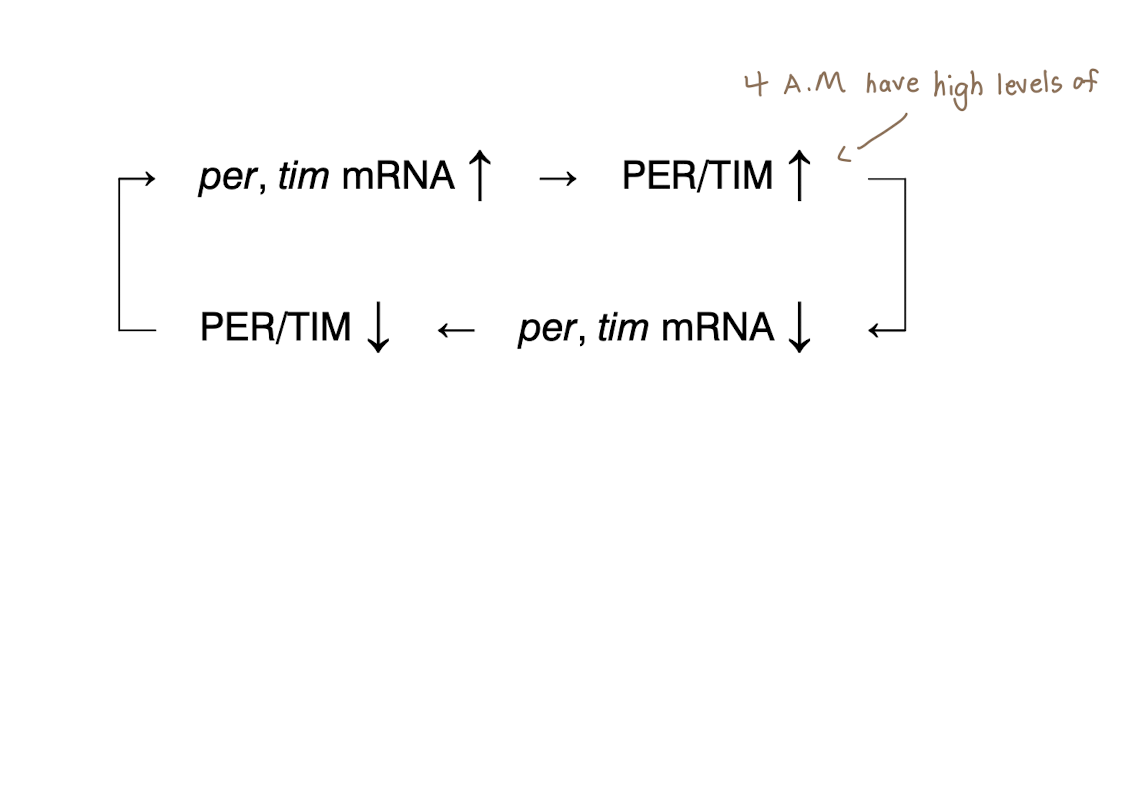
PER/TIM block (+) transc. factors (CLK, CYC)
Clock/clk gene codes protein CLK, cycle/cyc gene codes CYC
In day, dimer CLK-CYC binds DNA & stimulates per and tim transcription
In night, PER/TIME blocks CLK-CYC bound to DNA = per, tim repression
dbt lengthens FLY cycle
dbt lengthens the per/tim cycle
DBT from gene doubletime/dbt binds PER causing it to break down
PER levels rise slower = do not peak until 6 hrs after per = overall cycle length near 24 hrs
TTFL (Transcription-Translation Feedback Loop)
A biochemical mechanism in which gene expression is regulated by the proteins it produces, modulating circadian rhythms.
Mammalian homolog of TTFL
We have similar gene to per but instead of PER forming dimmer with TIM, we have CRY from cry gene
Mammalian homologs of clk, cyc,dbt are clk, cmal1, ck1e
In mice and other mammals CLK/BMAL1 dimer (same thing as CLK/CYC in flies) stimulates transcription of per and cry when not blocked by PER/CRY
CK1e (same thing as DBT) slow rise of PER protien levels
Synchronization of cellular clocks
Kept in sync by many external factors (ex. light, temp, feeding, exercie, social interactions = zeitgeber cues)
Main zeitgeber “time giver”, is light sensed by melanopsin retinal ganglion cells that project to master clock
Master clock
Suprachiasmatic nucleus (SCN) of hypothalamus
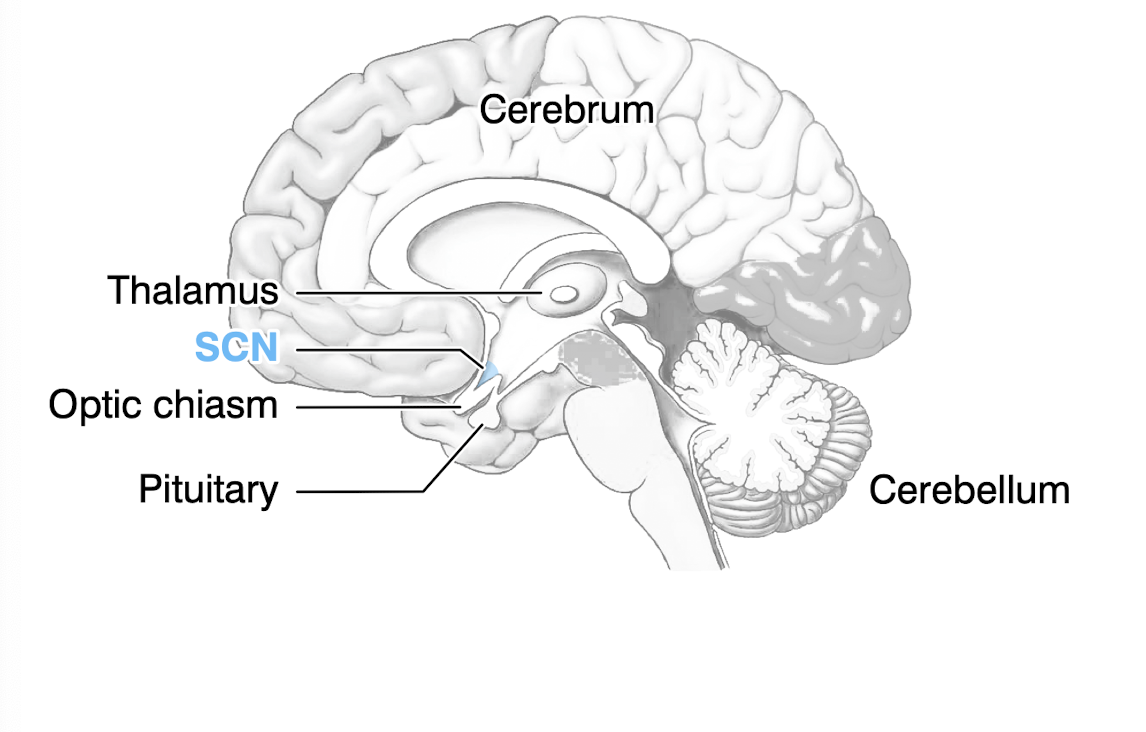
The Suprachiasmatic nucleus (SCN) of hypothalamus
SIts abv the optic chiasm
“Master clock”
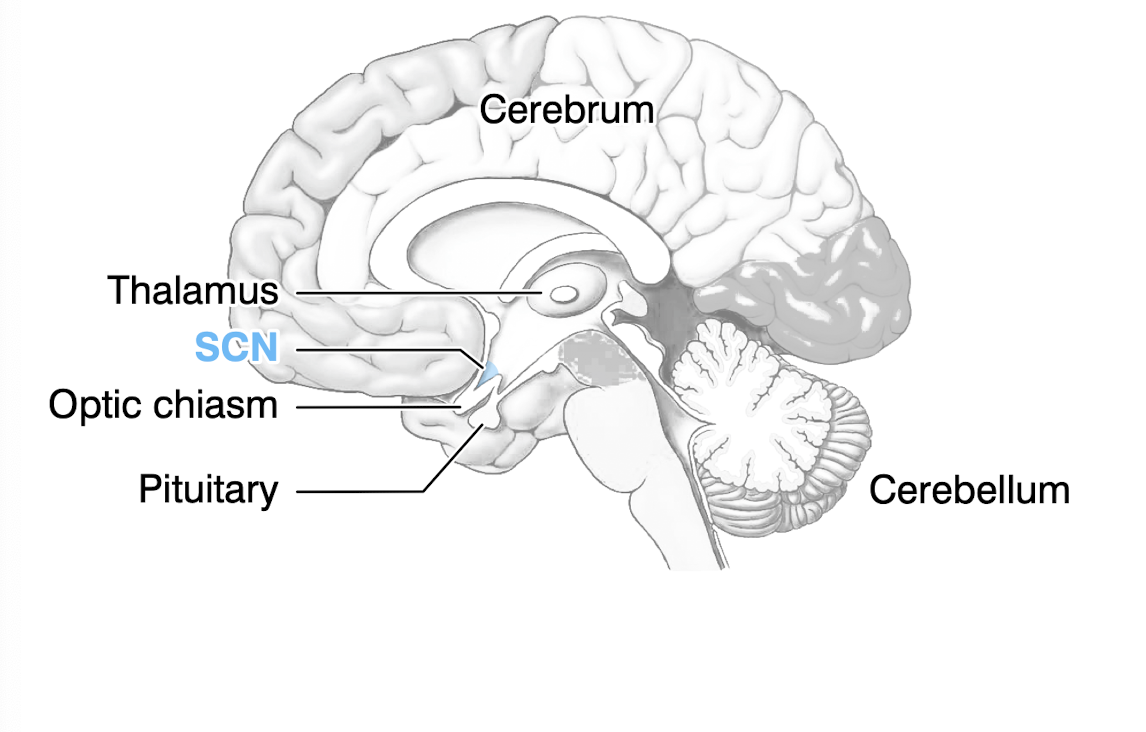
SCN and light
Retinal signals cause chemical changes in SCN cells → PER/CRY breakdown
If drop in PER/CRY after 4 am… (PER/CRY levels fall) → clock set fwd b/c of accelerated breakdown of PER/CRY b/c protein levels are lower than supposed to be
if drop in PER/CRY happen in evening…. (PER/CRY levels rise) → set clock back
SCN, light, dark
SCN neurons that receive retinal projections send these signals to other neurons in SCN so all clocks are adjusted, neural signals pass to other brain areas that send neural/hormonal signals all over body
Entrainment = process of making clocks around body all in synchrony
Darkness; Pineal body
Pineal body is in back of diencephalon
Secretes darkness hormone “melatonin”
starts at dusk, blood levels rise 8-fold peaking at 2 am, fall back to daylight levels by 8 am
Melatonin acts via melatonin receptors in SCN to reset master clock toward night time
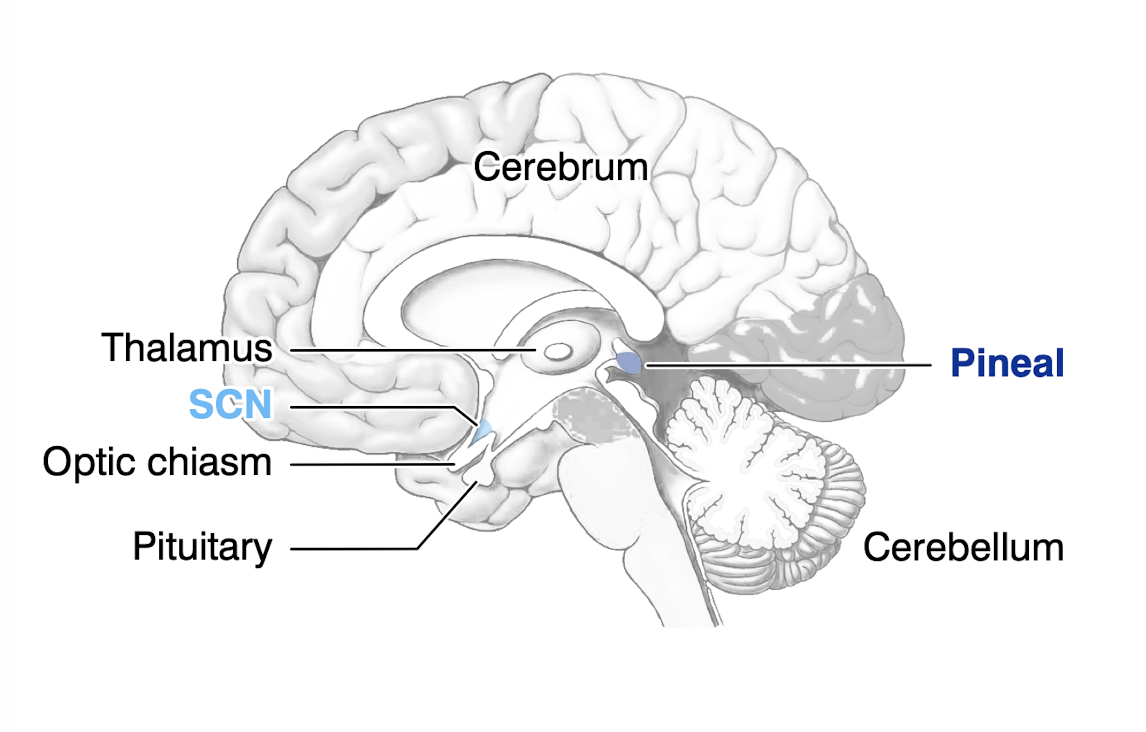
Melatonin pills
During jet lag, SCN master clock adjusts itself gradually to new schedule of light/dark by only 1 hr per day
take the pill at the time u want to go to bed but using the clock of the place you’re used to
Diurnal vs Nocturnal animals
Diurnal: active during day
Nocturnal: active during night
Chronotypes
sleep @ diff times throughout day-night cycle
likely evolved for safety of herd
Sleepiness and master clock
Daylight
SCN indirectly excite neuron in laternal hypothalamus so release orexin
Darkness
other cells in LH active, project throughout brain releasing neuropeptide melanin-concentrating hormone (MCH) → sleep inducing
Orexin and MCH inhibit each other
Sleep pressure
The physiological drive to sleep that builds up during wakefulness and decreases during sleep.
Awake
breakdown of ATP in brain cause adenosine build up → sleepy (as long as awake, adenosine level build = sleep pressure)
Asleep
ATP level restored, adenosine level fall
Adenosine
A neuromodulator that accumulates during wakefulness and promotes sleepiness.
Orexin
A neuropeptide involved in regulating wakefulness and arousal; its loss can lead to narcolepsy.
Melatonin
A hormone secreted by the pineal gland that helps regulate sleep-wake cycles; its levels rise in darkness.
Caffeine
A stimulant that blocks adenosine receptors, temporarily reducing feelings of sleepiness.
Blocks adenosine receptors but doesn’t lower adenosine levels
So… when caffeine wears off we crash
Has half-life of 6 hrs:
Blood level is 1/2 in 6 h
1/4 in 12 h
1/8 in 18 h
4 stages of sleep
rapid-eye movement (REM)
non-REM (split into 3 stages); 3 is deep NREM
REM sleep
A sleep stage marked by rapid eye movements, dreaming, and increased brain activity.
eyes move
dream
erratic 30-40 hz brain waves
muscle tone vanishes so no acting out in dreams
only birds and mammals have
First REM stage occurs after about 90 min, as night progresses sleep gets shallower and REM stages longer
Non-REM (NREM) sleep
A stage of sleep characterized by slow brain waves and the absence of dreams.
dreamless
slower brain waves
3 stages
stage 3 is deep NREM with regular 2-4 hz brain waves
 Note
Note  Flashcards (25)