Bioenegetics Forces
 Call Kai
 Learn
Learn Practice Test
 Spaced Repetition
 Match
Match Flashcards
 Knowt Play
1/25

There's no tags or description
Looks like no tags are added yet.
Name | Mastery | Learn | Test | Matching | Spaced | Call with Kai | Chat |
|---|
No analytics yet
Send a link to your students to track their progress
26 Terms
What is Force?
Effect that one object has on another
A push or pull exerted by one object on another object
Required to change the state of motion of an object
Causes Object to accelerate
Force (cause) → Acceleration (effect)
F=ma
F= force; m= mass of the object; a= acceleration
Force Units
Units: Newton (N)
1N =amount of force needed to accelerate a 1kg object by 1 m/s2
Weight is a force, has to be in N
weight = mass x gravity (gravity = -9.81 m/s2
Characteristics of force
Force is a vector quantity
both magnitude (size) and direction (orientation)
Magnitude of vector
size of the push or pull (longer mag = greater force/vector)
Direction of vector
Line of action: which way a force is pushing/pulling
point of application of a vector
Where the push/pull is applied on the object Scalar
Scalar
A quantity that is defined by its size/magnitude
ex: mass, time, speed, distance, temp,etc
Just magnitude no direction
Vector
A quantity that is defined by its size/magnitutide AND direction
Represented as arrows: length= size/magnitude, pointing= direction
ex: velocity, acceleration, “force,” etc
Distance
How much ground an object has covered (Scalar)
Displacement
Overall change in position (Vector)
consider start position & end position
Speed
How fast SCALAR
Velocity
The rate at which an object changes position VECTOR
ex: 65mph, North
Internal force
Act within the object or system ( human body)
Hold the object together
ex; muscle tension,ligament tension, bone compression (external forces become greater)
External Forces
Act on an object as a result of interaction with enviornment
Contact forces: occur from objects coming into contact (ground reaction force, friction force)
Non-contact forces: occur even if objects are not in contact (gravity, magnetic, electrical)
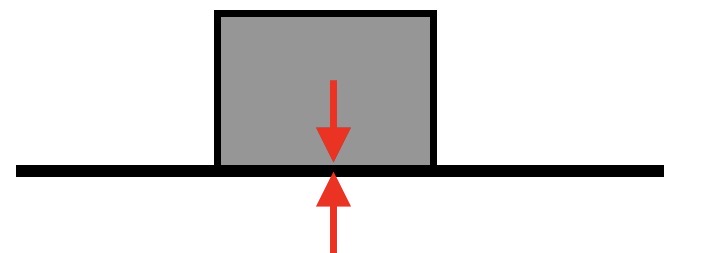
Normal contact Force
Perpendicular to the two objects in contact

Parallel (tangential) contact force
Parallel to contacting surfaces of two objects
Friction force formula
F= uR
F= friction force
u= coefficient of friction
R= normal contact force
Non-Contact Forces: forces that occur even if objects are not in
contact
• Weight – force of gravity acting on an object
• W = mg
• W = weight in newtons
• m = mass in kilograms (kg)
• g = acceleration due to gravity = 9.81 m/s2 downward
Net Force?
sum of all external forces acting on one object, also called
resultant force
• Not simply summing all external force magnitudes
− Must account for the direction of each force
• What is the effect of two 100N forces on an object?
− Depends on the specified direction of the two forces
Vector Composition
The process of determining a single vector (force) from two or more vectors
(forces) by vector addition
• Finding the resultant vector or net vector
Resultant vector
a single vector that represents the combined effect of two or
more vectors
Vector Resolution
• The process of breaking a single vector into two or more component vectors
• Typically, a vector is resolved into horizontal (x-axis) and vertical (y-axis) components
• Ex) a force of 10N at 30° above the horizontal
• Fx = 10cos30°
• Fy = 10sin30°
Head-Tail method
Rearrange to link head and tail
Colinear Vectors
Two or more vectors that have the same line of action
− Vectors are acting “parallel” to each other
Simply sum up the values to get the magnitude of the resultant vector
Concurrent Vectors
Vectors that do not act along the same line of action