Marine Communities Exam 1
 Call Kai
 Learn
Learn Practice Test
 Spaced Repetition
 Match
Match Flashcards
 Knowt Play
1/58

Earn XP
Description and Tags
study guides from slides + additional notes.
Name | Mastery | Learn | Test | Matching | Spaced | Call with Kai | Chat |
|---|
No analytics yet
Send a link to your students to track their progress
59 Terms
Study Guide for Lecture 1
•Know steps of scientific method in order.
•Understand basic experimental design. Be able to identify controls and design an experiment.
•Be able to differentiate good vs. bad hypotheses
•Differentiate between common use of the term theory and scientific theory
•Differentiate science from pseudoscience
•Describe each of the vertical and horizontal divisions of both the benthic and pelagic zones of the ocean, giving their boundaries and basic characteristics.
Earth’s surface is 71% dominated by ____?
oceans
What industries are based on marine organisms? What ecological services are provided?
Fisheries, tourism, pharmaceuticals.
Hurricane buffers, water filtration, carbon sinks
What are the steps in order of the scientific method?
Make an observation
Ask a question
Develop a hypothesis (needs to be testable and you can get data from it)
Experimental Design
Good experimental design pairs…
field experiments with lab experiments
T/F Every study is flawed.
True
T/F Science can prove.
False. “Science never proves.”
What are the 3 R’s of experimental design?
Randomisation: the random allocation of treatments to the experimental units. Randomize to avoid confounding between treatment effects and other unknown effects.
Replication: the repetition of a treatment within an experiment allows: To quantify the natural variation between experimental units. To increase accuracy of estimated effects.
Reduce noise: by controlling as much as possible the conditions in the experiment. A classical example is the grouping of similar experimental units in blocks. Using known characteristics/properties of the experimental units to explain variation, for example inclusion of block effects in the statistical model.
A non-falsifiable hypothesis is called ____.
pseudoscience
Our everyday usage of the word theory is analogous to the scientific term ____.
hypothesis
What is the order of oceans from largest to smallest?
Pacific, Atlantic, Indian, Arctic, Southern
Review thermohaline circulation

Why is Europe not as cold as Canada?
Gulf current of warm water
_____ is
• broad, low sloping (1:500 grade) platform at the margins of continents
• Extends from a few km (California) to 400 km (Newfoundland); mean ~ 200 km
• ~ 8% of the total ocean but very productive
Continental Shelf
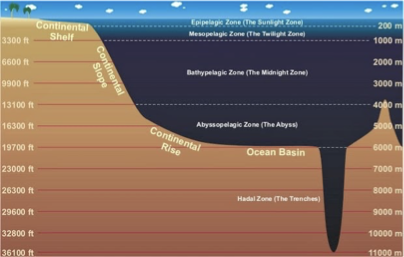
_____
• extends from shelf to deep sea
• grade is 1:20
•may be dissected by submarine canyons
Continental Slope
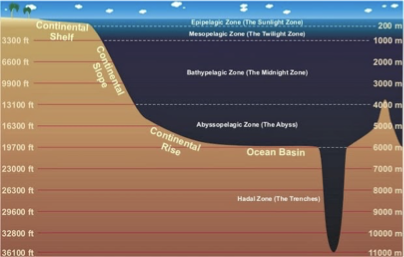
______ is
• flat, featureless plain of deep ocean
• most of ocean floor is abyssal in depth
• most common habitat on earth
Abyssal Plain
Can canyons have turbidity flows?
yes
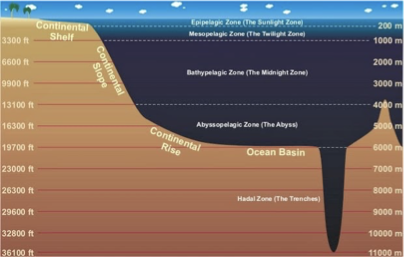
Know the order of the zones.
Epipelagic (sunlight zone)
Mesopelagic (twilight zone)
Bathypelagic (midnight zone)
Abyssopelagic (the abyss)
Hadal (the trenches)

Study Guide for Lecture 2
Explain how temperature and salinity can alter sea water density. What causes variation in salinity?
Define and explain halocline, thermocline, pycnocline. Be able to interpret depth profiles.
Explain differences in seasonality of stratification between tropical, polar, and temperate waters. How does latitude, formation or dissolution of sea ice, and river input affect salinity?
Why do water bodies stratify, and why is it ecologically important? How does stratification frequency vary with latitude?
Graphically indicate the distribution of temperature, water density, salinity, oxygen, and nutrient availability across a thermocline.
Where are hypoxia/anoxia more common – surface waters or deeper waters? Why? Why is hypoxia more common in the summer in temperate zones? What is a dead zone, what causes it, and why are they so hard to contain? In addition to anthropogenic addition of fertilizers that increases phytoplankton blooms, what natural processes help to make the Gulf Hypoxic Zone?
Describe how convergence zones, salinity, surface currents, and upwellings all contribute to thermohaline circulation of water through all of the world’s ocean basins.
Where are upwelling zones common and what effects do they have on coastal ecosystems?
Upwelling
Continental shelf
global conveyer belt
salinity
Interface with changing temperature
thermocline
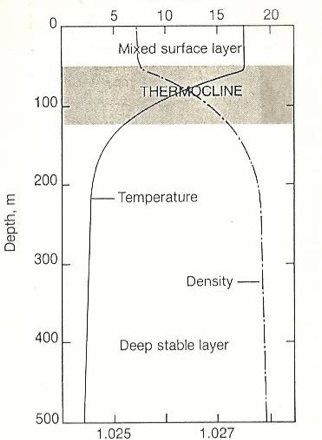
Because fresh water “floats” on top of denser, saltier water, a ____ is generated when fresh water is released on surface by
melting sea ice
large river input
(interface with changing salinity)
halocline
Interface with changing density
Pycnocline. Where you have a thermocline you’ll have a pycnocline. Where you have a halocline you’ll have a pycnocline.
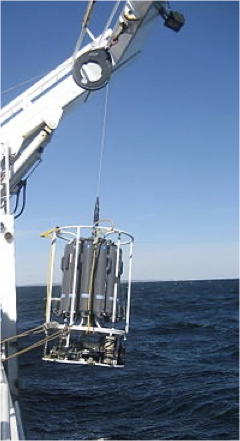
________ use electrolyte properties to measure conductivity, temperature, and depth from ships. Cl, Na (about 85% Na and Cl), S, Mg, Ca, K are the most common elements.
CTD probe
Normal Ocean seawater is 35 ____
ppt (parts per thousand)
parts per thousand / one way salinity is measured
0/00
separation. 3 water layers form.
stratification
O2 minimum zone
Low dissolved oxygen in water
hypoxic zone
Some seas are always hypoxic on bottom; some only during stratification; some never. Becoming more common with increasing levels of nutrient pollution.
Northern Gulf of Mexico Hypoxic Zone is largest studied.
Coriolis effect
trade winds
gyre
thermohaline circulation
rip currents
What controls salinity?
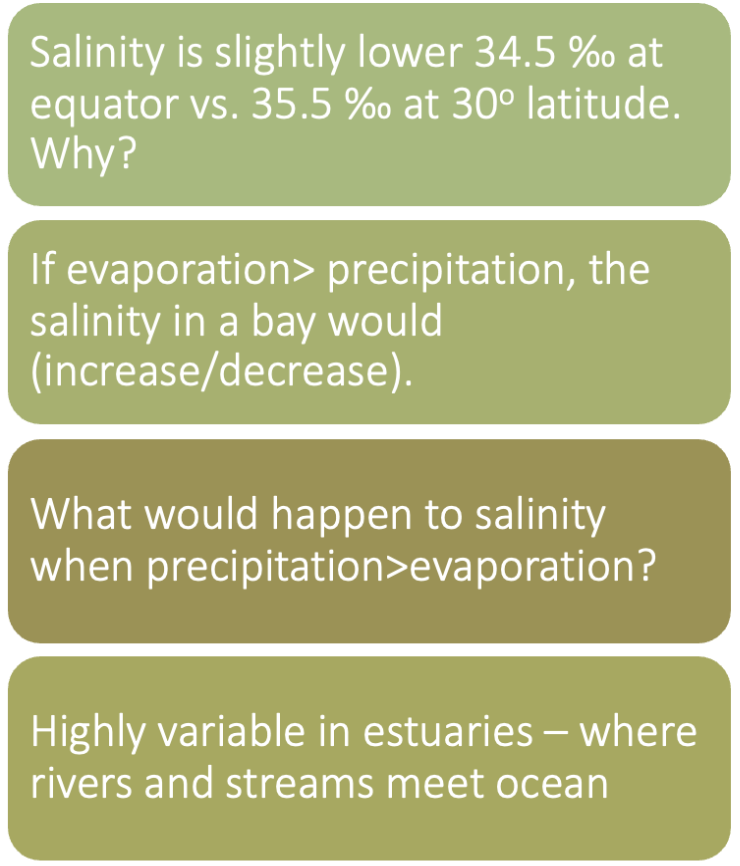
If evaporation > precipitation, the salinity in a bay would…
increase
Where rivers and streams meet the ocean. Salinity is ___ than 35 parts per thousand?
estuaries
lower
Normal ocean seawater is __ parts per thousand
35
When ice forms, salinity of surrounding water goes….
up
Salt is not incorporated into ice crystals. When sea ice melts, fresh water is released and salinity of surrounding water goes down.
Water density __ with increasing salt content and salty, heavy water sinks
increases
In surface waters, evaporation ___ salinity. Rainfall and runoff from rivers ___ it.
increases
decreases
Bottom water and sediments are often ___ in salinity and less variable than surface waters (bottom water is more stable)
higher
T/F Surface layer of water is mixed by the wind.
True. Mixed layer
In shallow temperate bays, continental shelf or temperate open ocean, stratification starts in ____ and ends in ___ with increased wind and lower temps.
spring
fall
surface mixing is limited to __-__ m
20-40
Tropical oceans mixed by warm temp and winds to about 100-500 m, stratification is nearly ____
permanent
When stratified density (and/or temp and salinity) varies with depth, density differences prevent ____ ____?
vertical mixing
Does stratification influence distribution of plankton and chemical factors?
Yes
T/F Surface waters of the open ocean are often nutrient starved
true
Deeper water will have less _________ (light limited), higher _____ (more free nutrients)
photosynthesis
decomposition
Concentration of oxygen is ___ in deeper waters.
less
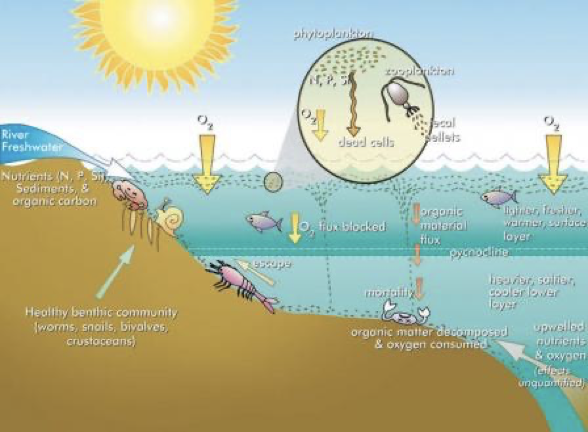
Stratified, no mechanism to replenish bottom-water oxygen
Bacterial demand for oxygen for cellular respiration is high (organic matter from surface sinks and is decomposed), reducing oxygen content
Sediment surface; on the sea floor
benthic
Which season would have the most benthic hypoxia?
Summer; more strongly stratified water column; increased decomposition (microbes metabolic rates ramping up, respiration rates ramping up, and consuming more oxygen)
In a stratified body of water, dissolved oxygen levels will be
higher above the pycnocline. High dissolved oxygen on the surface can be due to photosynthesis, diffusion from the air. There is more respiration below the pycnocline and uses more oxygen.

Do algal blooms stay at the surface?
No, they sink below the pycnocline and decompose. Extra nutrients cause algal blooms, but the algae sinks. More organic material to decompose, which uses up more oxygen and causes hypoxia.
Know the steps in this diagram.
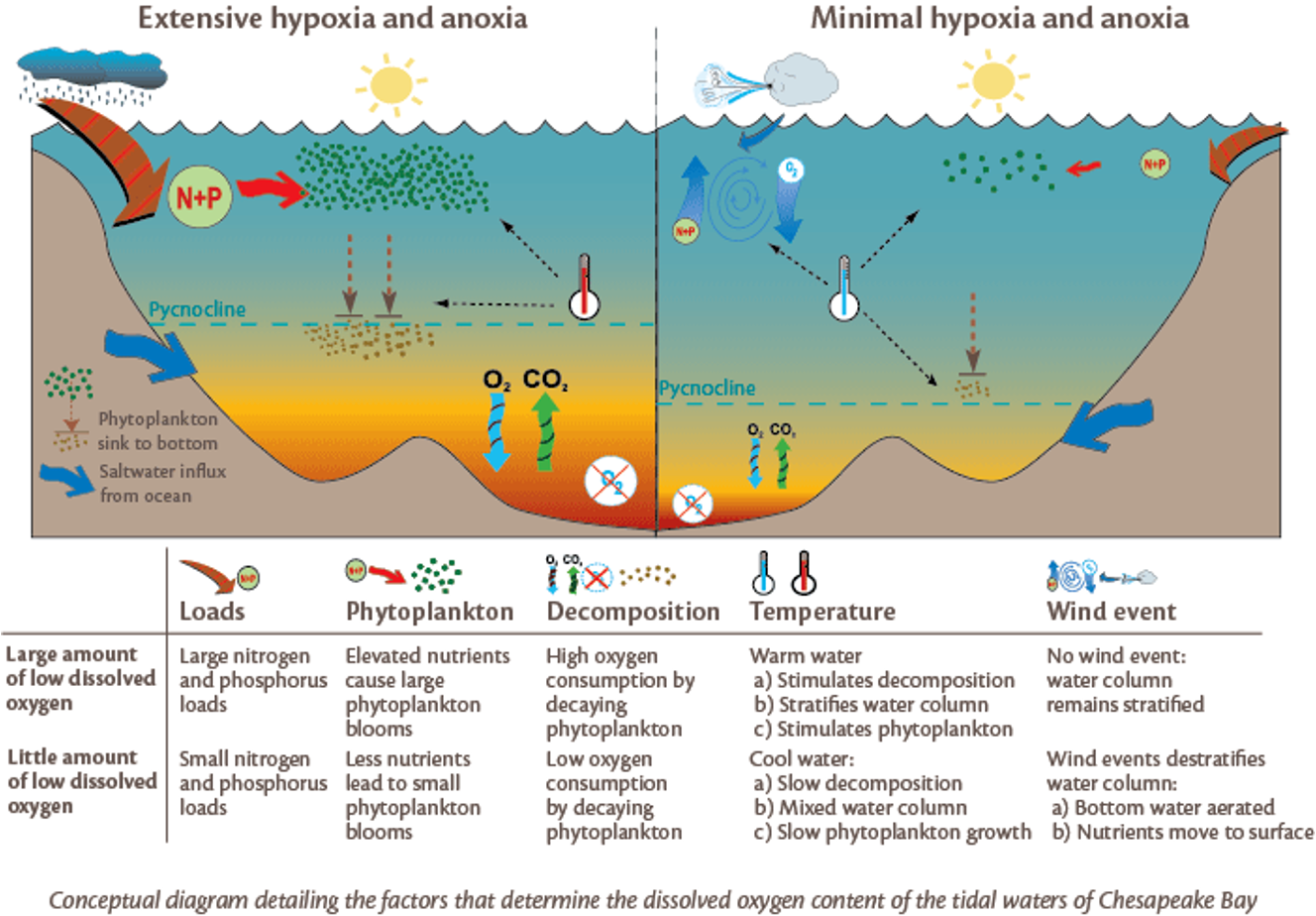
What can mix the water column?
Hurricanes/tropical storms