Classification of Living Things
 Studied by 0 people
 Call Kai
 Learn
Learn Practice Test
 Spaced Repetition
 Match
Match Flashcards
 Knowt Play
1/25

There's no tags or description
Looks like no tags are added yet.
Name | Mastery | Learn | Test | Matching | Spaced |
|---|
No study sessions yet.
26 Terms
Four main characteristics to classify organisms
1) number of cells - unicellular or multicellular
2) presence of nucleus - prokaryote or eukaryote
3) how energy is obtained - autotroph or heterotroph
4) mode of reproduction - sexual or asexual
Eight levels of classification
Domain, Kingdom, Phylum, Class, Order, Family, Genus, Species
Autotrophs
Organisms that can make their food, usually through photosynthesis or other chemical processes
Heterotrophs
Organisms that cannot make their own food, so they attain energy by consuming others.
The three domains
Eukarya, Archaea, Eubacteria
Eukarya
The domain that all eukaryotes are classified under
Archaea
The domain that all Archaebacteria are classified under
Eubacteria
The domain that all other bacteria are classified under
The six kingdoms
Bacteria, Archaebacteria, Protista, Fungi, Plantae, and Animalia.
Animalia
Multicellular
Eukaryotic
Heterotrophs
Sexually reproduce (some asexual, sea anemones)
Most animals can move from one place to another
Dogs, cats, fleas, and sea coral
Plantae
Multicellular
Eukaryotes
Autotrophs, in a few cases (venus flytrap) are heterotrophs
Some plants produce flowers while others don’t
Can reproduce sexually or asexually
Grass, trees, vegetable plants, weeds
Fungi
Eukaryotes
Many are multicellular, some unicellular
All Heterotrophs - feeding on dead or decaying organisms
Almost everywhere on land, some in water
Can reproduce sexually or asexually
Protista
Eukaryotes
Some unicellular, some multicellular
Some autotrophs, others are heterotrophs (some can photosynthesize)
Microscopic - Amoeba, Paramecium, and Euglena
Can reproduce sexually or asexually
Bacteria
Unicellular
Prokaryotes
Some are helpful or harmful (disease or gut bacteria)
Some are autotrophs, others heterotrophs
Asexual
Live in moderate environments
Archaebacteria
Unicellular
Prokaryotes
Extreme environments - volcanic vents, arctic temperatures, and hot springs
Can be autotrophic or heterotrophic
Asexual
Halophiles, thermophiles, and methanogens
Binomial Nomenclature
formal system of naming species with two parts: genus and species
dent
tooth
bi
2
rubra
red
alba
white
saccharum
sugar
cyano
blue
nigrum
black
helia
sun
quadra
4
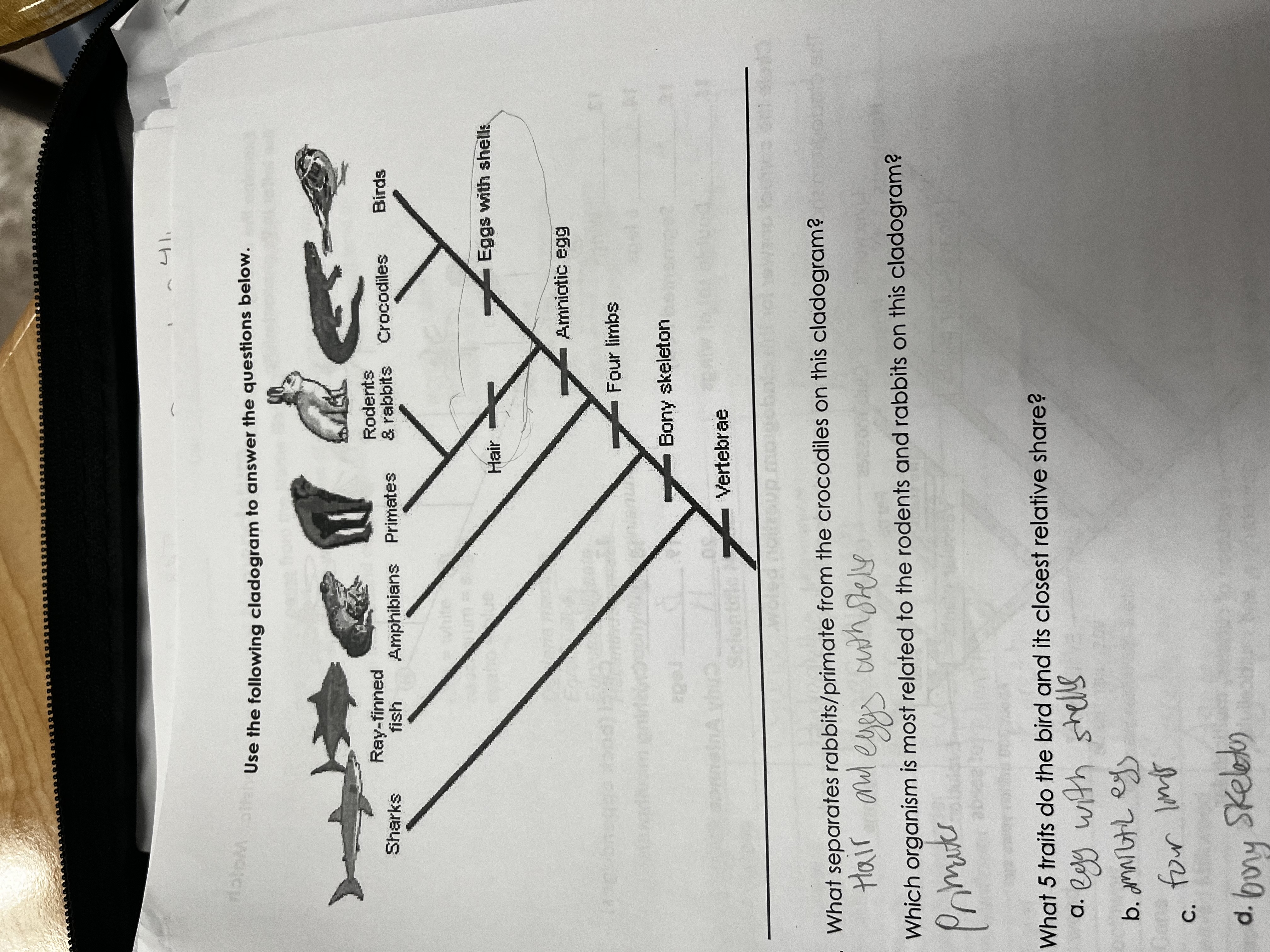
cladogram
branching diagram that illustrates the evolutionary relationships among organisms based on shared characteristics