1. Hydrology info
 Call Kai
 Learn
Learn Practice Test
 Spaced Repetition
 Match
Match Flashcards
 Knowt Play
1/16

There's no tags or description
Looks like no tags are added yet.
Name | Mastery | Learn | Test | Matching | Spaced | Call with Kai | Chat |
|---|
No analytics yet
Send a link to your students to track their progress
17 Terms
Phreatic zone vs Vadose zone
Phreatic = permanantely saturated - pp
Vadose = seasonally saturated and unsaturated
Define Artesian well
impermeable rock pushes on aquifers exerting high pressure causing water to rise to surface
Drainage density equation
Total length of all streams in a drainage basin divided by area of drainage basin
Names as many drainage basin characteristics as possible
Precipitation intensity/duration/type, vegetation, climate, land use, rock/soil type, PEVT, drainage density, basin size/shape, relief
Name the five types of erosion
Hydraulic action - force of water removes rock particles from bed/banks
Corrasion/abrasion - rock acts like sandpaper rubbing against bed
Solution/corrosion - acidic rainwater dissolves rocks
Cavitation - air bubbles trapped in water get compressed and then implode weakening rocks
attrition - erodes bedload as bedload knocks into eachother/bed/banks
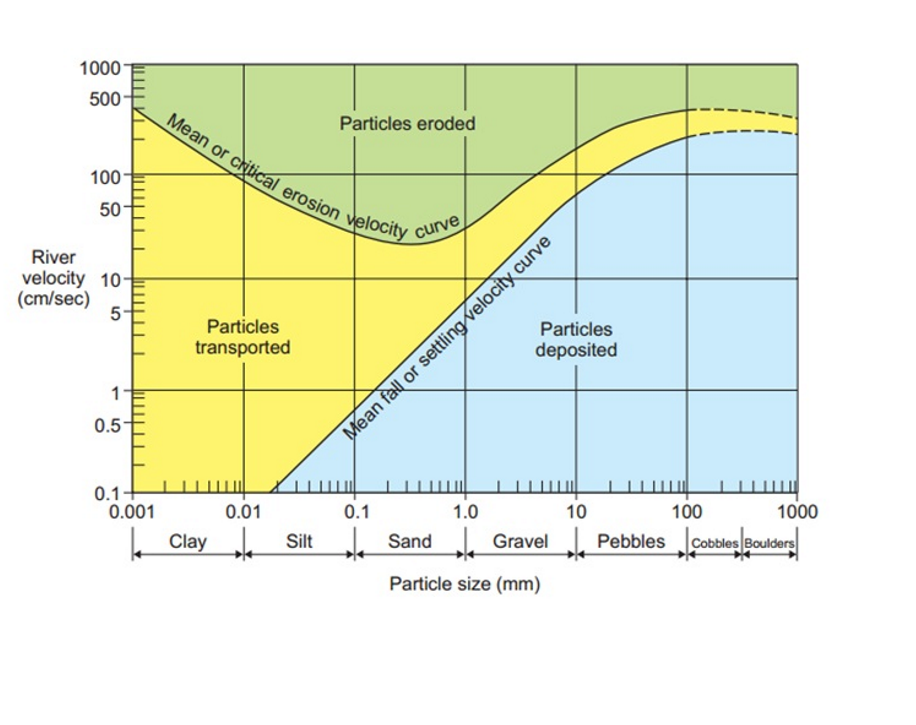
Explain Hjulstrom curve - axis, lines, regions, why lines change
logarithmic scale
River velocity on y-axis, bedload size on x-axis
mean erosion velocity curve = minimum velocity of water flow required to engage/erode a particle of that size
mean setting velocity curve = velocity required to maintain a particle of a given size
small particles have strong electrostatic charges to bind to river bed, difficult for water to get under clay
Define flocculation
Many small particles sticking together to form a larger particle
Define hydraulic radius
cross sectional area divided by wetter perimeter
represents efficiency of river channel
High hydraulic radius means an efficient channel as there is less friction
Name three types of river flow
Laminar
Turbulent
Helicoidal
Explain formation of waterfall/gorge + know meander/levees
The river crosses a discontinuity in the underlying geology (i.e. a place where two different rock types exist next to each other). Harder, more resistant rock (e.g. Igneous rock) overlies softer, less resistant rock (e.g. Limestone).
Waterfall forms where river processes interact with the underlying geology (rocks). Erosion process - such as hydraulic action, abrasion, solution - erodes the soft rock.
This creates an overhang. Pieces of bedload swirl around in this plunge pool due to high energy falling water. This leads to high amounts of abrasion.
The hard overlying rock is now unsupported and collapses into the plunge pool
As the process repeats itself, the waterfall retreats upstream.
This creates a steep-sided gorge downstream of the waterfall.
Define point bar, spliff off slope and river bluffs
Point bar = bed of gravel on inside bend of meander due to deposition
Slip off slope = relatively flat area of land on inside bend of meander
River bluff = a relict river cliff - not as steep and not near site of active erosion
What two factors make up risk
Frequency and severity
Physical factors of flooding
Prolonged/intense rainfall, tropical storms/monsoons, snowmelt, tsunami, landslide, Jokulhlaup, drainage basin characteristics, aspect
Jokulhlaup = volcano erupts beneath a glacier causing a large increase in meltwater
Human factors of flooding
Ploughing direction, urbanisation, deforestation,
Name all hard engineering flood management strategies
Dams, river straightening, artificial levees, diversion channels
Name all soft engineering flood management strategies
Afforestation, wetland conservation, flood plain zoning
Define recurrence intervals
Predicted time period between a flood of a certain size based on previous flood data