Unit 2 AP Bio
 Call Kai
 Learn
Learn Practice Test
 Spaced Repetition
 Match
Match Flashcards
 Knowt Play
1/82

There's no tags or description
Looks like no tags are added yet.
Name | Mastery | Learn | Test | Matching | Spaced | Call with Kai | Chat |
|---|
No analytics yet
Send a link to your students to track their progress
83 Terms
Cytology
The scientific study of cells, including their structure, composition, function, life cycle, and pathology.
Nucleus
A large, double-membrane-bound eukaryotic organelle that houses genomic DNA, controls gene expression, and regulates cellular activities.
Cytoplasm
The entire region inside the cell membrane but outside the nucleus, consisting of liquid cytosol, suspended organelles, and cytoskeleton.
Cell membrane
The selectively permeable phospholipid bilayer boundary enclosing the cell interior from the extracellular environment.

Cell
The fundamental structural, functional, and biological unit of all living organisms.
Tissue
A group of specialized, similar cells and their extracellular matrix working together to perform a specific shared function.
Mitochondria
Double-membraned organelle with inner folds called cristae that serves as the site of aerobic cellular respiration to produce ATP.
Microtubule
Hollow cylindrical cytoskeleton filament composed of tubulin protein dimers that maintains cell shape, transports vesicles, and forms the mitotic spindle, cilia, and flagella.
Centrosome
The main microtubule-organizing center (MTOC) in animal cells containing two perpendicular centrioles that organizes the spindle apparatus during cell division.
Microfilament
Thin, solid cytoskeleton fiber made of actin protein that supports cell shape, muscle contraction, cytoplasmic streaming, and cytokinesis.
Lysosome
Membrane-bound organelle containing acidic hydrolytic digestive enzymes that break down damaged organelles, pathogens, and cellular waste.
Smooth endoplasmic reticulum
Network of membrane tubules lacking ribosomes responsible for lipid synthesis, carbohydrate metabolism, drug detoxification, and calcium storage.
Secretory vesicle
Small membrane-bound sac formed by budding off the Golgi apparatus that transports modified proteins or lipids to the plasma membrane for exocytosis.
Peroxisome
Single-membrane organelle containing oxidative enzymes that execute beta-oxidation of fatty acids, producing H2O2 which catalase breaks down into water and oxygen.
Vacuole
Membrane-bound storage organelle that maintains turgor pressure in plant cells and handles temporary storage or endocytic uptake in animal cells.
Golgi apparatus
Stack of flattened membrane sacs called cisternae that modifies, sorts, and packages proteins and lipids received from the rough ER.
Chromatin
Uncondensed form of eukaryotic DNA wrapped around histone proteins, present in the nucleus during interphase to allow transcription.
Nucleolus
Dense, non-membrane-bound region within the nucleus that synthesizes ribosomal RNA (rRNA) and assembles ribosomal subunits.
Rough endoplasmic reticulum
Membrane network studded with ribosomes that synthesizes, folds, and tags proteins destined for secretion, cell membranes, or lysosomes.
Ribosomes
Non-membrane-bound molecular complexes of rRNA and protein that translate mRNA sequences into polypeptide chains.
Intermediate filament
Stable, rope-like cytoskeleton fiber composed of varied proteins such as keratin that provides mechanical support and anchors organelles.
Pneumonia
Inflammatory lung infection in which alveoli fill with fluid or pus, impairing gas exchange.
Situs inversus
Congenital condition characterized by a mirror-image reversal of the normal layout of internal visceral organs.
Phospholipids
Amphipathic lipid molecules consisting of a hydrophilic phosphate head and two hydrophobic fatty acid tails.
Insulin receptor
Transmembrane glycoprotein receptor that triggers intracellular signaling cascades upon hormone binding to recruit GLUT4 transporters to the cell membrane.
GLUT4
Glucose transporter protein found in muscle and fat cells that translocates to the plasma membrane upon insulin stimulation to import glucose.
Sweat test
Diagnostic procedure for cystic fibrosis that measures chloride concentration in sweat resulting from defective CFTR ion channels.
Metabolic
Relating to metabolism, the total set of catabolic and anabolic chemical reactions occurring within a living organism.
Organelles
Specialized subcellular structures within eukaryotic cells, each performing a dedicated biological function.
Endoplasmic reticulum
Continuous network of membrane tubules and sacs extending from the nuclear envelope involved in protein and lipid biosynthesis.
Mitochondrial disorders
Group of genetic diseases caused by dysfunctional mitochondria leading to impaired ATP production, typically inherited maternally.
Lysosomal storage disorder
Family of genetic diseases caused by missing or defective lysosomal enzymes, leading to abnormal accumulation of undigested substrates.
Mitotic spindle
Dynamic microtubule structure formed during nuclear division that attaches to kinetochores and separates sister chromatids.
Cilia
Short, hair-like microtubule projections on cell surfaces that beat rhythmically to move fluids or function as sensory antennae.
Flagella
Long, whip-like microtubule cell projections that use wave-like motion to propel entire cells through fluid.
Respiratory system
Organ system responsible for gas exchange, composed of nasal passages, trachea, bronchi, lungs, and alveoli.
Mucus
Viscous secretion of glycoproteins, water, and salts produced by goblet cells to lubricate epithelial surfaces and trap debris.
Primary ciliary dyskinesia
Autosomal recessive genetic disorder causing ciliary motor dysfunction, leading to chronic respiratory infections and impaired mucus clearance.
Cheek cells
Human squamous epithelial cells from the inner mouth lining commonly examined in light microscopy.
Phospholipid bilayer
Double layer of amphipathic phospholipids with hydrophilic heads facing outward and hydrophobic tails facing inward, forming cell membranes.
Villi
Finger-like tissue projections lining the small intestine that greatly increase surface area for nutrient absorption.
Diffusion
Passive net movement of particles from a region of higher concentration to lower concentration driven by random thermal motion.
Passive transport
Movement of substances across a cell membrane down their concentration gradient without cellular energy expenditure.
Facilitated diffusion
Passive movement of polar or charged molecules across a membrane down their concentration gradient using channel or carrier proteins.
Osmosis
Specialized passive diffusion of water molecules across a selectively permeable membrane toward a region of lower water potential.
Hypertonic
Describes a solution with a higher solute concentration and lower water potential compared to the inside of a cell, causing water loss and cell shrinkage.
Hypotonic
Describes a solution with a lower solute concentration and higher water potential compared to the inside of a cell, causing water gain.
Isotonic
Describes solutions with equal solute concentrations and equal water potentials, resulting in no net osmotic movement of water.
Active transport
Energy-dependent movement of molecules across a cell membrane against their concentration gradient using carrier proteins and ATP.
ATP (Adenosine Triphosphate)
The cell's primary energy currency molecule that releases stored chemical energy when its high-energy phosphate bonds are broken.
Secretion
Process by which cells synthesize and release functional molecules to the extracellular environment, often via exocytosis.
Endocytosis
Active transport process where the plasma membrane invaginates to engulf large particles, fluids, or molecules into intracellular vesicles.
Exocytosis
Active secretory process where internal membrane-bound vesicles fuse with the plasma membrane to discharge their contents extracellularly.
Interphase
Longest phase of the cell cycle consisting of G1, S, and G2 stages during which cell growth, organelle duplication, and DNA replication occur.
Mitosis
Eukaryotic nuclear division process producing two genetically identical daughter nuclei through prophase, metaphase, anaphase, and telophase.
Cytokinesis
Division of the cytoplasm following nuclear division, splitting one parent cell into two distinct daughter cells.
Chromosome
Highly condensed structure of DNA wrapped around histone proteins carrying genetic information, visible during nuclear division.
Prophase
First stage of mitosis characterized by chromatin condensation into visible chromosomes, nuclear envelope breakdown, and mitotic spindle assembly.
Centrioles
Pair of barrel-shaped microtubule structures inside animal centrosomes that organize spindle fiber formation during division.
Metaphase
Stage of mitosis where spindle microtubules attach to chromosome kinetochores and align chromosomes along the cell equator.
Anaphase
Stage of mitosis where cohesin proteins break and sister chromatids are pulled apart toward opposite cell poles by spindle fibers.
Chromatids
Identical DNA copies produced during S phase and joined at a centromere that separate during anaphase.
Telophase
Final stage of mitosis where chromosomes arrive at poles, decondense back into chromatin, and nuclear envelopes reassemble.
Cancer
Disease characterized by uncontrolled cell division resulting from genetic mutations in proto-oncogenes or tumor suppressor genes.
Apoptosis
Regulated, programmed cell death pathway that safely removes damaged, abnormal, or unnecessary cells.
Cell cycle checkpoint
Regulatory control point (G1, G2, M) where cellular mechanisms check DNA integrity, cell size, and spindle attachment before proceeding.
Cervical cancer and HPV
Malignancy resulting from high-risk Human Papillomavirus integration into host DNA, disrupting normal cell cycle control genes in cervical epithelial cells.
HeLa cells
The first human immortal cell line, isolated in 1951 from Henrietta Lacks' cervical tumor cells, capable of dividing indefinitely in vitro.
Immortal cell line
Cell culture line that bypasses cellular senescence and divides indefinitely in vitro.
Prokaryotic Cells
Simple cells that are characterized by not having a nucleus, structurally smaller
and simpler than eukaryotic cells.
Eukaryotic cells
complex cells that are characterized by having a nucleus and other membrane-bound organelles
Nucleoid
a region in the cell where DNA is located (not surrounded by a membrane).
organelles
a tiny, specialized structure inside a cell that performs a specific job, much like an organ does in the body
Taxonomy
the science of defining and naming groups of biological organisms based on shared
characteristics.
domains
categorize all life on earth into three overarching groups: archaea, bacteria, and
eukarya.
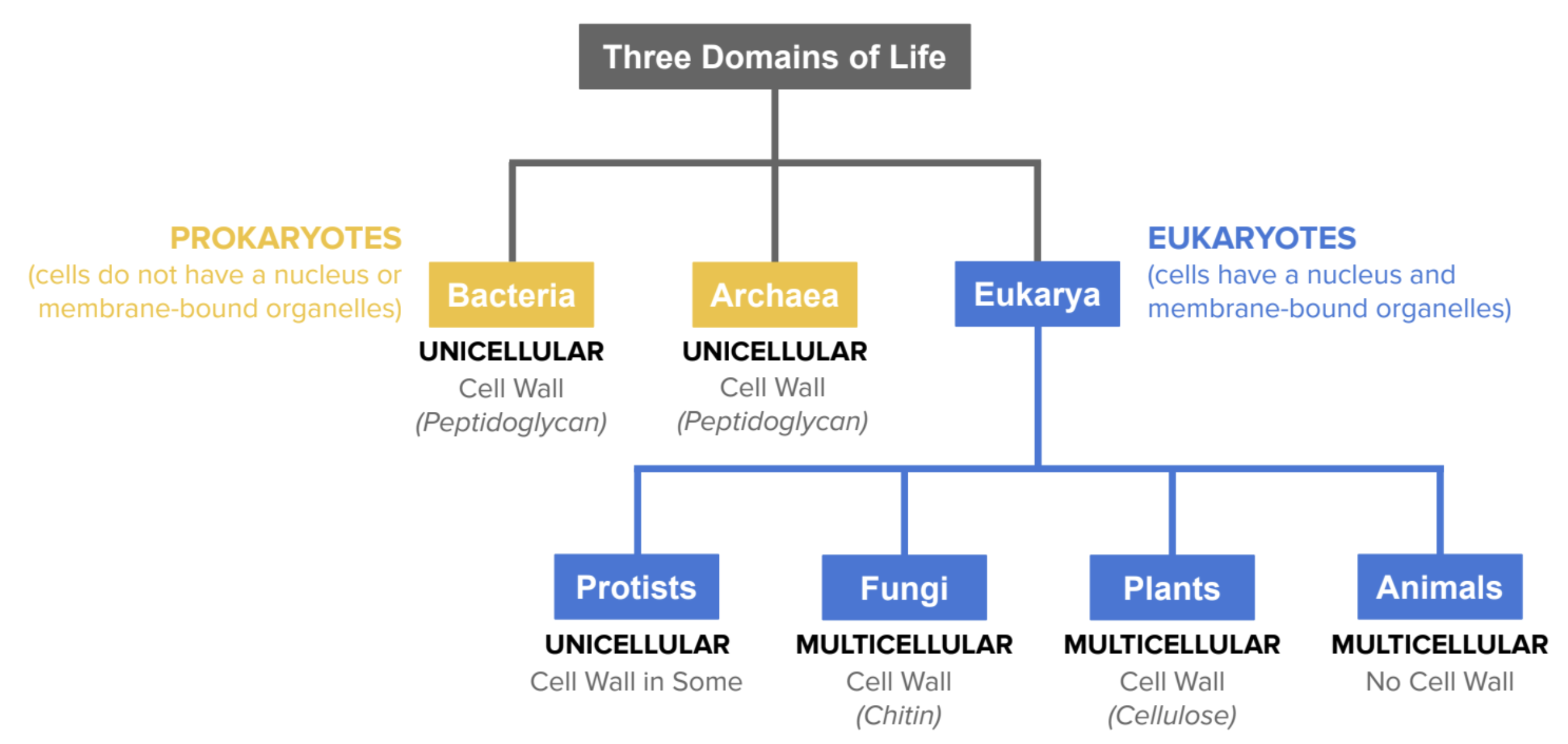
protists
any eukaryotic organism that is not an animal, plant, or fungus
Eukarya
consist entirely of eukaryotic organism, which can be single-celled or multi-celled. Include four main types of organisms: animals, plants, fungi, and protists (single-celled eukaryotes).
Archaea
include a group of prokaryotes that are mainly characterized by their ability to thrive in extreme environments, such as deep sea vents with temperatures over 100 °C, hot springs, and highly basic, acidic, and salty waters. common in more neutral environments, such as in soil, wetlands, and in the intestines of cattle and humans (which produce methane gas while helping with digestion).
Bacteria
include a diverse group of prokaryotes that are most notably recognized for their role in disease, health, important ecological relationships with plants and animals, and
decomposing dead organic matter.
Animal Cells
a type of eukaryotic cell that lacks a rigid cell wall and contains a membrane-bound nucleus along with other specialized structures called organelles
Plant Cells
the basic structural and functional unit of all plants
chloroplasts
specialized cell organs, known as organelles, found in plants and algae that turn sunlight into food through photosynthesis