BCH4024 Douma Exam 4 - Lecture 6
 Call Kai
 Learn
Learn Practice Test
 Spaced Repetition
 Match
Match Flashcards
 Knowt Play
1/59

There's no tags or description
Looks like no tags are added yet.
Name | Mastery | Learn | Test | Matching | Spaced | Call with Kai | Chat |
|---|
No analytics yet
Send a link to your students to track their progress
60 Terms
What is the goal of transcription initiation?
To bring the RNA polymerase holoenzyme to the promoter and start transcription.
What makes up the RNA polymerase holoenzyme in prokaryotes?
The core enzyme plus the sigma subunit.
What does the sigma subunit do?
It recognizes promoter sequences and directs RNA polymerase to the correct site to initiate transcription.
Where are prokaryotic promoters located relative to the transcription start site?
Upstream of the transcription start site.
What are consensus sequences?
Sequence of nucleotides that are particularly common at promoters.
Why is the consensus sequence important?
It represents the sequence with the most interactions with RNA polymerase and the highest affinity for binding.
What are the key elements of a typical prokaryotic promoter?
Specific sequences at the -10 and -35 regions, with a spacer of defined length in between.
What is the consensus sequence at the -10 region?
TATAAT.
What is the consensus sequence at the -35 region?
TTGACA.
What happens if a promoter deviates from the consensus sequence?
It weakens promoter strength, leading to reduced transcription.
What is an "UP element" in prokaryotic promoters?
An AT-rich sequence upstream of the promoter that enhances RNA polymerase binding via interactions with alpha subunits.
What effect does an UP element have on transcription?
It increases transcription by strengthening RNA polymerase binding.
What are constitutive promoters?
Promoters that are always accessible for RNA polymerase binding, typically regulating housekeeping genes.
Does a constitutive promoter always mean high transcription?
No, it can be strong or weak depending on its similarity to the consensus sequence.
What is the rate of transcription initiation determined by?
It's determine by its similarity to the bacterial promoter consensus sequence.
How do deviations from the consensus sequence affect promoter strength?
More deviations result in weaker promoter binding and lower transcription. 'Strong promoters' have very high sequence similarity with the promoter consensus sequence, whereas 'weak promoters' have several base differences.
How do mutations in a promoter affect the rate of transcription initiation?
A mutation in a promoter that moves away form the consensus sequence decreases the rate of transcription initiation.
What initiates the formation of the RNA polymerase holoenzyme?
Binding of sigma to the core enzyme.
What is the closed complex in transcription initiation?
The RNA polymerase holoenzyme loosely bound to promoter DNA with strands still annealed/closed.
What triggers formation of the open complex?
Sigma separates the DNA strands, creating a transcription bubble.
How fast does RNA polymerase synthesize RNA during early initiation?
About 1 nucleotide per second.
Why is early RNA synthesis during initiation slow?
Sigma tightly holds onto the promoter, resisting movement into elongation.
When does sigma dissociate from RNA polymerase?
After approximately 10 nucleotides of RNA have been synthesized.
What is promoter clearance?
The transition from initiation to elongation when RNA polymerase escapes the promoter and sigma dissociates.
How fast is RNA synthesis during elongation?
About 50-90 nucleotides per second.
What slows down transcription elongation?
DNA supercoiling ahead of the transcription bubble and formation of RNA secondary structures like hairpins.
What helps relieve torsional stress during elongation?
Topoisomerases.
What can happen to the nascent RNA during elongation in prokaryotes?
Ribosomes can immediately bind and begin translation.
Can transcription and translation happen simultaneously in prokaryotes?
Yes, because there is no nucleus separating the processes.
What binds RNA polymerase and ribosomes to link transcription and translation?
NusG
What triggers transcription termination in prokaryotes?
Encountering a terminator sequence.
What are the two types of transcription termination in prokaryotes?
Rho-independent termination and rho-dependent termination.
What characterizes a rho-independent terminator?
The terminator has a self-complementary region that forms the hairpin, followed by a conserved string of uracil (U) units.
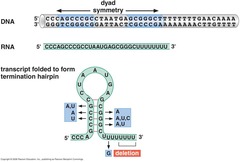
How does rho-independent termination work?
A hairpin secondary structure is formed to pull/low down RNA polymerase. Then, an A/U rich region with weak hydrogen bonding follows that can be easily broken off, dissociating RNA polymerase.
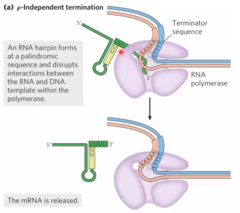
What is rho?
A protein factor that has an ATP-dependent RNA-DNA helicase activity.
What is required for rho-dependent termination?
The rho protein, an RNA helicase.
What is a rut element/site?
A CA-rich sequence on RNA that acts as the binding site for the rho protein.
How does rho-dependent termination work?
Rho binds the rut site and moves along RNA, eventually colliding with RNA polymerase and terminating transcription.
What is an operon?
A cluster of prokaryotic genes regulated together under a single promoter and terminator.
What is a polycistronic mRNA?
A single RNA molecule that contains multiple open reading frames encoding multiple proteins.
Are operons found in eukaryotes?
No, they are specific to prokaryotes.
What is the advantage of organizing genes into an operon?
It is energy efficient, allowing coordinated expression of related proteins.
What are inducible promoters?
Promoters that can be turned on or off depending on environmental conditions.
What factors regulate inducible promoters?
Specificity factors (like sigma), repressors, and activators.
What is a repressor?
A protein that binds to an operator site and blocks transcription.
What is an activator?
A protein that binds upstream of the promoter and enhances transcription.
Where are operator sites typically located?
Immediately downstream of the promoter.
Where are activator binding sites typically located?
Upstream of the promoter.
How do transcription factors recognize specific DNA sequences?
By interacting with the major and/or minor grooves of DNA.
What is a DNA-binding domain?
A protein region that allows transcription factors to bind DNA in a sequence-specific manner.
What structure fits into DNA grooves for recognition?
An alpha helix from the DNA-binding domain.
What is the recognition helix?
The alpha helix within the DNA-binding domain that forms sequence-specific interactions with DNA bases.
Why do most transcription factors interact with the major groove?
The major groove provides more sequence-specific information.
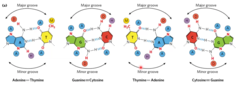
Can transcription factors bind the minor groove?
Rarely, but sigma is an example that binds the minor groove.
What kind of bonds form between recognition helices and DNA?
Hydrogen bonds and Van der Waals interactions.
What is a helix-turn-helix motif?
A structural motif in transcription factors consisting of two helices separated by a turn, where the first helix is for structural purpoese, and the second helix is the recognition helix.
Why do transcription factors bind DNA as dimers, trimers, or tetramers?
To increase specificity and stability of DNA binding.
What is a homodimer?
A dimer formed by two identical protein subunits.
What is a heterodimer?
A dimer formed by two different protein subunits.
How does binding as a multimer increase specificity?
By increasing the number of recognition helices, it increases the specificity of the reaction. The protein must recognize multiple sequences spaced precisely apart in DNA.