m1_intro to critical care
 Call Kai
 Learn
Learn Practice Test
 Spaced Repetition
 Match
Match Flashcards
 Knowt Play
1/40

There's no tags or description
Looks like no tags are added yet.
Name | Mastery | Learn | Test | Matching | Spaced | Call with Kai | Chat |
|---|
No analytics yet
Send a link to your students to track their progress
41 Terms
Critical Care Nursing
The specialty within nursing that deals specifically with human responses to life-threatening problems. These problems deal dynamically with human responses to actual or potential lifethreatening illnesses
Critical Care Nursing
_________ practice is based on a scientific body of knowledge and incorporates the professional competencies specific to critical care nursing practice and is focused on restorative, curative, rehabilitative, maintainable, or palliative care, based on identified patient’s need
Critical Care
is direct delivery of medical care for a critically ill or injured patient
Critical / Intensive Care Unit (CCU / ICU)
A specially designed and equipped facility staffed by skilled personnel to provide effective and safe care for patients with a life-threatening problem that is potentially reversible.
Critically Care Patients
A critically ill patient is one who is at high risk for actual or potential life-threatening health problems and requires intense and vigilant nursing care (AACN).
Progressive Care Unit
Intermediate care units or step-down units. Provide a transition between the CCU & the general care unit or discharge.
Critical Care Nurse
A licensed professional nurse who is responsible for ensuring that acutely and critically ill patients and their families receive optimal care. Cares for patients with acute and unstable physiologic problems as well as their caregivers.
Critical Care Nurse
Has an in-depth knowledge of anatomy and physiology, pathophysiology, pharmacology and advance assessment skills, as well the ability to use advanced biotechnology
The patient may be physiologically unstable, requiring advanced and sophisticated clinical judgments by a critical care nurse and a physician.
The patient may be at risk for serious complications and require frequent assessment, and often invasive interventions.
The patient may require intensive and complicated nursing support related to the use of IV polypharmacy and advanced biotechnology.
reasons for CCU admission
Nutrition
Anxiety
Pain
Impaired Communication
Sensory-Perceptual Problems
Sleep Problem
common problems for CCU patients
Anxiety towards their patient’s condition, prognosis and concerns.
Disruption of daily routines to support the patient.
Reassurance on patient care and decisions.
Convenience of access to the patient.
Preparing caregivers by briefly describing the patient’s appearance and the physical environment.
Being present during invasive procedures and CPR
issues related to caregivers
scope of critical care nursing
The ____ is defined by the dynamic interaction of the critically ill patient, the critical care nurse and the critical care environment in order to bring about optimal patient outcomes through nursing proficiency within an environment conducive to the provision of this highly specialized care
Palliative care
Constant intensive assessment, timely critical care interventions and continuous evaluation of management through multidisciplinary efforts are required to restore stability, prevent complications and achieve optimal health. _____ should be instituted to alleviate pain and sufferings of the patient and family in situations where death is imminent.
Critical Care Nurses
___ are registered nurses, who are trained and qualified to practice critical care nursing. They possess the standard critical care nursing competencies in assuming specialized and expanded roles in caring for the critically ill patients and their family. The critical care nurse is personally responsible and committed to continue learning and updating of knowledge and skills
critical care environment
The ________ constantly supports the interaction between the critically ill patients, their family and the critical care nurses to achieve desired patient outcomes. It entails readily available and accessible emergency equipment, sufficient supplies and effective supporting system to ensure quality patient care as well as staff safety and productivity.
standards of critical care nursing
Critical care specialty addresses the management and support of patients with severe or life-threatening illness. The goal of critical care nursing is to promote optimal adaptation of critically ill patients and their families by providing highly individualized care, so that the critically ill patients adapt to their physiological dysfunction as well as the psychological stress in the Critical Care Unit or Intensive Care Unit (ICU). In order to achieve this, standards should be developed to serve as a guide for monitoring and enhancing the quality of intensive care nursing practice.
The critical care nurse (CCN) functions in accordance with legislation, common laws, organizational regulations and bylaws, which affect nursing practice.
The CCN provides care to meet individual patient needs on a 24- hour basis.
The CCN practices current critical care nursing competently.
The CCN delivers nursing care in a way that can be ethically justified.
The CCN demonstrates accountability for his/her professional judgment and actions.
The CCN creates and maintains an environment which promotes safety and security of patients, visitors and staff.
The CCN masters the use of all essential equipment, available services and supplies for immediate care of patients.
The CCN protects patients from developing environmental induced infection.
The CCN utilizes the nursing process in an explicit systematic manner to achieve the goals of care.
The CCN carries out health education for promotion and maintenance of health. 1
The CCN acts to enhance the professional development of self
11 Standards
1800s
early 1900s
Johns Hopkins Hospital in Baltimore
premature infant unit
history of critical care
Critical care evolved from the recognition that the needs of patients with acute, life threatening illness or injury could be better met if the patients were organized in distinct areas of the hospital.
In the ____, Florence Nightingale described the advantages of placing patients recovering from surgery in a separate area of the hospital.
A three-bed postoperative neurosurgical intensive care unit was opened in the ______ at _____. This was soon followed by a ________ in Chicago.
war
1950s
The nursing shortage after the __ forced the grouping of postoperative patients into designated recovery areas so that appropriate monitoring and care could be provided.
The technologies and combat experiences of health care providers during the wars of the 20th century also provided a stimulus for specialized medical and nursing care in the civilian setting.
The _____ brought the new technology of mechanical ventilation and the need to group patients receiving this new therapy in one location.
Critical care nursing
equipment and specially trained staff
_____ was organized as a specialty less than 60 years ago. The development of new medical interventions and technology prompted recognition that nursing was important in the monitoring and observation of critically ill patients. Physicians depended on nurses to watch for critical changes in the condition of patients in the physicians’ absence, and they sometimes depended on the nurses to initiate emergency medical treatment.
As sophisticated technology began to support more elaborate medical interventions, hospitals began to organize separate units to make more efficient use of __________.
recovery rooms
skilled nurses
1960s
Postoperative care was moved into ________, where nurses with specialized knowledge regarding anesthesia recovery provided the patient care.
Medical and surgical intensive care units segregated the critically ill patients where they could be cared for by _____.
By the ____, nurses consolidated their knowledge and practice into focused areas such as coronary care, nephrology, and intensive care. Nurses assumed many functions and responsibilities formerly reserved for physicians, and they assumed a new authority by virtue of their knowledge and expertise.
Professional Regulation Commission Board of Nursing (PRC BON)
1996
clinical nurse practitioners, nurse educators and nurse managers
In the Philippines, the ______ is committed to provide need driven, effective and efficient specialty nursing care services of high standard and at international level within the obtainable resources. To respond to this mission and commitment, a PRC BON Working Group in Developing the Nursing Specialty Framework was formed in the _____ to take on the task of setting the process based framework and guidelines for specialty nursing services. The Working Group members are __________.
Critical Care Nurses Association of the Philippines, Inc. (CCNAPI)
The expanding healthcare and nursing knowledge together with new and evolving healthcare sites, structures, and technologies all have contributed to the need and desire for specialty nursing organizations like the __________ to revisit the existing statements of its Standards of Nursing Practice to provide clear and updated statements regarding the scopes of practice and standards of critical care nursing. This will ensure continued understanding and acknowledgment of nursing’s varied specialty professional contributions in today’s healthcare environment.
Nurse Clinician I, Nurse Clinician II and Nurse Specialist
The CCNAPI Standards of Practice of 1982 has been revisited and revised to be aligned with the 2005 BON statements of the 11 Core Competencies for Entry Level for Safe and Quality Nursing Care. The CCNAPI Core Competencies of a Critical Care Nurse are stated according to the levels of expected behavior defining the actual knowledge, skills and abilities in the practice of critical care by a nursing professional. These statements cover expected behavior of a ________ that will serve as the basis for assessing competence in critical care practice.
critical care nursing practice
The competence of critical care nurses together with established nursing standards and the identified core competencies for registered nurses will result to excellence in _____. This three pronged holistic framework ensures quality performance through an adherence to nursing standards, the application of competencies, and the integration of appropriate nursing model/s into the care delivery process.
1. Safe and Quality Nursing Care
2. Management of Resources
3. Legal Responsibilities
4. Ethico-Moral Responsibilities
5. Collaboration and Teamwork
6. Personal and Professional Development
7. Communication
8. Health Education
9. Quality Improvement
10. Research
11. Record Management
To achieve safe and quality client-centered care, nurses working in the critical care units are envisioned to adopt not only the stated core competencies of registered nurses but also the specific competencies stipulated in the following eleven major key responsibility areas:
critical care nurses
CCNAPI
Professional Regulatory Commission (PRC)
Department of Health and PHIC
JCI or ISO
In the Philippines, ______ are specifically supported by the _____ since it is their official organization. This organization provides practice guidelines, opportunities for networking, educational programs, professional publications, research opportunities, etc.
They are also under the umbrella of the _______ since they are all licensed professionals.
Regulation and standardization of ICUs in the hospitals are regulated by the _________, or any regulatory body like ____
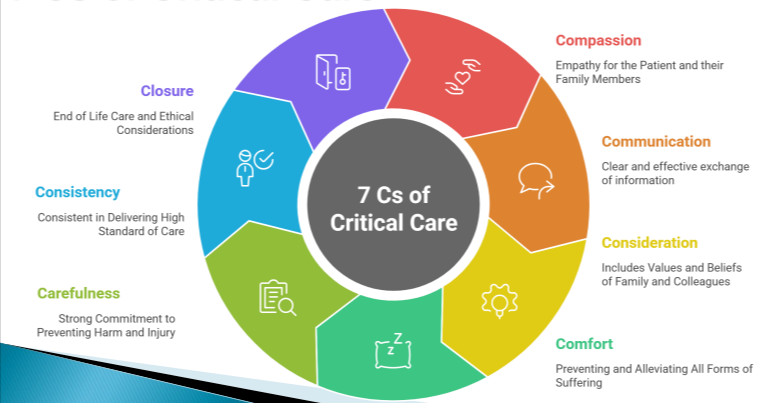
7 Cs of critical care
Level 1
Level 2
Level 3
The role of a particular critical care unit will vary, depending on staffing, facilities and support services as well as the type and number of patients it has to manage. Taking into account the guidelines of the Society of Critical Care Medicine, the critical care service provision in Philippines can be classified into 3 levels:
Level 1
– Referred to as high dependency. Resuscitation, short term mechanical ventilation and simple invasive cardiovascular monitoring for < 24 hours.
Level 2
– Located in general hospital, undertake more prolonged ventilation. Provides a high standard of general intensive care, including complex multisystem life support.
Level 3
– Tertiary referral unit for intensive care patients. Provides comprehensive critical care including complex multisystem life support for an indefinite period. Demonstrated commitment to academic education and research
Age group:
Neonatal
Pediatric
Adult
The Critical Care Unit can be categorized according to patients’ age group or medical specialties.
Specialty:
Medical
Surgical
Cardio-thoracic
Respiratory
Neurosurgical
Trauma
Majority of the CCUs in the Philippines provide service for patients of various specialties. They are labeled as General ICUs. In certain hospitals, the critical care unit is dedicated to the following:
Open System
The admitting and attending doctors dictate/change management, or perform procedures without consultation or communication with a Critical Care Specialist. A Critical Care Specialist may be available for advice or be consulted to provide interventional skills (optional).
Closed System
Management is coordinated by a qualified Critical Care Specialist. There is a multi-disciplinary team of specially trained critical care staff. The “intensivist” is the final common pathway for all medical decision-making including the decision to admit or discharge.
hybrid model
Irrespective of the ICU “System” Operation, there should be a designated group of registered nurses to provide highly specialized care to the critically ill patients. The nursing staff in each unit should have the relevant qualification in the specialty of the respective unit.
central nursing station
Patients must be situated so that direct or indirect (by video monitor) visualization by healthcare providers is possible at all times. This permits the monitoring of patient status under both routine and emergency circumstances. The preferred design is to allow a direct line of vision between the patient and the central nursing station.
In ICUs with a modular design, patients should be visible from their respective nursing substation.
Electric Power and Back up
Water Supply
Oxygen, Compressed Air, Vacuum
Adequate Lighting
Environmental Control Systems
ICU requirements
cardiac monitor
swan-ganz catheter/ pumononary artery catheter
apnea monitor
arterial line
ventilator
defibrillator
external pacemaker
syringe/ infusion pump
crash cart/ e-cart
suction machine
portable x-ray
central venous catheter (CVC)
chest tube
gastrointestinal tubes
endotracheal tubes
equipment and supplies in the critical care unit