Biology- Unit 1
 AP Practice
 Call Kai
1/45

Earn XP
Description and Tags
Name | Mastery | Learn | Test | Matching | Spaced | Call with Kai | Chat |
|---|
No analytics yet
Send a link to your students to track their progress
46 Terms
What are the four main macromolecule classes?
Carbohydrates
Lipids
Proteins
Nucleic acids
What is the skeleton of most organic molecules?
Carbon chains, which vary in length and shape
Hydrocarbons
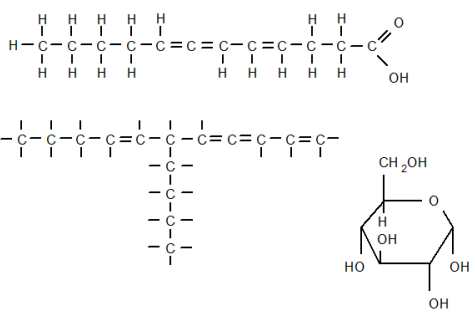
Organic molecules consisting of only carbon and hydrogen
Non-polar → no partial charges, equal sharing of valence electrons, hydrophobic
Isomers
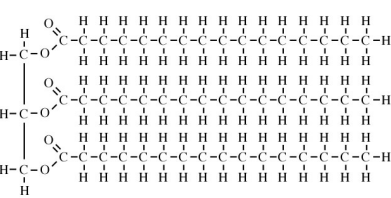
Compounds with the same molecular formula but different structures and properties; 3 main types
Structural isomers
Geometric isomers (AKA cis-trans isomers)
Enantiomers
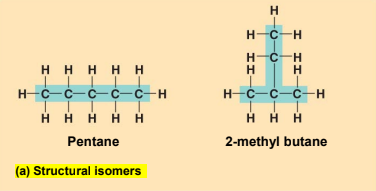
Structural isomers
Have different covalent arrangements of their atoms (straight vs. branched)
Geometric isomers (AKA cis-trans isomers)
Have the same covalent arrangements but differ in spatial arrangements due to inflexibility (double bonds)
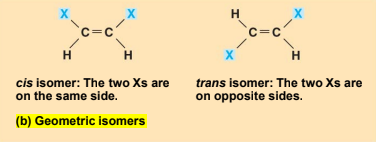
Enantiomers
Isomers that are mirror images of each other
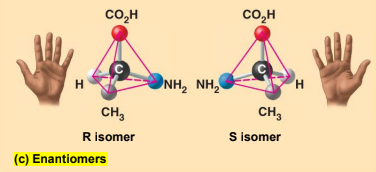
Most of the time, when a drug has enantiomer forms… (+ give an example)
one form is biologically active while the other is not.
Ex. Celexa (50% active, 50% inactive) and Lezapro (100% active), Ibuprofen (active S version, inactive R version)
Functional groups
Essentially, molecule “tags” that give hydrocarbons unique properties/function and make them polar
Functional groups give hydrocarbons a glow-up, making them more attractive
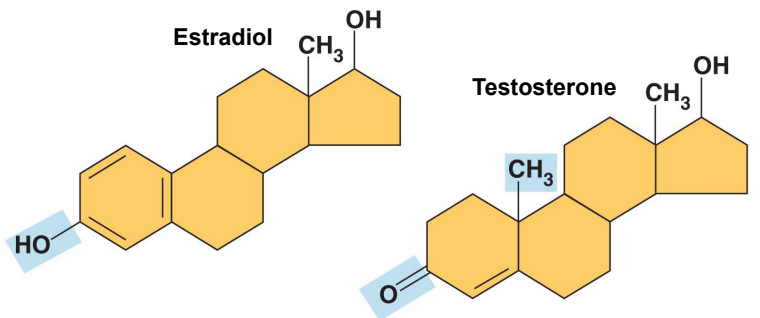
What are the eight most important functional groups?
Hydroxyl
Carbonyl
Carboxyl
Amino
Sulfhydryl
Phosphate
Methyl
Acetyl
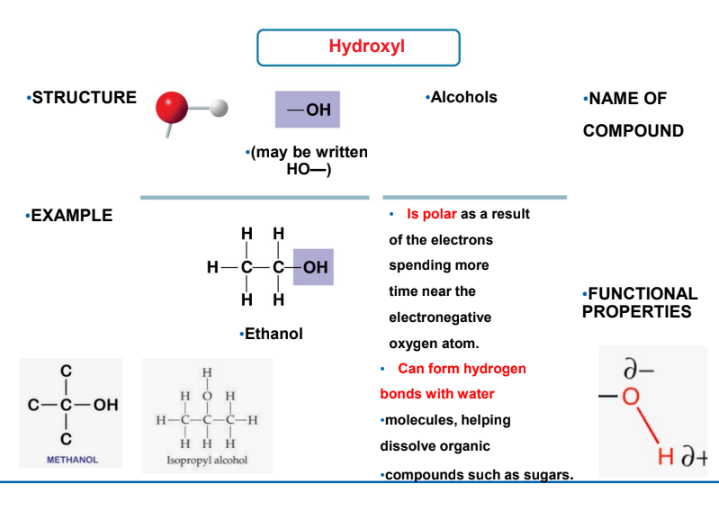
Hydroxyl
—OH, HO—
Alcohols
Ex. ethanol
Polar
Can form hydrogen bonds with water molecule, helping dissolve organic compounds such as sugars
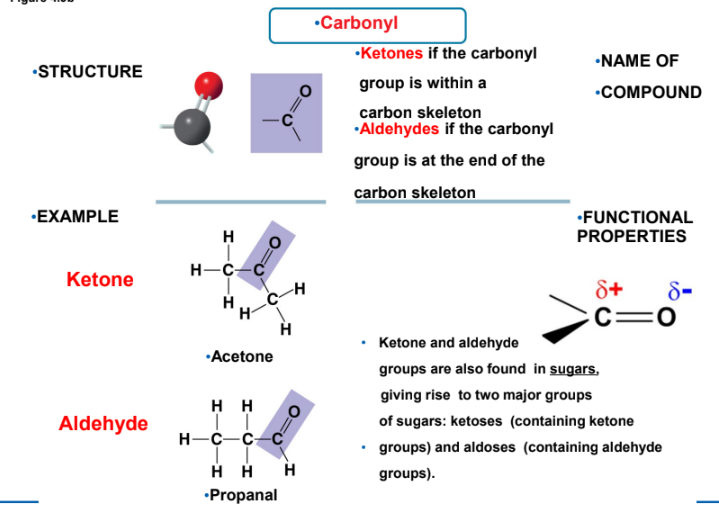
Carbonyl
C=O
Ketones (if it’s within a carbon skeleton), aldehydes (if it’s at the end of a carbon skeleton
Also found in sugars, giving rise to two major groups of sugars: ketoses and aldoses
Polar
Carboxyl
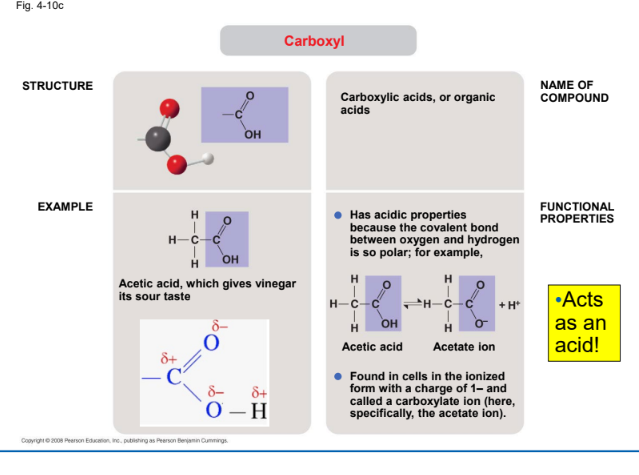
OH—C=O
Carboxylic acids, or organic acids
Ex. Acetic acid
Found in carboxylate ions, which are ionized cells with a charge of -1
Polar
Acts as an acid
Sometimes, the H pops off and makes the substance more acidic
Amino
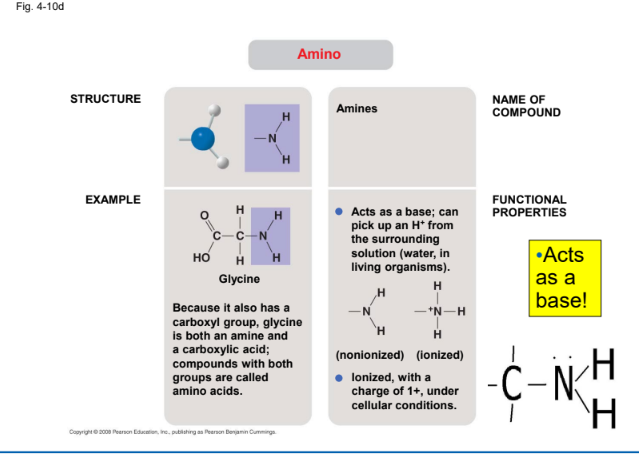
H—N—H
Amines
Ex. glycine (has both an amine and a carboxylic acid; compounds with both groups are called amino acids)
Polar
Acts as a base
Can pick up an H+ from the surrounding solution
Ionized with a charge of 1+ under certain cellular conditions
Sulfhydryl
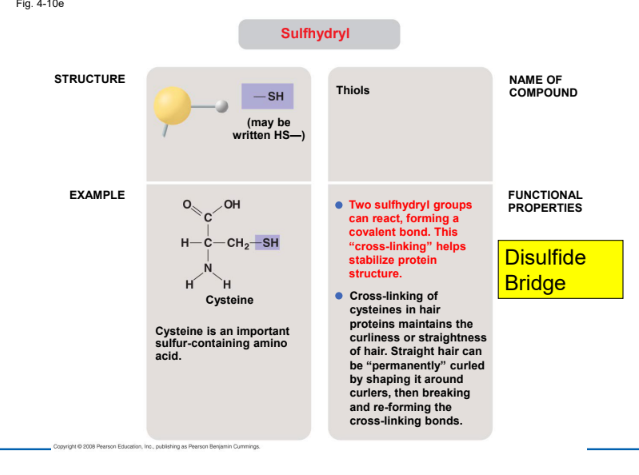
—SH, HS—
Thiols
Ex. cysteine
When two sulfhydryl groups react, they form a covalent bond known as a disulfide bridge
Polar
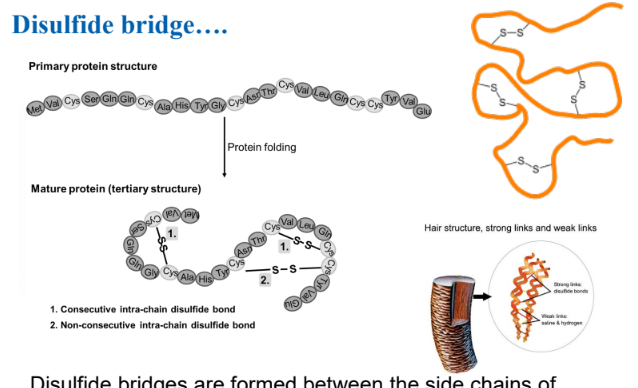
Disulfide bridge
A strong covalent bond (-S-S-) formed between the sulfur atoms of two cysteine amino acids in a protein
Causes curly hair; the chemical found in perms breaks disulfide bridges
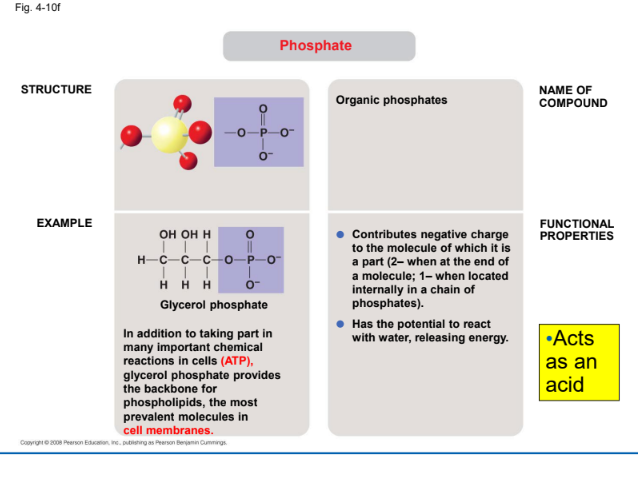
Phosphate
(x3) O—P=O
Organic phosphates
Ex. glycerol phosphate (ATP), which provides the backbone for cell membranes
Polar
Acts as an acid
Contributes a negative charge to the molecule it’s a part of (2- when it’s at the end of a molecule, 1- when it’s located internally in a chain of phosphates)
Has the potential to react with water, releasing energy
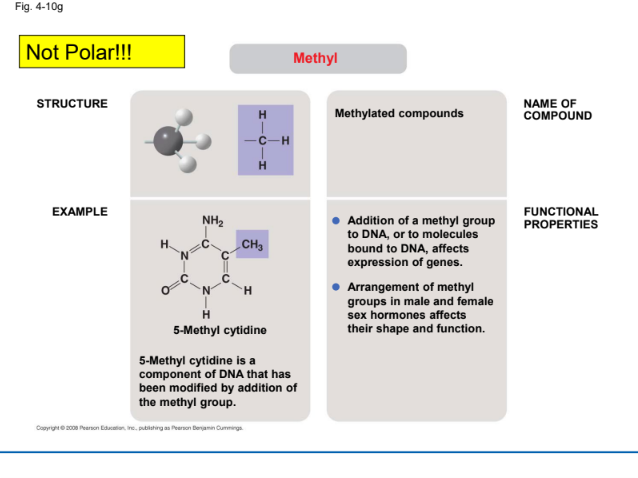
Methyl
(x3) H—C
Methylated compounds
Ex. methyl cytidine
Shuts down damaged DNA strands
Found in sex hormones, and the arrangement of methyl groups affects their shape and function
Non-polar
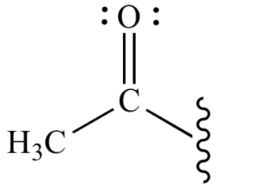
Acetyl
H3C—C=O
Has a carbonyl and a methyl group
Reactivates genes/DNA shut down by methyl; serves as an “on switch”
Polar
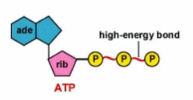
Adenosine triphosphate (ATP)
The primary energy-transferring molecule in the cell (releases energy after reacting with water)
Adenosine + 3 phosphate groups
Which elements go with each macromolecule class?
Carbohydrates- CHO
Lipids- CHO (P in phospholipids)
Proteins- CHONS
Nucleic acids- CHONP
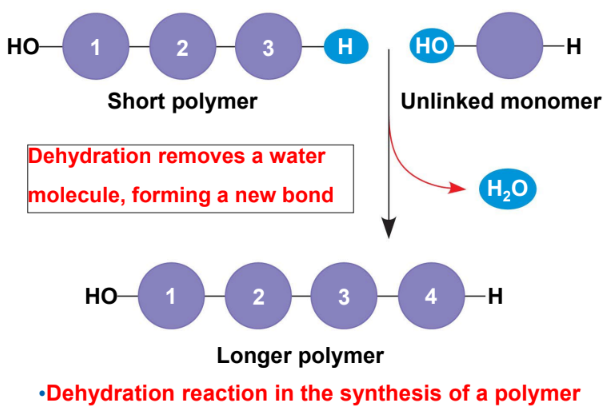
Polymer
A long molecule consisting of many similar building blocks (monomers) covalently bonded together
Monomer
The building blocks that covalently bond to form polymers
Which macromolecule classes are polymers?
Carbohydrates, proteins, and nucleic acids
Dehydration reaction
Occurs when two monomers bond together through the loss of a water molecule
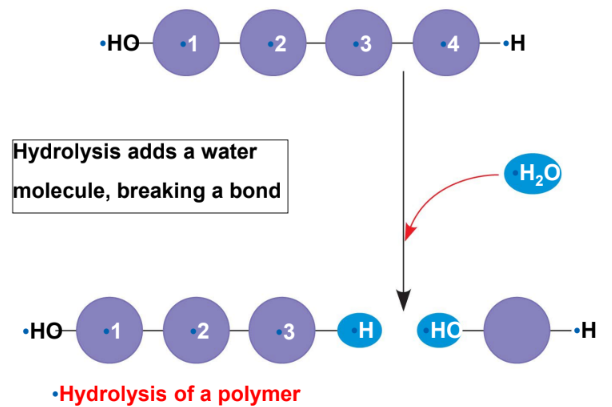
Hydrolysis
A reaction that disasembles polymers into monomers (essentially, it’s the reverse of the dehydration reaction)
Carbohydrates include…
the sugars and the polymers of sugars.
Monosaccharides
Single sugars, the simplest carbohydrates
Have molecular formulas that are usually multiples of CH2O
Glucose (C6H12O6) is the most common monosaccharide
Polysaccharides
Carbohydrate macromolecules/polymers composed of many monosaccharides
What is the formula for glucose?
C6H12O6
Glucose
A monosaccharide in the carbohydrate family
Ratio of CH2O; formula is C6H12O6
Contains OH functional groups, making it polar
Has linear and ring forms
Galactose is an isomer of glucose
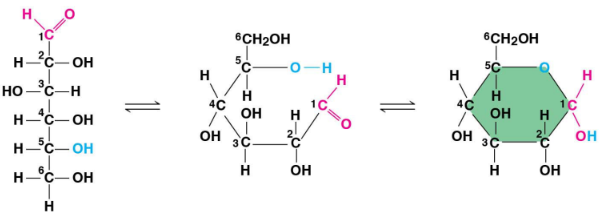
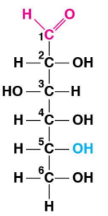
What molecule is this?
Glucose (linear form)
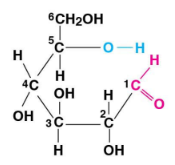
What molecule is this?
Glucose (ring form)
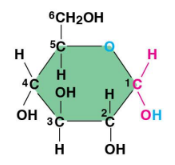
What molecule is this?
Glucose (ring form)
Disaccharide
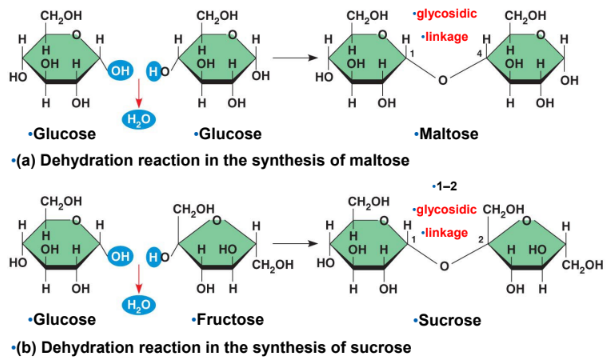
Formed when a dehydration reaction joins two monosaccharides (with a glycosidic linkage)
Ex. maltose, sucrose