Avian Secret Species Assessment 낱말 카드
 Call Kai
 Learn
Learn Practice Test
 Spaced Repetition
 Match
Match Flashcards
 Knowt Play
1/80

There's no tags or description
Looks like no tags are added yet.
Name | Mastery | Learn | Test | Matching | Spaced | Call with Kai | Chat |
|---|
No analytics yet
Send a link to your students to track their progress
81 Terms
Raptorial bill
A hooked beak specialized for tearing meat; indicates a carnivorous diet. Found in eagles, hawks, falcons, and owls. Hooked bill → tearing flesh → meat-eating diet.

Nectar-feeding bill
A slender, downward-curved bill specialized for accessing nectar; indicates a nectar-feeding diet. Slender + downward-curved bill → adapted to access nectar.

Seed-eating bill
A stout, conical bill specialized for crushing seeds; indicates a seed-eating/granivorous diet. Stout + conical bill → strong crushing ability → can break seeds.

Probing bill
A long, thin bill specialized for probing into mud or soft ground; indicates feeding on food located within soft substrate. Long + thin bill → can reach food in mud/soft ground.

Tubular nose
Tube-shaped nostrils that excrete excess salt, associated with a downward hook on the bill; indicates adaptation to a marine lifestyle. Tubular nostrils → salt excretion → marine adaptation.

Webbing between toes
Webbing connecting the toes; increases the surface area of the foot against water and is adapted for moving through water/swimming.
Palmate
A type of webbed foot with webbing between the toes; associated with movement through water.

Totipalmate
A type of webbed foot; webbing between the toes is associated with movement through water.

Semipalmate
A type of webbed foot; webbing between the toes is associated with movement through water.

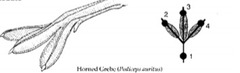
Lobate feet
Feet with webbing on individual toes rather than one continuous web; adapted for standing on sand or other soft ground.
Extra-long toes
Very long toes adapted for standing on lilypads; distribute weight and help the bird remain on the surface.
Anisodactyly
A foot arrangement in passeriformes specialized for perching. Tendons in the back of the leg cause the toes to curl and stiffen, allowing the bird to grip branches.
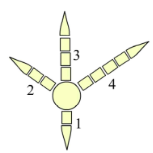
Zygodactyl
A toe arrangement in which 2 toes point forward and 2 point backward; makes it easier to manipulate and hold food. Found in most owls, parrots, and cuckoos.
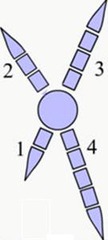
Syndactyl
A toe arrangement in which the 2nd and 3rd toes are fused; found in kingfishers and bee-eaters.

Pamprodactyl
A toe arrangement in which the 1st and 4th toes can pivot forward and backward; found in some swifts.

Aspect ratio
The ratio of wingspan to chord. Very long, narrow wings have a high aspect ratio, while short, rounded wings have a low aspect ratio. Wing aspect ratio is related to speed, energy use, and manoeuvrability.
Primaries
The longest flight feathers; can be controlled like rigid fingers and provide forward thrust during flight.
Secondaries
Flight feathers that are less controlled than primaries and provide an airfoil, helping produce lift during flight.
Elliptical wings
Short, rounded wings with large wing slots and a low aspect ratio; adapted for manoeuvrability and short bursts of high speed. They have high energetic costs. Short + rounded → low aspect ratio → manoeuvrability.

Large wing slots
Large spaces between primary feathers characteristic of elliptical wings; associated with manoeuvrability and short bursts of flight.

Slotted high-lift wings
Also called passive soaring wings; long, broad wings with long primary feathers spread out, producing high lift. They have low energy costs and allow birds to ride thermals or orographic lift while soaring.

High lift
The ability of long, broad wings to generate enough lift for soaring; associated with slotted high-lift/passive soaring wings.
Thermals
Rising air currents that birds with slotted high-lift wings can ride to soar with low energy costs.
Orographic lift
Lift produced by air currents moving upward over terrain; birds with slotted high-lift wings can use it for low-energy soaring.
High-speed wings
Long, pointy, convex wings with slender tips and no wing slots; minimize drag and are adapted for fast flight, although they have high energetic costs.

Slender wing tip
A narrow, tapered wing tip characteristic of high-speed wings; helps minimize drag and increase speed.
Convex wings
Wings with a convex shape, characteristic of high-speed wings; helps minimize drag and is associated with fast flight.
Drag
Resistance to movement through the air; high-speed wings are long, pointy, convex, and shaped to minimize drag, allowing fast flight.
High-aspect-ratio wings
Also known as active soaring wings. Very long, narrow wings with a high aspect ratio; have low energy costs and allow birds to ride wind currents, often over the ocean, using dynamic soaring.

Oesophagus
A tube that propels food down the digestive tract. It is large in birds that swallow prey whole, such as cormorants, herons, and some raptors.

Crop
An expanded portion of the oesophagus that stores and softens food and regulates its flow through the digestive tract. Well-developed in granivores such as Galliformes and Columbiformes; Columbiformes produce crop milk.
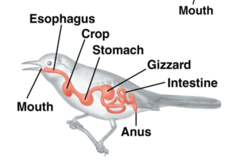
Proventriculus
The "chemical" stomach; secretes hydrochloric acid and digestive enzymes and aids in digesting bones. Well-developed in granivores, carnivores, and birds that swallow prey whole.

Gizzard
The muscular stomach of a bird; mechanically breaks down food and is especially well-developed in granivores that consume harder food such as seeds.

Ventriculus
Another name for the gizzard; the muscular stomach that mechanically breaks down food.

Small intestine
A region of the digestive system responsible for cellulose digestion and nutrient absorption. Well-developed in herbivores and omnivores and less-developed in carnivores.

Caeca
Two blind pouches in the digestive system whose size may depend on diet; involved in fermentation of coarse material and water absorption. Larger caeca indicate greater capacity for fermentation of coarse material.

Large intestine
A relatively short region of the bird digestive system that absorbs water and electrolytes.

Cloaca
The region where the digestive, urinary, and reproductive systems meet; functions in water absorption and serves as a holding area for wastes.

Granivore
A bird that eats seeds. Associated physical characteristics include a stout, conical bill, well-developed crop, well-developed proventriculus, and well-developed gizzard. Stout conical bill → crushes seeds; crop → stores/softens food; gizzard → mechanically breaks down hard food.

Carnivore
A bird that eats meat. Associated physical characteristics include a raptorial hooked bill, well-developed proventriculus, and less-developed small intestine. If prey is swallowed whole, the oesophagus may also be large.
Herbivore
A bird that eats plant material. Associated with a well-developed small intestine capable of cellulose digestion and nutrient absorption; may also be associated with fermentation of coarse material.
Omnivore
A bird that eats both plant and animal material. Associated with a well-developed small intestine involved in cellulose digestion and nutrient absorption.

Nectar feeder
A bird specialized for feeding on nectar; identified by a slender, downward-curved bill.

Whole-prey eater
A bird that swallows prey whole; may have a large oesophagus to propel large prey through the digestive tract and a well-developed proventriculus to aid chemical digestion and bone digestion.
Marine adaptation
A physical adaptation to living/feeding in a marine environment; a tubular nose that excretes excess salt is a key clue.
Manoeuvrability
The ability to change direction or move through space easily; associated with elliptical wings that are short, rounded, and have a low aspect ratio.
Speed
A flight characteristic associated with high-speed wings, which are long, pointy, convex, and shaped to minimize drag.

Energy cost
The amount of energy required for a particular type of flight. Elliptical and high-speed wings have high energetic costs, while slotted high-lift and high-aspect-ratio wings have low energy costs.
Soft food
Food that requires less mechanical breakdown; birds eating soft food have a less-developed gizzard.
Hard food
Food requiring substantial mechanical breakdown, such as seeds; associated with a well-developed gizzard.
Diet vs. digestion
The relationship between a bird's physical digestive structures and its diet: different diets select for different digestive structures. Large crop → granivore; large gizzard → hard food/granivore; large proventriculus → granivore/carnivore/whole prey; well-developed small intestine → herbivore/omnivore; less-developed small intestine → carnivore; larger caeca → more fermentation/coarse material.
Bill → diet inference
Bill shape can be used to infer diet because different bill shapes are specialized for different feeding methods: hooked → meat; stout/conical → seeds; slender/downward-curved → nectar; long/thin → probing mud/soft ground; tubular nose/downward hook → marine adaptation.
Foot → locomotion inference
Foot structure can be used to infer locomotion and habitat: webbed → swimming; lobate → standing on sand/soft ground; extra-long toes → lilypads; anisodactyl → perching; zygodactyl → grasping/manipulating food.
Wing → locomotion inference
Wing shape can be used to infer flight style: short/rounded → manoeuvrability; long/broad/slotted → passive soaring; long/pointy/convex → high-speed flight; very long/narrow → active/dynamic soaring.
Short + rounded wings
Indicate elliptical wings with a low aspect ratio; associated with manoeuvrability, short bursts of high speed, and high energetic costs.
Long + broad wings
Indicate slotted high-lift/passive soaring wings; produce high lift and allow low-energy soaring using thermals or orographic lift.
Long + pointy + convex wings
Indicate high-speed wings; minimize drag and allow fast flight but require high energy.
Very long + narrow wings
Indicate high-aspect-ratio/active soaring wings; allow efficient flight at low energy cost by riding wind currents, often over the ocean.
Long primary feathers spread out
A characteristic of slotted high-lift/passive soaring wings; increases lift and allows the bird to ride thermals or orographic lift.
Slender tip + no wing slots
A characteristic of high-speed wings; minimizes drag and is associated with fast flight.
Long + narrow + ocean
Very long, narrow, high-aspect-ratio wings are associated with birds that ride wind currents over the ocean using dynamic soaring.
Hooked bill → carnivore
A hooked raptorial bill can tear meat, so it indicates a carnivorous diet.
Stout conical bill → granivore
A stout, conical bill can crush seeds, so it indicates a seed-eating/granivorous diet.
Slender downward-curved bill → nectar feeder
A slender, downward-curved bill is adapted to access nectar, so it indicates nectar feeding.
Long thin bill → probing
A long, thin bill can probe mud or soft ground, so it indicates feeding on food located in soft substrate.
Large oesophagus → whole prey
A large oesophagus is associated with birds that swallow prey whole because it helps propel large prey through the digestive tract.
Large crop → granivore
A well-developed crop stores and softens food and is especially associated with granivores.
Large gizzard → hard food
A well-developed gizzard mechanically breaks down food and is especially associated with granivores/hard food.
Large proventriculus → chemical digestion
A well-developed proventriculus provides strong chemical digestion and is associated with granivores, carnivores, and birds that swallow prey whole.
Well-developed small intestine → herbivore/omnivore
A well-developed small intestine is associated with cellulose digestion and nutrient absorption, indicating an herbivorous or omnivorous diet.
Less-developed small intestine → carnivore
A less-developed small intestine is associated with carnivorous birds.
Large caeca → coarse material
A larger caeca indicate greater capacity for fermentation of coarse material.
Round → manoeuvrability
Short, rounded elliptical wings have a low aspect ratio and provide manoeuvrability and short bursts of high speed.
Pointy → speed
Long, pointy, convex high-speed wings minimize drag and allow fast flight.
Long + broad → passive soaring
Long, broad slotted high-lift wings generate high lift and allow low-energy passive soaring.
Very long + narrow → dynamic soaring
Very long, narrow high-aspect-ratio wings allow efficient dynamic soaring by riding wind currents.
Webbed → swimming
Webbing between the toes increases the surface area of the feet and is adapted for moving through water.
Lobate → soft ground
Lobate feet have webbing on individual toes and are adapted for standing on sand or soft ground.
Extra-long toes → lilypads
Extra-long toes allow birds to stand on lilypads.
Anisodactyly → perching
Anisodactyl feet have tendons that cause the toes to curl and stiffen, allowing birds to grip branches and perch.
Zygodactyl → grasping
Zygodactyl feet have 2 toes forward and 2 backward, making it easier to manipulate and hold food.