Other Phacomatosis
 Call Kai
 Learn
Learn Practice Test
 Spaced Repetition
 Match
Match Flashcards
 Knowt Play
1/51

There's no tags or description
Looks like no tags are added yet.
Name | Mastery | Learn | Test | Matching | Spaced | Call with Kai | Chat |
|---|
No analytics yet
Send a link to your students to track their progress
52 Terms
Tuberous sclerosis (Bourneville's disease)
condition characterized by various forms of skin lesions caused by autosomal dominant mutation of TSC genes located on chromosomes 9 AND 16 (both mutations required).
2
Mutations of the TSC (1 or 2) gene are more common (50%) and produce more severe disease
66%
percentage of tuberous sclerosis cases that are due to spontaneous mutation
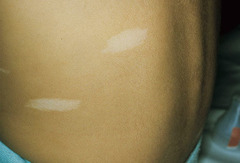
Ash leaf spots
hypomelanotic areas of the skin present in 90% of patients having tuberous sclerosis
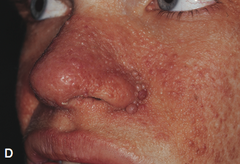
Adenoma sebaceum
angiofibromas of the skin presenting as a reddish brown papular rash in 75% of patients having tuberous sclerosis
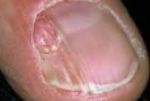
25
Fibromas of the nail occur in ______% of patients having tuberous sclerosis
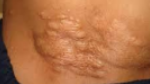
Shagreen patches
connective tissue hamartomas occurring in 20% of tuberous sclerosis patients typically in the lumbosacral region.
RPE depigmentation
Angiofibromas of the lid and conjunctiva
2 Ocular Findings in Tuberous Sclerosis

Lung complications
Renal complications (cysts, carcinoma)
Rhabdomyosarcoma (67%)
Spinal sclerosis (40%)
Pitting of tooth enamel
5 Systemic Considerations of Tuberous Sclerosis
2, 1, 2
The definite diagnosis of tuberous sclerosis involves the identification of ____ major features, or ____ major and ____ minor features
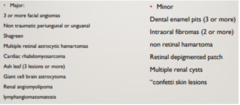
1
The possible diagnosis of tuberous sclerosis involves the identification of ___ major feature and ____ minor feature
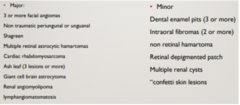
Von Hippel Lindau disease
condition characterized by angiomatoses of the retina and cerebellum and renal cell carcinoma due to an autosomal dominant mutation of the 3p25-26 tumor suppressing gene. Does not involve cutaneous lesions.
peripheral
Retinal hemangioblastomas occurring in von Hippel Lindau disease occur in the _____ retinal
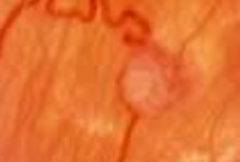
RD, glaucoma, persistent uveitis
patients having advanced retinal hemangioblastomas and Von Hippel Lindau disease experience blindness secondary to associated... (3)
50%
percentage of von Hippel Lindau patients that have bilateral retinal disease
60%
percentage of von Hippel Lindau patients that have multiple lesions in one eye
50%
percentage of von Hippel Lindau patients that will have severe vision loss if left untreated
Photocoagulation
Cryotherapy
Anti-VEGF injection
3 Treatments of Retinal Hemangioblastomas
cerebellum
Lesions of the CNS in Von Hippel Lindau disease typically occur in the...
Syrinx
fluid filled cyst of the spinal cord or brainstem occurring in Von Hippel Lindau disease. Presents as weakness, atrophy of hands and arms, pain, and nystagmus.
Endolymphatic sac tumors
aggressive tumors in Von Hippel Lindau disease that present with symptoms such as hearing loss, tinnitus, vertigo, and facial weakness.
-Renal cell carcinoma
-Pheochromocytoma
-Polycythemia
-Benign cysts of kidney, pancreas, liver, epididymis
4 Visceral findings in Von Hippel Lindau Disease
-CNS or retinal hemangioblastoma with a visceral manifestation
-Family history
-Presence of gene mutation
Diagnosis of Von Hippel Lindau Disease (3)
Sturge Weber Syndrome
condition characterized by capillary venous vascular malformation of the brain, meninges, and skin with an unknown inheritance pattern. Occurs due to a somatic mosaic mutation of G protein alpha subunit q (GNAQ).
CN V
Facial hemangioma seen in Sturge Weber syndrome is present at birth following the distribution of...
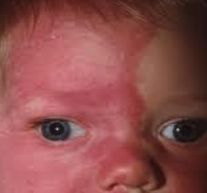
hemihypertrophy
Port wine stain may be associated with ____ of the face
60%
percentage of Sturge Weber patients that develop secondary glaucoma by the age of 2 yo. Is more common if the hemangioma involves the upper lid.
ipsilateral, patieto-occipital
Central nervous system hemangiomas in Sturge Weber syndrome usually occur _____ to the facial lesion located in the _____ area. The underlying cortex is maldeveloped with absent or non-functional veins and calcium deposition ("tram track")
Cortical seizures (75%)
Learning disability (55-85%)
Hemiplegia
VF deficits
Headaches
Growth hormone deficiency
6 Clinical Consequences of Sturge Weber Syndrome
-Facial angioma with ipsilateral intracranial hemangioma
-Ipsilateral choroidal hemangioma
-Congenital glaucoma
Diagnosis of Sturge Weber Syndrome involves at least 2 of these three diagnostic criteria
can
Patients (can or cannot) have a port wine stain in the absence of Sturge Weber syndrome
Wyburn mason syndrome (retinocephalic vascular malformation)
very rare condition characterized by arterio-venous malformations of the brain, retina, orbit, and skin.
Racemose angioma
Orbital AVM
Optic nerve AVM
3 Ocular Findings of Wyburn Mason Syndrome
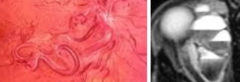
ipsilateral, 50
Central nervous systemic AV malformations in Wyburn mason syndrome occur ____ to the retinal lesion with ____% of these patients having symptoms
intracranial with retinal AVM
Diagnosis of Wyburn mason syndrome involves...
Louis Bar syndrome (ataxia telangiactasia)
condition characterized by cutaneous lesions of the ears, nose, and antecubital fossae usually present around the age of 4 yo. Occurs due to autosomal recessive mutation of the AT gene (DNA damage repair) on chromosome 11.
Bilateral bulbar conjunctival telangiectasia
Ocular motility disturbances
2 Ocular Findings of Louis Bar Syndrome
3-6
Bilateral bulbar conjunctival telangiectasia in Louis bar syndrome
Appear at the age ____ yo and become more prominent with age
Complete supranuclear ophthalmoplegia
ocular motility disturbance in Louis bar syndrome ultimately progresses to...
10
Louis bar syndrome patients may become wheelchair bound by age ____ yo due to atrophy of the cerebellar cortex and vermis
Dysarthria
slurred speech due to loss of muscular control. seen secondary to CNS lesions of Louis bar syndrome
Chorea
involuntary fidgety muscle movements. seen secondary to CNS lesions of Louis bar syndrome
Dystonia
involuntary muscle contractions. seen secondary to CNS lesions of Louis bar syndrome
IgG2, IgG4, IgA, IgE
4 immunoglobulins that are deficient in Louis bar syndrome
100
patients with Louis bar syndrome have a ____x the risk of cancer due to poor DNA repair
Alpha-fetoprotein
cancer marker that is elevated in Louis Bar syndrome patients
-Increased radiation induced chromosomal breakage in cultured cells
-Progressive cerebellar ataxia with mutations in both alleles
Definite Diagnosis of Louis Bar Syndrome requires 1 of these two findings
-Ocular or facial telangiectasia
-elevated Alpha-fetoprotein
-depressed IgA levels
Probable (3) and Probable (2) Diagnosis of Louis Bar Syndrome
(3 diagnostic findings)
Klippel-tranaunay weber syndrome (KTWS)
condition characterized by an overgrowth of tissue secondary to a mutation of the PIK3CA gene. Presents with cutaneous capillary malformations, varicosities, and tissue hypertrophy most commonly affecting the arms, trunk, head, and neck. Gait deformities and scoliosis may arise from abnormal bone and soft tissue hypertrophy.
98
Port wine stain that thickenings and darkens with age is seen in _____% of patients having Klippel-Tranaunay weber syndrome
Orbital varix
Iris heterochromia
Choroidal angioma
3 Ocular Findings of Klippel-Tranaunay Weber Syndrome
Cutaneous vascular abnormality
Soft tissue hypertrophy
Bony hypertrophy
Varicose veins
Diagnosis of Klippel-Tranaunay Weber Syndrome
(requires 2 of these four diagnostic criteria