Plant Responses - Chp 32
 Call Kai
 Learn
Learn Practice Test
 Spaced Repetition
 Match
Match Flashcards
 Knowt Play
1/25

There's no tags or description
Looks like no tags are added yet.
Name | Mastery | Learn | Test | Matching | Spaced | Call with Kai | Chat |
|---|
No analytics yet
Send a link to your students to track their progress
26 Terms
Stimulus
anything that causes a reaction in an organism
Response
activity in a cell or organism that occurs as a result of the stimulus
How does the way plants respond differ from how animals respond?
only have a chemical response;animals have a chemical, nervous and immune system
their responses are slow; animals are capable of fast and slow responses
plant reponses include; growth, flowering, production of enzymes
animals responses include movement, feeding etc
What are the external factors that stimulate plant responses?
Light intensity - provides energy for photosynthesis
Day length - causes plants to flower, seed and fruit formation, and seed germination
Gravity - causes roots to grow downwards, and shoots to grow upwards
What are the internals factors that stimulate a plant response?
plants produce chemicals, growth regulators, in the meristematic regions of the plant
Tropism
a change in the growth of a plant in response to an external stimulus to obtain more favourable growing conditions
Phototropism
change of growth in response to light
Geotropism
change of growth in response to gravity
Thigmotropism
change of growth in response to touch
Hydrotropism
change of growth in response to water
Chemotropism
change of growth in response to chemicals
Growth regulator
a chemical that controls the growth of a plant
Where are growth regulators produced?
meristem → travel through vascular tissue to different parts of the plant
What impacts the affect of growth regulators?
concentration - usually active in small amounts; can have opposite effect at higher or lower concentrations
location - can have opposite effects in shoot or root
Promoters + example
increase the rate of growth for the plant
auxin (IAA)
Inhibitors
What does IAA stand for? not sure if need to know
indoleacetic acid
Where is Auxin made
in shoot tips, young leaves, seeds
What are the functions of auxin?
stimulates cells to grow longer, causing stem elongation and root growth
develops fruit
causes phototropism and geotropism
moves through plant by active transport
What are the effects of auxin?
Tropisms - causes growth as the cells elongate
Apical dominance - apical bud releases auxins and stops the lateral buds from growing; if the apical bud is removed the side branches will develop and a low bushy plant will form
Fruit formation - stimulate the growth of food in the fruit around the seed, this results in seedless fruits
Root growth - at low concentrations only will cause roots to grow
What is another name for seedless fruits?
parthenocarpic
How does auxin cause cell elongation?
auxin helps break down the cell walls in a plant, allowing them to expand
Describe the role of Auxin in phototropism

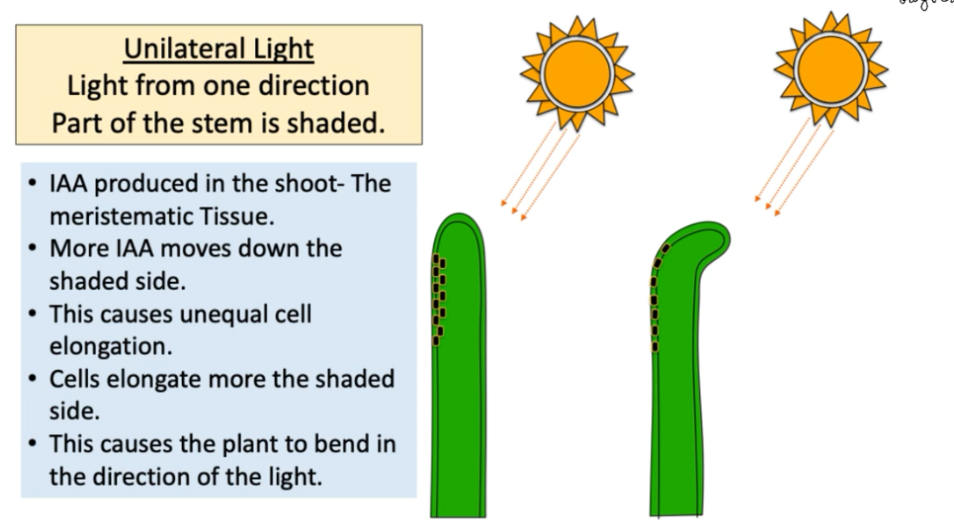
diffuses down the shaded side
bends due to the unequal distribution
Draw a graph to show the behaviour of roots and shoots in response to auxins

Give 2 commercial uses for growth regulators:
ethene is used to commercially ripen fruits
auxins are used to produce seedless fruits
root powders such as NAA stimulates root growth from plant cuttings
Name 4 methods of plant protection
Anatomical
epidermis prevents the entry of pathogens and prevents excessive water loss
guard cells close to prevent water loss in high temperatures
abscisic acid produced in mesophyll cells also cause stomata to close to conserve water
Chemical
cabbages produce mustard oils to deter animals
oak trees produce tannins to deter caterpillars
rhubarb contains oxalic acid, which is fatal to animals in high doses