Chapter 2: Mental Health and Stress
 Call Kai
 Learn
Learn Practice Test
 Spaced Repetition
 Match
Match Flashcards
 Knowt Play
1/18

There's no tags or description
Looks like no tags are added yet.
Name | Mastery | Learn | Test | Matching | Spaced | Call with Kai | Chat |
|---|
No analytics yet
Send a link to your students to track their progress
19 Terms
positive psychology
The focus is on the positive emotions, characteristics, strengths, and conditions that create happiness.
six broad virtues “enable human thriving”
•Wisdom.
•Courage.
•Humanity.
•Justice.
•Temperance.
Transcendence.
characteristics of mentally healthy people
•They possess high self-esteem—positive regard for themselves (general perception of yourself)
•They accept imperfections.—highlights best level of self-esteem
•They are altruistic—unselfishly concerned for others.
•They have a sense of control over their lives.
•They demonstrate social competence and can rely on others.
•They are not overwhelmed by fear, love, or anger.
•They are optimistic; they maintain a positive outlook on life.
•They have a capacity for intimacy and do not fear commitment.
•They are creative and appreciate creativity in others.
•They persevere and take on challenges.
•They take reasonable risks in order to grow.
•They bounce back from adversity—hardiness, resilience
wisdom and knowledge
cognitive strengths that entail the acquisitions and use of knowledge
courage
emotional strengths that involve the exercise of will to accomplish goals in the face of opposition, external or internal
humanity
interpersonal strengths that involve “tending and befriending” others
justice
civic strengths that underlie healthy community life
temperance
strengths that protect against excess
transcendence
strengths that forge connections to the larger universe and provide meaning
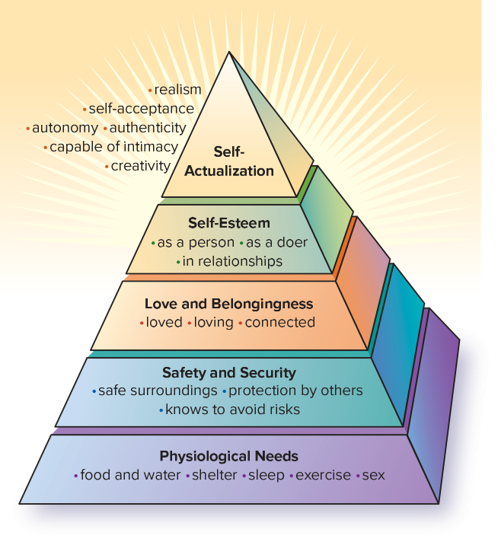
self-actualization
the state attained when a person has reached their full potential; Developed by Abraham Maslow as the level at which people achieve transcendence—a sense of well-being that comes from finding purpose and meaning in life.
Maslow’s Hierachy of Needs
autonomy meaning ones choice to do something
optimism
the general expectation that things will turn out well.
•A tendency to see problems as temporary and specific rather than permanent and general.
self-efficacy
a general sense that you have some control over your life.
resilience
the ability to bounce back from adverse events.
what are the 3 components of happiness
•Positive emotion and pleasure (savoring sensory experiences).
•Engagement (being deeply involved with family, work, romance, and hobbies).
•Meaning (using personal strengths to serve some larger end).
T/F: some people may have a happiness “set point” determined by genetics
true
happiness by the numbers
40% is our happiness
10 friends
5 interactions
33, 55, the 70s
$95,000 income
6-7 hours socializing
emotional intelligence
qualities like self-awareness,
self-discipline, persistence, and empathy are more important to attain success in life than intelligence quotient (IQ)
people who are emotionally intelligent can…
•Recognize, name, and understand their emotions.
•Manage their emotions and control their moods.
•Motivate themselves.
•Recognize and respond to emotions in others.
•Be socially competent.