Reactions of ions in aqueous solution
 Call Kai
 Learn
Learn Practice Test
 Spaced Repetition
 Match
Match Flashcards
 Knowt Play
1/71

There's no tags or description
Looks like no tags are added yet.
Name | Mastery | Learn | Test | Matching | Spaced | Call with Kai | Chat |
|---|
No analytics yet
Send a link to your students to track their progress
72 Terms
How are metal-aqua complexes formed?
Metal-aqua complexes are formed when a transition metal is added to water.
How many water ligands form with a transition metal ion?
Six.
Draw a copper-aqua complex. Does this structure in water apply to all transition metal ions?
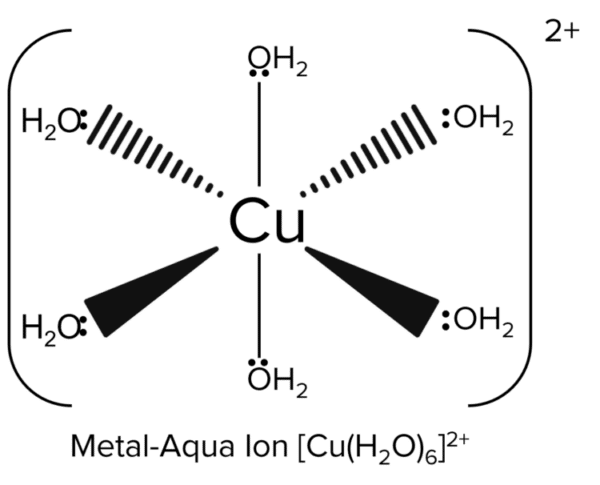
Yes, all transition metal ions form these complexes in water.
What is a ligand?
A coordinate bond.
Why do water ligands form?
The oxygen in water has a lone pair of electrons on the oxygen, this lone pair of electrons form a coordinate bond with the transition metal ion (this happens six times when a transition metal ion is mixed in water).
How is a 2+ metal-aqua complex written?
[M(H2O)6]2+ (aq)
How is a 3+ metal-aqua complex written?
[M(H2O)6]3+ (aq)
True or false? Metal-aqua ions are basic when in solution.
False. METAL-AQUA IONS ARE ACIDIC WHEN IN SOLUTION.
True or false? The charge of the metal-aqua ion has an effect on how acidic the metal-aqua ion is.
True.
True or false? The hydroxide ion shows that something is acidic.
False. THE HYDROXIDE ION SHOWS THAT SOMETHING IS BASIC, THE HYDROXONIUM ION/ HYDROGEN ION SHOWS THAT SOMETHING IS ACIDIC (H3O+).
Give the general symbol equation for the reaction between a metal-aqua complex and water that show metal-aqua complexes are acidic when mixed with water.
[M(H2O)6]x+ (aq) + H2O (l) →← [M(H2O)5(OH)]x-1+ (aq) + H3O+ (aq)
True or false? Mixing a metal-aqua ion complex with water is a hydrolysis reaction.
True.
True or false? 2+ complex ions are very acidic as they dissociate fully.
False. 2+ COMPLEX IONS ARE NOT VERY ACIDIC AS THEY DISSOCIATE WEAKLY.
True or false? 3+ ion complexes are more acidic than 2+ ion complexes.
True.
Explain why 3+ ion complexes are more acidic than 2+ ion complexes.
3+ metal ions have a greater charge density than 2+ metal ions (because they have a larger charge and are small).
So 3+ ions are more polarizing than 2+ ions.
So 3+ ions attract the lone pair of electrons on the oxygen in water more.
So 3+ ions weaken the O-H bond in water more.
This makes it easier for that bond to be broken to release a H+ ion (more H+ ions, more acidic).
True or false? Metal ion complexes can be further hydrolysed by hydroxide ions.
True.
What is the main product of the reaction between a metal ion complex and hydroxide ions?
(Insoluble) metal hydroxide.
Explain what happens to the position of equilibrium when hydroxide ions (OH-) are added to the reaction between a metal-aqua complex and water.
The negatively charged hydroxide ions react with the positively charged hydroxonium ions.
This decreases the concentration of hydroxonium ions in the equilibrium mixture.
Equilibrium will shift right to oppose this change (favours the forward reaction that produces hydroxonium ions).
Give the symbol equation for the reaction for the further hydrolysis of former 2+ metal-aqua complexes with hydroxide ions.
[M(H2O)5(OH)]+ (aq) + H2O (l) → ←M(H2O)4(OH)2 (s) + H3O+ (aq)
True or false? It takes two reactions with hydroxide ions for former 3+ metal-aqua complexes to become insoluble metal hydroxides.
True.
True or false? Metal-aqua complexes stop reacting with hydroxide ions once a solid compound with no charge (insoluble metal hydroxide) is formed.
True.
Give the general symbol equation for the first and then second reaction between former 3+ metal-aqua complexes until a solid metal hydroxide is formed.
1st reaction
[M(H2O)5(OH)]²+ (aq) + H2O (l) → ← [M(H2O)4(OH)2]+(aq) + H3O+ (aq)
2nd reaction
[M(H2O)4(OH)2]+ (aq) + H2O (l) →← M(H2O)3(OH)3 (s) + H3O+ (aq)
What is the source of hydroxide ions in the further hydrolyses of metal-aqua complexes?
The hydroxide ions are sourced from the former water molecules that lost a H+ ion when giving it to water in previous reactions with water.
Why do metal hydroxides form as precipitates in solution?
They are insoluble.
Why does the hydrolysis of 2+ metal-aqua complexes take two steps whereas the hydrolysis of 3+ metal-aqua complexes take three steps?
In 2+ metal-aqua complexes only two water ligands must be deprotonated to form a neutral compound whereas 3+ metal-aqua complexes three water ligands must be deprotonated to form a neutral compound.
What does amphoteric mean?
Being able to act as an acid or a base.
True or false? Metal hydroxides are not amphoteric.
False. METAL HYDROXIDES ARE AMPHOTERIC.
True or false? Metal hydroxides with dissolve in both excess acid and base.
True (as they are amphoteric).
Explain how you can dissolve metal hydroxides.
Add acid (source of H+ ions) to the metal hydroxide. The metal hydroxide acts as a base and accepts H+ ions (acting as a Bronsted-Lowry base).
Give the symbol equation for the reaction between a metal hydroxide (formed from a metal that usually has a 3+ charge as an ion, aluminium is example) and hydroxide ions. Is aluminium hydroxide acting as a Bronsted-Lowry acid or base in this reaction?
Al(H2O)3(OH)3 (s) + OH- (aq) → [Al(H2O)2(OH)4]- (aq) + H2O (aq)
It is acting as a Bronsted-Lowry acid.
Give the symbol equation for the reaction between a metal hydroxide (formed from a metal ion that usually has a 3+ charge, aluminium is the example) and H+ ions (from an acid). Is aluminium hydroxide acting as a Bronsted-Lowry acid or base in this reaction?
Al(H2O)3(OH)3 (s) + 3H3O+ (aq) →← [Al(H2O)6]3+ (aq) + 3H2O (aq)
Aluminium hydroxide is acting as a Bronsted-Lowry base.
What is a ligand substitution reaction?
A reaction in which ligands in a complex ion are switched for different ligands.
What is the main product of the reaction between metal-aqua ions and (non-excess) ammonia?
Metal hydroxide precipitate.
Under what conditions do ligand exchange reactions take place when reacting metal-aqua ions with ammonia?
When ammonia is in excess.
Give the equation for ammonia in water.
NH3 (aq) + H2O (l) →← NH4+ (aq) + OH- (aq)
True or false? The main product of the reaction of metal-aqua ions with small amounts of ammonia is the same as the main product of the reaction between metal-aqua ions are hydroxide ions.
True.
Give the symbol equation for the reaction between copper-aqua ions and excess ammonia.
[Cu(H2O)6]2+(aq) + 4NH3 (aq) →←[Cu(NH3)4(H2O)2]2+ (aq) + 2H2O (l) + 2OH- (aq)
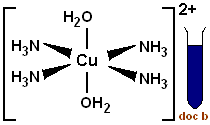
(This reaction is the same for other 2+ aqua ions).
What is a monodentate ligand?
An ion or molecule that binds to a central transition metal ion by donating a single pair of electrons, forming one dative bond per molecule.
What is a bidentate ligand?
An ion or molecule that has two lone pair of electrons.
What is a multidentate ligand?
An ion or molecule that has more than two lone pairs of electrons.
Give the general word equation for the reaction between 2+ metal-aqua ions and sodium carbonate (or just any compound containing carbonate ions).
Sodium carbonate + 2+ metal-aqua ion →← metal carbonate precipitate + water
Give the general symbol equation for the reaction between a 2+ metal-aqua complex and a carbonate ion.
[M(H2O)6]2+ (aq) + CO32- (aq) →← MCO3 (s) + 6H2O (l)
True or false? Metal carbonates are soluble in water.
False. METAL CARBONATES ARE INSOLUBLE IN WATER.
Why do 3+ metal-aqua ions react so differently to 2+ metal-aqua ions with carbonates?
As 3+ metal-aqua ions are more acidic, there are more hydroxonium (H3O+) ions in solution.
The carbonate ions react with free hydroxonium ions instead of replacing the water ligands.
Give the general symbol equation for the reaction between 3+ metal-aqua ions and carbonates. State and explain any observations during this reaction.
2[M(H2O)6]3+ (aq) + 3CO32- (aq) →← 2M(OH)3(H2O)3 (s) + 3CO2 (g) + 3H2O (l)
Effervescence, caused by carbon dioxide gas being produced.
How can you use carbonates to determine whether you have a sample of 2+ metal-aqua ions or 3+ metal-aqua ions?
Add carbonates to your sample. If there is effervescence, 3+ metal-aqua ions are present (as they react with carbonates to produce carbon dioxide gas), if not 2+ metal-aqua ion are present.
What is the usual source of hydroxide ions for test-tube reactions?
Sodium hydroxide (NaOH).
What is the usual source of carbonate ions for test-tube reactions?
Sodium carbonate.
How do you test for different metal-aqua ions with simple test-tube reactions?
1) Add a sample of the unknown metal-ion solution into a test-tube.
2) Add sodium hydroxide/ammonia/sodium carbonate drop by drop (in small amounts) and record any observations in the test tube.
3) Add more sodium hydroxide/ammonia/sodium carbonate so that they are in excess and record any observations in the test tube.
State and explain two safety precautions that must be taken when doing simple test-tube reactions to identify metal-aqua ions.
Wear gloves and goggles, some of the chemicals are irritants.
Do the investigation in a fume cupboard, ammonia is a respiratory irritant.
List four metal ions that will react with sodium hydroxide to form precipitates.
Iron (II)
Copper (II)
Aluminium (III)
Iron (III)
Why doesn’t aluminium hydroxide react with excess sodium hydroxide to form a precipitate?
It dissolves as it is amphoteric (this doesn’t happen to any other metal ions).
List four metal ions that will react with ammonia to form precipitates.
Iron (II)
Copper (II)
Aluminium (III)
Iron (III)
Why does copper hydroxide precipitate dissolve in excess ammonia?
A ligand substitution reaction takes place (this doesn’t happen to any other metal precipitates).
List four metal ions that react with sodium carbonate to form precipitates.
Iron (II)
Copper (II)
Aluminium (III)
Iron (III)
Why must Fe²+ solutions be made fresh?
Fe²+ ions oxidise readily with air to form Fe³+ ions.
What is the colour of [Cu(H2O)6]2+/Cu2+ (aq)?
Blue.
What colour is Cu(OH)2(H2O)4 ?
Pale blue precipitate.
What colour is [Cu(NH3)4(H2O)2]2+ (aq)?
Dark blue solution.
What colour is CuCO3?
Green-blue precipitate.
What colour is [Fe(H2O)6]2+/Fe2+ (aq)?
Pale green.
What colour is Fe(OH)2(H2O)4?
Dirty green precipitate.
What colour is FeCO3?
Green precipitate.
What colour is [Fe(H2O)6]3+ /Fe3+ (aq)?
Yellow.
What colour is Fe(OH)3(H2O)3?
Orange precipitate.
What colour is Fe(OH)3(H2O)3 when it is formed from a reaction with sodium carbonate?
Brown precipitate.
What colour is [Al(H2O)6]3+/Al3+ (aq)?
Colourless.
What colour is Al(OH)3(H2O)3?
White precipitate.
What colour is [Al(OH)4(H2O)2]-?
Colourless solution.
Give the balanced symbol equation for the reaction between hydrochloric acid and aqueous copper (II) ions.
[Cu(H2O)6]2+ + 4Cl- → [CuCl4]2- + 6H2O
What colour is [CuCl4]2- solution?
Yellow-green.
What colour is [CoCl4]2- solution?
Blue.