BIO 3010 Midterm I MCQ
 Call Kai
 Learn
Learn Practice Test
 Spaced Repetition
 Match
Match Flashcards
 Knowt Play
1/51

There's no tags or description
Looks like no tags are added yet.
Name | Mastery | Learn | Test | Matching | Spaced | Call with Kai | Chat |
|---|
No analytics yet
Send a link to your students to track their progress
52 Terms
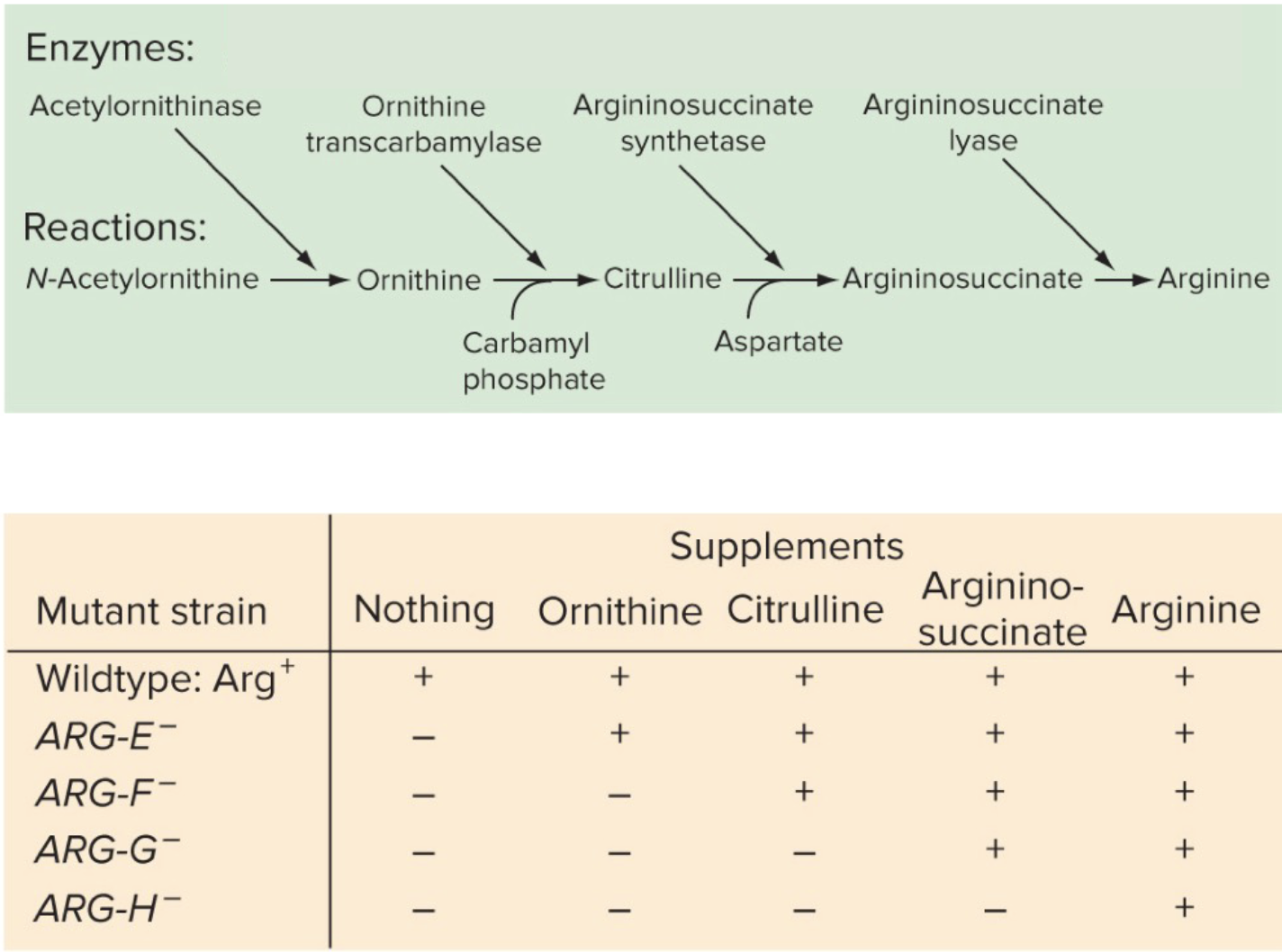
The green box describes the enzymatic pathway that produces arginine. The orange box describes
results from testing whether growth of particular mutant strains of yeast can be rescued with
precursors to arginine. According to these results, which enzyme does ARG-F code for?
a. Acetylornithinase
b. Ornithine transcarbamylase
c. Argininosuccinate synthetase
d. Aspartate
e. Argininosuccinate lyase
Ornithine transcarbamylase
Mendel’s Law of Independent Assortment accurately describes
a. the reason that parental traits seem to blend together in offspring
b. the molecular nature of genes and alleles
c. why the two alleles of a gene are incorporated independently into gametes
d. the reason some alleles are recessive
e. the segregation of alleles at genes not physically linked to one another
the segregation of alleles at genes not physically linked to one another
Which of the following is essential for natural selection to occur?
a. the population must be small enough for adequate inbreeding to occur
b. traits must be continuous rather than discrete
c. there must be a long period of time during which selective factors can act
d. there must be a consistent relationship between an individual’s value of a trait and its survival or reproductive success
e. there must be multiple traits targeted
there must be a consistent relationship between an individual’s value of a trait and its survival or reproductive success
James Watson is known for (pick all the apply):
a. publication describing the structure of DNA
b. use of unpublished X-ray diffraction data gathered by Rosalind Franklin
c. racism and misogyny
All of them
Single-stranded RNA is composed of a phosphate backbone, ...
a. deoxyribose sugar and nitrogenous bases, bound together by covalent bonds.
b. deoxyribose sugar and nitrogenous bases, bound together by non-covalent hydrogen bonds.
c. ribose sugar and nitrogenous bases, bound together by covalent bonds.
d. ribose sugar and nitrogenous bases, bound together by hydrogen bonds.
e. dideoxyribose sugar and nitrogenous bases, bound together by non-covalent hydrogen bonds.
ribose sugar and nitrogenous bases, bound together by covalent bonds.
According to NASA (1979), “life...
a. ...is defined by Mendel and so must only be terrestrial.”
b. ...is a self-sustaining system that guides the production of new variation.”
c. ...is a self-sustaining system capable of Darwinian selection.”
d. ...is unlikely to have evolved by Darwinian selection.”
e. ...is currently complex and so must have originated with simpler RNA.”
…is a self-sustaining system capable of Darwinian selection.”
The demonstration that RNAs can copy template RNA by adding triplets of ribonucleotides showed that:
a. ribosomes are not required for RNA synthesis
b. RNAs can have polymerase activity
c. the genetic code arose at the same time as the first genetic material
d. ribozymes were the earliest form of life
e. polymerase activity can never be improved by selection
RNAs can have polymerase activity
Which of the following is consistent with the “RNA World” hypothesis (i.e., that RNA was the
ancestral genetic material)?
a. The widespread occurrence of self-replicating RNAs
b. The ability of RNAs with modified bases to catalyze small peptides
c. The abundance of adenine and uracil dimers in pre-biotic times
d. The relatively simple components that make up ribonucleotides
e. The simplicity of modern ribosomes
The ability of RNAs with modified bases to catalyze small peptides
Which of the following best describes the most important finding of Frederick Griffith's experiments in which he injected Pneumococcus bacteria into mice?
a. protein was identified as the genetic material responsible for transformation between virulence states
b. the immune system of mice was responsible for bacterial transformation, whether towards virulence or
non-virulence
c. virulent bacteria were transformed into non-virulent bacteria when co-injected with cell components from heat-killed non-virulent bacteria
d. virulent bacteria caused pneumonia in mice
e. non-virulent bacteria transformed into virulent bacteria when injected with cell components from heat-killed virulent bacteria
non-virulent bacteria transformed into virulent bacteria when injected with cell components from heat-killed virulent bacteria
RNase P is an example of:
a. coding RNA
b. tRNA
c. artificially selected RNA
d. ribosomal RNA
e. catalytic RNA
catalytic RNA
Which statement is true?
a. RNA uses all of the same bases as DNA, only more of them
b. RNA can be converted to DNA by RNA polymerase I
c. RNA can only interact with other RNAs, not proteins
d. RNA is single stranded and can have complex secondary structure
e. RNA always codes for protein
RNA is single stranded and can have complex secondary structure
UTP is an example of:
a. an RNA
b. a ribonucleoside
c. a nitrogenous base
d. a ribonucleotide
e. a modified tRNA nucleotide
a ribonucleotide
Dapi is an example of:
a. a transcription factor
b. a chemical used to visualize protein by fluorescence
c. a DNA major groove intercalator
d. a plant defense chemical
e. a chemical used to visualize DNA
a chemical used to visualize DNA
The genetic code
a. has overlapping codons
b. reads 3’ to 5’ on the mature mRNA
c. often results in functional proteins when 2 nucleotides are inserted and 1 nucleotide is deleted
d. is degenerate
e. specifies 64 different amino acids
is degenerate
The stop codon of a typical eukaryotic protein-coding gene marks...
a. where a frame shift has occurred in the coding sequence
b. the place where transcription ends
c. the place where transcription starts
d. the end of the gene
e. the final codon before an untranslated region is transcribed
the final codon before an untranslated region is transcribed
The classical “Central Dogma” of molecular biology states that:
a. DNA is transcribed into RNA, which is translated into protein
b. DNA is translated into RNA, which is transcribed into protein
c. DNA is translated into protein, which transcribed into RNA
d. DNA is transcribed into RNA, which is transcribed into protein
e. RNA is translated into DNA, which is transcribed into protein
DNA is transcribed into RNA, which is translated into protein
select all that apply
Modern criticism of the “one gene, one enzyme” hypothesis could include:
a. some genes do not encode proteins
b. some enzymes are not encoded by genes
c. some genes can produce more than one protein
d. some genes produce proteins other than enzymes
e. some enzymes encode more than one gene
a, c, and d
If a segment of DNA with bases 3’-ATG-CAT-GCC-5’ on the template strand is transcribed into mRNA,
what is the corresponding segment of mRNA (before any processing)?
a. 5’-TAC-GTA-CGG-3’
b. 3’-TAC-GTA-CGG-5’
c. 3’-UAC-CUA-CGG-5’
d. 5’-UAC-GUA-CGG-3’
5’-UAC-GUA-CGG-3’

In the coding sequence of DNA below an inserted nucleotide is shown in lower case. If this is the start of an open reading frame, what would be the consequence(s) for the final peptide.
ATGAACAATcGCGCCTGAGGTAGCTGAC
a. a silent substitution
b. incorporation of amino acids encoded by the 3’ UTR
c. secretion from the cell
d. premature termination
e. addition of a new lysine that can be methylated post-translationally
premature termination

What peptide sequence would you expect from the template strand of DNA below?
3’ - AAC CTC TAC GAG CTC ATG - 5’
a. Tyr Glu Leu Met Glu Leu
b. Ile Asn Ser Ile Arg Ser
c. Tyr Asn Leu Tyr Glu Leu
d. Leu Glu Met Leu Glu Tyr
Leu Glu Met Leu Glu Tyr
In eukaryotes:
a. mRNAs rarely include non-coding sequence
b. genes cannot overlap
c. genes often are split between chromosomes
d. introns are transcribed
e. only two stop codons exist
introns are transcribed

select all that apply
For the gene model below, choose all the correct identifications.
a. 1: 5’ untranslated region
b. 2: exon coding sequence
c. 3: exon (non-coding sequence)
d. 4: exon (non-coding sequence)
e. 5: transcriptional start site
b, d, and e
What is true about cis-regulatory elements?
a. they code for activator and repressor proteins
b. they are sometimes present within introns
c. they occur primarily at the transcriptional start site
d. they are translated at the same time as RNA
e. their sequences are invariant
they are someimes present within introns
Gene bodies sometimes overlap because
a. genes frequently share a basal promoter
b. transposable elements normally copy gene coding sequences “in frame”
c. cis regulatory elements can be far from the coding sequence itself
d. exons and introns can be templated on different strands of DNA
e. alternative splicing allows single primary transcripts to encode >1 polypeptide from >1 gene
exons and introns can be templated on different strands of DNA
Sequencing of the human genome revealed
a. as many as 20,000 exons per gene
b. just over 40,000 genes, similar to what had been predicted theoretically
c. gene bodies as large as 2,000,000 bp
d. just under 2,000,000 genes, similar to what had been predicted theoretically
e. a very small total amount of sequence containing repetitive elements
just over 40,000 genes, similar to what had been predicted theoretically
Which of the following components is required for a successful Polymerase Chain Reaction (PCR)?
a. RNA polymerase
b. RNA primers
c. DNA polymerase
d. ddNTPs
e. DNA ligase
DNA polymerase
Which of the following statements are true about simple sequence repeat loci?
a. most occur in coding sequence
b. they usually are deleterious to fitness
c. they often have alleles that vary in size
d. they simplify genome assembly
e. they are found only between genes bodies, not within them
they often have alleles that vary in size
In the context of second generation sequencing, the PCR step is important for:
a. detecting terminator-linked dyes
b. attaching template to the flow cell
c. ligating adapters to the template DNA
d. modifying the dye-labeled nucleotides
e. adding dye labeled nucleotides to the terminators previously incorporated
attaching template to the flow cells
For whole genome sequencing, libraries of bacterial artificial chromosomes...
a. prevented sequencing of bacterial DNA at the same time as human DNA
b. prevented sequence assembly by narrowing the genomic intervals in which new sequences might have originated
c. were employed by the privately funded effort to ensure no sequence “went missing”
d. have largely been replaced by third generation long-read sequencing
e. revealed the transcriptional start sites of each protein coding gene
have largely been replaced by third generation long-read sequencing
Modern genetics and genomic analyses have benefited enormously from technical advances made since the 1970s. Such advances include:
a. the “rediscovery” of Darwin and application of his laws to artificial selection experiments
b. identification of RNA as the genetic message
c. elucidation of the genetic code
d. methods for targeted genome editing
e. validation of the one gene – one enzyme hypothesis
methods for targeted genome editing
Kary Mullis played an important role in developing PCR, all while taking acid and surfing. He
demonstrated that:
a. ribonucleotides are required as primers for extension
b. DNA strands can be ligated back together for uninterrupted priming
c. oligonucleotide primer binding during denaturation allowed for subsequent product extension
d. repeated cycles of template denaturation, primer annealing and strand extension can provide exponential amplification of a DNA template
e. a sequence of primer annealing, followed by template denaturation and then strand extension can provide exponential amplification of a DNA template
repeated cycles of template denaturation, primer annealing and strand extension can provide exponential amplification of a DNA template
Since the inception of DNA sequencing, the amount of raw sequence data that can be generated by a
sequencing instrument per “run” has increased by:
a. about 5X the original amount
b. about 50X the original amount
c. about 500X the original amount
d. about 5000X the original amount
e. none of the above
none of the above
“Reversible terminators” are important in what context?
a. Solid phase sequencing
b. PCR
c. Gene body identification
d. RNA transcription
e. Prokaryotic gene regulation
Solid phase sequencing
Which of the following statements is true about cyclins and CDKs?
a. cyclins remain at constant abundance across the cell cycle and complexes formed between cyclins and variably abundant CDKs permit phosphorylation of target proteins
b. cyclins are present only during mitosis and G2
c. cyclins remain at constant abundance across the cell cycle and complexes formed between cyclins and variably abundant CDKs permit dephosphorylation of target proteins
d. cyclins change in abundance across the cell cycle and complexes formed between cyclins and CDKs permit phosphorylation of target proteins
e. cyclins change in abundance across the cell cycle and complexes formed between cyclins and CDKs permit dephosphorylation of target proteins
cyclins change in abundance across the cell cycle and complexes formed between cyclins and CDKs permit phosphorylation of target proteins
A major role of unphosphorylated Retinoblastoma protein is to:
a. promote entry into S phase, thereby leading to cancer progression
b. promote the degradation of CyclinD, thereby preventing entry into S phase
c. promote lamin phosphorylation, thereby leading to nuclear envelope dissolution
d. sequester CDK4, thereby preventing CyclinD phosphorylation
e. sequester the E2F transcription factor, thereby preventing entry into S phase
sequester the E2F transcription factor, thereby preventing entry into S phase
Peto’s paradox seems to be explained by
a. the relative lack of oncogenes in larger and longer-lived species, compared to their presumed ancestors
b. larger and longer-lived species not having appreciably greater rates of cancer than smaller, shorter lived
species
c. the ability of larger and longer-lived species to survive with more tumors than smaller, shorter-lived
species
d. the presence of additional tumor suppressor genes in some large-bodied and long-lived species, compared to their presumptive ancestral state
e. the reduced number of oncogenes in smaller shorter lived species compared to their presumed ancestors
the presence of additional tumor suppressor genes in some large-bodied and long-lived species, compared to their presumptive ancestral state
p53 (TP53) induces expression of all of the following EXCEPT:
a. the gene encoding CDK inhibitor p21
b. genes encoding proteins that function in apoptosis
c. genes promoting the G1-to-S transition
d. genes required for programmed cell death
e. genes required for DNA repair
genes promoting the G1-to-S transition
Given your knowledge of p21 function from this class, silencing of its transcription in cancer cells might reasonably be expected to:
a. target p53 for degradation
b. inhibit CDK4-cyclinD phosphorylation
c. allow phosphorylation of Rb
d. prevent entry into S phase
e. promote a quiescent state (G0)
allow phosphorylation of Rb
select all that apply
Without genomic alterations in tumor suppressor number, life-time cancer risk for an organism
would be expected to increase as:
a. lifespan increases
b. cell number increases
c. telomere length increases
d. body size increases
e. CDK inhibitor genes increase
a, b, and d
Leading strand DNA replication involves:
a. initiation by an unusual 5’-to-2’ phosphate bond
b. addition of nucleotides in a 5’-to-3’ direction
c. formation of Okazaki fragments
d. synthesis of a single DNA primer per chromosome
e. polymerase alpha activity
addition of nucleotides in a 5’-to-3’ direction
Select all that apply
In the famous experiments of Meselson and Stahl to identify the mechanism of DNA replication, they found that bacteria grown for a long time in 15N and then transferred for one cycle of replication to 14N contained DNA that sedimented in a single layer after centrifugation. This outcome was consistent with:
a. conservative replication
b. semi-conservative replication
c. dispersive replication
d. semi-dispersive replication
e. semi-circular replication
b and c
select all that apply
Lagging strand DNA synthesis involves:
a. formation of Okazaki fragments
b. an RNA primer
c. strand synthesis in the 5' to 3' direction
d. activity of DNA ligase
e. a PCNA-dependent "sliding clamp"
a, b, c, d, and e
select all that apply
Which of the following statements about telomeres is accurate?
a. their length typically decreases within families during each passing generation
b. their DNA sequence allows base pairing within a displacement loop
c. their repeating Leu-Gly codons (TTA-GGG) are binding sites for charged tRNAs
d. they become shorter because repeated sequences cannot be replicated accurately
e. they are rejuvenated by synthesis of DNA from an RNA template
b, d, and e
Replication in eukaryotic cells involves:
a. selection of multiple origins from sites licensed by the Pre-Replication Complex
b. kinetochore binding to centromeric factors
c. repeated use of a single origin per chromosome arm
d. activation of condensins to disrupt nucleosomes downstream of the replication fork
e. none of the above
selection of multiple origins from sites licensed by the Pre-Replication Complex
The centromere is characterized by:
a. localization of an H1 variant that promotes kinetochore assembly
b. progressive shortening during each cell cycle
c. AT-rich repeated sequence
d. specification of the DNA replication origin
e. acetyltransferase activity during chromatid pairing
AT-rich repeated sequence
Roberts syndrome best illustrates the:
a. essential role of telomere rejuvenation during the eukaryotic life cycle
b. critical function of gene conversion following cross-over in prophase I
c. consequences of chromosome non-disjunction during meiosis
d. loss of CDK-dependent cell cycle control in cancers of old age
e. importance of cohesin stabilization for chromatid pairing during mitosis
importance of cohesin stabilization for chromatid pairing during mitosis
Which of the following is NOT likely to be required for chromosome packaging in mitosis?
a. nucleosomes
b. cohesin
c. condensin
d. nucleolus
e. topoisomerase
nucleolus
How do histone deactylase (HDAC) enzymes inhibit gene expression?
a. by removing acetyl groups from promoter nucleotides, thereby reducing RNA polymerase II binding efficiency
b. by removing acetyl groups from specific amino acids in histone tails, increasing the affinity of
nucleosomes for DNA
c. by deacetylating the growing primary RNA transcript, allowing for increased stability and protein synthesis
d. by adding methyl groups where acetyl groups have been removed
e. by binding to cis regulatory elements distant from the gene body, thereby acting as a bridge with repressive transcription factors
by removing acetyl groups from specific amino acids in histone tails, increasing the affinity of
nucleosomes for DNA
An important pathological role for aberrant histone modification in a pediatric glioma is suggested by:
a. consistent methylation of histone H3 lysine 27 across patients
b. the lack of histone 2X for repairing DNA damage
c. the absence of histone acetylation across the genome
d. recurrent mutations in histone 3 genes across patients that change lysine-27 to methionine
e. the insertion of premature stop codons in genes expressed by these patients
recurrent mutations in histone 3 genes across patients that change lysine-27 to methionine
What is true of CHiP-Seq experiments?
a. they require treatment with DNase
b. they require a “reference” genome sequence to be available
c. they should provide a complete genome sequence when done properly
d. they depend on in vitro translation
e. they are useful for assaying histones but not other DNA-binding factors
they require a “reference” genome sequence to be available
Which of the following would you expect to be more common in heterochromatin as opposed to
euchromatin?
a. HAT proteins
b. H3K27me3
c. active RNA pol II
d. acetylated histones
e. active ribosomes
H3K27me3
select all that apply
Which of the following might be found in chromatin (pick all that apply):
a. histone 1
b. chromodomain protein 1
c. RNA polymerase II
d. polycomb complex proteins
e. DNA
a, b, c, d, and e