Animal Behavior and Welfare Exam 1
 Call Kai
 Learn
Learn Practice Test
 Spaced Repetition
 Match
Match Flashcards
 Knowt Play
1/133

There's no tags or description
Looks like no tags are added yet.
Name | Mastery | Learn | Test | Matching | Spaced | Call with Kai | Chat |
|---|
No analytics yet
Send a link to your students to track their progress
134 Terms
Sentience
The capacity to be affected positively or negatively and have experiences and feel. The capacity to experience suffering and pleasure, implies a level of conscious awareness and consciousness of feelings.
Anthropomorphism
Attributing human characteristics, traits, emotions, or intentions to non-humans
Critical Anthropomorphism
Using human needs as a starting point for considering what animals may need in order to have a good life or, at least, to avoid suffering
Precautionary Principle
If there is a perceived risk to a practice, in the absence of scientific proof and consensus of the risks, err should be on the side of caution, and precautionary measures should mitigate threat even if the cause-and-effect relationship have not been fully established, "better safe than sorry"
Most species unlike us
We don't recognize welfare implications of
Early Definitions of Animal Welfare
Physically healthy, able to survive and reproduce, able to cope with their environment.
Very closed-minded definition
Coping
How an animal is managing and responding to their environment and challenges, regulating their physical and mental state, maintaining stability and homeostasis,
Animal Welfare
The overall mental and physical state of an individual animal and refers to the quality of life experienced by the animal
Welfare is about the animal
Outliers in a large group of animals still matter, the overall group of animals may have good welfare, but you need to look at the individuals
Welfare vs. QoL Timeframe
Quality over quantity, death = no more experiences = no welfare issues, how an animal dies is a welfare concern but not if.
Science of Animal Welfare
Tells us what animals can experience and how conditions affect them
Ethics of Animal Welfare
Asks how we ought to act towards sentient beings
Law of Animal Welfare
Sets the minimum we must do, often trailing both science and ethics
Is animal welfare the same as animal rights?
No
Veterinarian's Oath
Being admitted to the profession of veterinary medicine, I solemnly swear to use my scientific knowledge and skills for the benefit of society through the protection of animal health and welfare, the prevention and relief of animal suffering, the conservation of animal resources, the promotion of public health, and the advancement of medical knowledge
Animal Welfare and the Public
Veterinarian's views on animal welfare are currently trusted, credible, consulted
Professionalism
Requires that the acceptability of current animal-using practices is constantly reviewed and that proposals for evidence-based improvements are made by veterinarians
Importance of animal welfare in veterinary medicine
There are risks to the veterinary profession if veterinarians do not play a full and visible role in the advancement of animal welfare and if we are not seen as advocates for animal interests
1860's Welfare
No pain control, little to no anesthesia
1958 Humane Methods of Slaughter Act (US)
Only federal legislation that protects farm animals on the farm, except chickens
Public Concern in the 1960's
Ruth Harrison Animal Machines, Pepper the dog stolen off owner's property and sold to research market and euthanized
1965 UK Brambell Report
An animal should at least have sufficient freedom of movement to be able without difficulty, turn around, groom itself, get up, lie down, and stretch its limbs. Foundation for 5 Freedoms
1979 Farm Animal Welfare Council
Created the 5 Freedoms based on the Brambell Report
5 Freedoms
1. Freedom from hunger and thirst
2. Freedom from discomfort
3. Freedom from pain, injury, and disease
4. Freedom to express normal behaviors
5. Freedom from fear and distress
1966 Laboratory Animal Welfare Act
1st US federal law regarding animals used for research
1970 Animal Welfare Act (AWA)
Revamp of 1966 Laboratory Animal Welfare Act, Only US federal law regulating the treatment of animals in research, teaching, testing, exhibition, transport, and by dealers. Enforced by USDA and APHIS
The Three R's
"The Principles of Humane Experimental Technique"
Replacement: Alternative to animal use
Refinement: Minimize animal's pain and distress by improving techniques
Reduction: Reduce # of animals used
Speciesism
Attention to those species with whom we are familiar. Different levels of consideration for different animals based on species, not evidence of a difference in their ability to feel positive or negative emotions.
Anthropocentrism
Philosophical, cultural viewpoint, "human beings are the central or most significant entities in the worlds"
Bernie Rollin
Philosopher, bioethicist, created "telos"
"Telos"
An animals' nature, the fulfillment or thwarting of which mattered to them
1990's Temple Grandin
First to discuss stress in handling animals during slaughter and production. Created objective scoring system to assess welfare during handling and slaughter
US Animal Welfare Act 2002
Changed the term "animal" to specifically exclude birds, rats, and mice bred for use in research
UK 2006 Animal Welfare Act
Modified 5 Freedoms, made them 5 Needs
Five Animal Welfare Needs
1. Need for suitable environment
2. Need for suitable diet/nutrition
3. Need to be able to exhibit normal behavior patterns
4. Need to be housed with, or apart from, other animals
5. Need to be protected from pain, suffering, injury, and disease
Ag-gag Laws
Criminalized 1. video recording or photographing anything within an agricultural facility without permission from the owner 2. misrepresenting oneself when applying for a job at an agricultural facility in that one's motives is to collect data or imagery from the facility
2010 Updated Veterinarian's Oath
Being admitted to the profession of veterinary medicine, I solemnly swear to use my scientific knowledge and skills for the benefit of society through the protection of animal health and welfare, the prevention and relief of animal suffering, the conservation of animal resources, the promotion of public health, and the advancement of medical knowledge
21st Century
AWA includes birds, 5 welfare domains, CA prop 12, positive welfare states
CA Prop 12
In CA, meat facilities must house animals in places that meet the minimum housing standards, higher welfare standards
Framework: Continuum
Sliding scale, good welfare: positive experiences, adequate welfare: minimal suffering, poor welfare: negative experiences
Framework: Inputs and Outputs
Resource based and animal based
Inputs
Info about environment, management, and animal risk factors. Resource-based measures. Ex. What the animal is eating, does it receive vaccines, things owner is doing
Outputs
Info about disease, physiology, and behavior. Outcome-based measures. Ex. Health issues or diseases, behaviors animal is exhibiting, things the animal has or is doing in response to inputs
Problem with the Five Freedoms
Conflicting ideals, impossibilities, redundancies, focus on negative. If not achievable, people ignore them, limited adherence
Framework: Three Circles
Functioning state, affective state, and natural living. Overlap and relationship
Functioning State
Physical state, all the physical factors that indicate health and physical fitness
Affective State
Mental state, emotions, cognitive state, mental well-being vs pain, fear, distress; negative and positive
Natural Living
Need to express natural, highly motivated innate behaviors typical of their species "in the nature"
Framework: The Five Welfare Needs
2006 UK, Need to....
1. Be protected from pain, injury, suffering, and disease
2. A suitable diet
3. A suitable environment
4. Exhibit normal behavior patterns
5. Be housed with or apart from other animals
The Five Welfare Domains
Domain 1: Nutrition
Domain 2: Physical Environment
Domain 3: Health
Domain 4: Behavioral Interactions
These 4 all contribute to
Domain 5: Mental State/Experiences
All of these together are a framework for animal welfare assessment
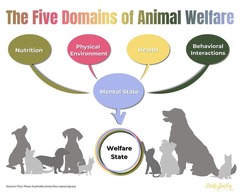
Why the Five Welfare Domains Work
Mental state emphasized, for every physical aspect affected there is an accompanying affective sate, positive welfare states, life worth living
Overall affective experience in mental domain = welfare status of the animal
Welfare assessments as a veterinarians
Helping farms establish good animal welfare, animal care guidelines, voluntary 3rd party audits, not legislation, provide further assurance. ALL VOLUNTARY, welfare standard is the minimum
Behavior and Welfare
Gateway between external and internal, behavior is one of the main means to evaluate welfare, informs clinical handling, and client education. Need to understand normal behavior is so you can detect abnormal behavior
Normal Behavior
Behavior as a species, group, and as an individual
Ethology
scientific study of animal behavior
Charles Darwin
Continuity of behaviors throughout animal kingdom, evolution, natural selection shaping behavior and emotional expression
Konrad Lorenz
Imprinting or sensitive period learning with plasticity
Fixed action patterns -> varied, feedback, context/motivation learning
Innate releasing mechanisms -> motivation sensory circuitry
Supernormal stimuli -> stimulus generalization and peak shift
Nikolaas Tinbergen
4 questions to explain behavior, how's and why's
Temperament
Genetically acquired, inherited behavioral responses to specific situations or stimuli
Personality
Combination of animal's temperament, learning experiences, and development
Tinbergen's 4 Questions
Development & Mechanism: Response to immediate factors
Function & Evolution: Purpose of the behaviors
Tinbergen's 4 Questions: Development
How does the behavior emerge over an animal's life, and how is it shaped by experience and age?
Tinbergen's 4 Questions: Mechanism
What internal mechanisms underly this behavior: neuro, hormonal, physiology, sensory, musculoskeletal?
Tinbergen's 4 Questions: Function
What purpose does it serve in survival or reproduction? What is the adaptive significance, usefulness in terms of fitness? Why does the animal respond in this way instead of another way?
Tinbergen's 4 Questions: Evolution
What is the evolutionary history of this behavior? Do we see it in related species? Why did this behavior evolve in the species? Why did the individual's ancestors have this behavior? Compared to other species?
Objective Observations
Based in fact, avoids overstating or oversimplifying, no feelings.
Ex. dilated pupils, ears flat, tail tucked
Subjective Observations
Interpretations, assigning meaning
Ex. Fearful, anxious
Ethogram
List, description and catalog of discrete, objective behaviors of an animal. Recognizable behaviors, standardization, no underlying emotional state or purpose
Umwelt
Environment or surroundings, the unique, subjective world that each animal experiences based on their own specific sensory and cognitive capabilities
Behavioral Needs
What does performing a particular behavior mean to the animal
Jack Panksepp (1990s) 7 Mammalian Emotional Systems
Positive: Seeking, care, play, and lust
Negative: Fear, sadness, anger
Highly motivated behaviors are usually accompanied by emotions
Negative if completing the behavior isn't possible
Positive once behavior is taking place
Varying terms about emotions
Emotion, feeling, mood, and affective state
Valenced
Pleasent or unpleasent
Affective State
The integrated picture of how an animal is doing mentally over a period of time. Includes all emotions or feelings experienced as pleasant or unpleasant; experienced consciously and which motivate animals to behave in particular ways
Emotional Conflict
Animal has competing emotions or motivations (i.e. when they are motivated to perform two opposing behaviors)
Frustration
Animal is motivated to perform a behavior, but is not able to do so (i.e. there is no available outlet or means for them to perform a normal behavior.
Negative Affective States
Comes from frustration or previous unpleasant experiences
Distance-Increasing
Increase distance between self and perceived threat or discomfort, avoid conflict, fear, communication
Distance-Decreasing
Decrease distance between self and other, affiliative, encourage approach, inviting
Displacement Behaviors
Normal behaviors that occur out of context for given situation; conflicted and unsure
Calming Signals
Help to avoid or stop conflict or help them cope with stress
Cognitive Bias
Way an animal's underlying affective state (emotion or mood) influences how the animal interprets/thinks about and response/reacts to ambiguous information or situations
Behavioral Repertoire
Time budget, fitting into the constructs of our society
Preferences
Choosing one option over others. To have preference, an animal must be able to compare different options that meet the same need or motivation.
Choice
Consequence of motivations, preferences, and decisions
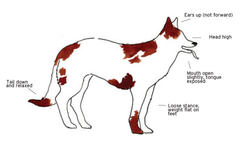
Relaxed Dog Body Language
Eyes: Relaxed eyes, normal pupils, soft eyes
Ears: Neutral; back but not flattened; loose
Mouth: Open or closed; lips are long and soft, commissures relaxed
Face: Soft and loose
Spine/Posture: Flexible from neck to tail
Tail: Level with topline; slightly above or below topline, wagging
Stressed Dog Body Language
Eyes: Dilated pupils, prolonged staring or avoiding eye contact; whale eyes
Eras: Out to the side; flat against head
Mouth: Closed; lips-short, tense; snarl; lip lift; bite
Face: Skin taut; wrinkled brow; lips pulled back; tense jaw
Spine/Posture: Ridged and/or stiff
Tail: High above topline; tucked; wagging

Hackles
When up it indicates a state of arousal, not synonymous with aggression, can happen during play, potential to tip into aggression
Arousal
Intense emotional state
Tail Wagging and Behavior
Depends on breed, signifies arousal
High Flagged Tail
Highest arousal and confidence
Freezing Tail
Warning sign of aggression, tail goes from wagging to still
Belly Up
Can be distance decreasing signal and invite to belly rubs, look at whole dog, if soft and relaxed likely this.
Or could be distance increasing signal, lacking confidence and an appeasement behavior, submissive gesture. If dog shows signs on stress like lip licking it is likely this
Appeasement Behavior
Meant to reduce threat; deferential behavior with pacifying signals to another individual
Active Appeasement
Greeting or attention-seeking behaviors; ex. nuzzling, licking, lowering body
Passive Appeasement
Reduction in activity with goal of diverting/decreasing attention, ex. ears flat, tail tucked, averting eyes
Displacement Behaviors Examples
yawning, shaking off, lip licking, excessive blinking, scratching, paw lift, grooming out of context
Avoidance Behaviors Examples
Averting gaze/eyes; avoiding visual contact, turning head away, turning whole body away, crouching/moving back or away, trying to escape, hiding behind objects or persons, backing up with paw up
Ladder of Aggression
Subtle signs at first, escalates up the ladder and shifts fast when ignored