A&P: Chapter 4 Tissues, Chapter 5 Integumentary Systems, & Chapter 1 Introduction
 Call Kai
 Learn
Learn Practice Test
 Spaced Repetition
 Match
Match Flashcards
 Knowt Play
1/94

There's no tags or description
Looks like no tags are added yet.
Name | Mastery | Learn | Test | Matching | Spaced | Call with Kai | Chat |
|---|
No analytics yet
Send a link to your students to track their progress
95 Terms
What are the four types of tissue?
Epithelial, Connective, Nervous, and Muscular
What does epithelial tissue consist of and what does it do? (structure and function)
Epithelial tissue consists of of sheets of cells the cover the bodys structures and glands that produce secretions.
What does connective tissue consist of and what does it do?
Connective tissue consist of a matrix of amorphous ground substances and fibers that support the body and binds tissues and organs.
What are the two specialized connective tissues, and why?
Blood and lymph because they consist of fluid instead of fibers.
What does muscle tissue consist of and what does it do?
Muscle tissue consist of smooth, cardiac, and skeletal muscle fibers that produce body movement.
What does nervous tissue consist of and what does it do?
Nervous tissue consist of neurons and neuralgia that conduct impulses from one part of the body to another.
What do the two types of epithelial tissue do?
Protect body structures and glands that produce secretions
What are epithelial sheets classified by and what are they called?
Epithelial sheets are classified by their shape and size. For size they can be simple (consisting of one layer) or stratisifed (multiple layers). For size shape they can be cubodial, columnar, or squamous.
What does simple epithelial do?
It facilitates absorption and filitration
What does stratified epithelial do?
It protects underlying tissue from abrasion.
Where is simple epithelial found?
The kidneys, small intestine, and trachea.
Where is stratisfied epithelial found?
Ducts of salivary glands, male urethra, and the bladder.
What are the types of glandular epithelial, and what do they do?
Endocrine and Exocrine, endocrine secretes inside the body, such as hormones, exocrine secretes outside the body through a duct, such as sweat glands or mammary glands.
Epithelial tissue is avascular but innervated, what does that mean?
It means that epithelial tissue has nerves but no blood flow/vessels.
What is the covering & lining membranes of epithelial tissue?
membranes that cover body surfaces and line internal organs.
What are the three types of membranes and examples?
Cutaneous membranes (dry membranes) like skin, Mucous membranes (wet membranes), like the nasal cavity, and serous membranes (internal membranes) like the pericardium of the heart.
What is the function of connective tissue?
Connective tissue binds, supports, protects, insulates, and stores reserve fuel and transports substances (blood).
What are the four classes of connective tissue?
Connective tissue proper, cartilage, bone, and blood
What are the subclasses of Connective Tissue Proper?
loose connective tissue and dense connective tissue.
What are the three types of loose connective tissue?
Aerolar, adipose, and reticular
What are the three types of dense connective tissue?
Dense regular, dense irregular, and elastic
What cells are found in connective tissue proper?
Fibroblast, fibrocytes, and adipocytes
What is the matrix of connective tissue proper made of?
A gel like ground substance and 3 types of fibers: collagen reticular, and elastic
Whats the functions of connective tissue proper?
Binds tissues, supports and protects, resists mechanical stress, stores water and salts, and stores fat for energy.
What are the subclasses of cartilage?
Hyaline cartilage, elastic cartilage, and fibrocartilage.
What are the cells found in cartilage?
Chondroblasts and chondrocytes.
What is the matrix of cartilage made up of?
A gel like ground substance and fibers: collagen, and elastic fibers in some.
What are the functions of cartilage?
Resists compression, cushions, and supports body structures.
Blood is a liquid, so why is it considered a connective tissue?
Because of its extracellular matrix
What are the subclasses of bone tissue?
Compact bone and spongy bone
What cells make up bone tissue?
Osteoblast and osteocytes
What is the bone tissue matrix made of?
Gel like ground substance and collagen fibers.
What are the main functions of bone tissue?
To resist compression and tension, and to support.
What cells make up blood?
Erythocrytes (RBW, red blood cells), Leukocytes (WBCm white blood cells), Platelets, and plates.
What is the blood matrix made out of
Plasma, it has no fibers
What is the function of blood
A fluid tissue that carries O2 and CO2, nutrients, wastes, and other substances.
What are the three types of muscle tissue?
Skeletal, cardiac, and smooth.
What are the characteristics of skeletal muscle?
It is the only voluntary muscle, has striation and a nuclei
What are the characteristics of Smooth muscle?
It is involuntary, no striations and a singular nucleus.
What are the characteristics of Cardiac muscle?
It is involuntary, striated, intercalated discs, and has a single nucleus.
What is nervous tissue made of?
nerouns and neurglia.
What is nervous tissues function?
to transmit and recieve impulses.
What does the integumentary system consist of?
hair, skin, nails, sweat glands, and sebaceous (oil) glands
What are the main functions of the integumentary system?
protection, temperature regulation, cutaneous sensations, metabolic functions, blood reservoir, excretes wastes
What are the two distinct regions of the skin?
Epidermis and dermis
what does the epidermis consit of
epithelial tissue that is avascular (no blood flow)
What does the dermis consist of?
fibrous connective tissue, this is vascular (has blood flow)
What is the hypodermis?
Its not part of the skin but it shares some functions. its a subcutaneous layer deep to skin. it is mostly adipose tissue that absorbs shock and insulates, and anchors skin to underlying structures, such as muscles.
What are the four types of cells found in the epidermis? and what do the do?
keratinocytes which produce keratin and slough off everyday, dendritic which activate the immune system and are star shaped and deep in the epidermis (langerhans), merkel cells which are sensory receptors of touch (tactile), and melanocytes which are spider shaped melanin cells deep in the dermis.
What are the five layers of the epidermis? (Come Lets Get Sun Burned)
Stratum Basal
Stratum spinosum
Stratum granulosum
Stratum Lucidum (only in thick skin)
Stratum corneum
How many layers of strata are in thick skin and what is considered thick skin?
There are five layers in thick skin, they are only on the palms and soles of the hands and feet.
How many strata are in thin skin?
4 strata
Where is the stratum basale (basal layer)
It is the deepest epidermal layer so it is closest to the dermis
What happens to cells in the basal layer?
they die as they move toward the surface
10-25 percent of the basal layer consist of what cell
melanocytes
What cells are in the stranum spinosum (prickly layer)
keratinocytes, they are prickly in this layer so they are called prickle cells
What begins in the stratum granulosum (granular layer)
keratinization
What happens to cells above the stratnum granulosum (granular layer)
They die
What type of skin is stratum lucidum (cleay layer) found in
Thick skin
Where does the stratum lucidum lie
Superficial to the stratum granulosum
The stratum lucidum as thin translucent band of 2-3 rows of dead what
keratinocytes
The stratum coreneum (horny layer) 20-30 rows of flat what?
anucleated, keratinized deal cells
Even though the cells are dead the still function to what?
protect deeper cells from the environment, prevent water loss, protect from abrasion and penetration, and acts as a barrier against biological chemical and physical trauma.
How do cells change?
they change by going through apoptosis aka controlled cell death.
The dermis is a strong flexible what?
connective tissue
what does the dermis contain?
nerves, blood vessels, lymphatic vessels, hair follicles, oil glands and sweat glands
what two layers are in the dermis?
papillary and reticular
what are the two types of nerve cells?
meissner corpuscles and lamellar (pacinian) corpuscles
what is the dermal papillae? and what do they do?
fingerlike projections into the epidermis that act as touch receptors ( messiners corpuscles)
In thick skin dermal papillae lies on top of dermal ridges which give rise to what?
epidermal ridges aka finger prints
ridges are collectively called fiction ridges, what do they do?
enhance gripping ability, contribute to sense of touch, sweat pores in the ridges leave unique finger print patterns.
what is the papillary layer
the papillary layer is the superficial layer of the dermis, it is a vascular connective tissue.
what does the reticular layer consist of
coarse dense fibrous connective tissue
the reticular layer makes up what percent of dermal thickness
approximately 80%
the connective tissue in the reticular layer does what?
it has elastic fibers that provide stretch-recoil properties, and has collagen fibers that provide strength and resiliency. it also binds water and keeps the skin hydrated
What can occur in the reticular layer?
aging and stretch marks.
what two skin surface do NOT contain sweat glands (sudoriferous glands)
nipples and parts of external genitalia
what are the two types of sweat glands
eccrine glands and apocrine glands.
where do eccrine (everybody) glands secrete and what do they secrete
the palms, soles, and forehead. they secrete sweat (99% water, salts, vitamin c, antibodies, and metabolic wastes)
eccrine glands function in what?
thermoregulation
apocrine (acne/puberty) glands are confined to what areas?
axillary and anogenital areas
what do apocrine glans secrete and what does the secretions cause
milky or yellowish sweat that contains fatty substances and proteins. bacterias break down the sweat leading to body odor
where eccrine sweat glands ducts empty
the hair follicle
what are the modified apocrine glands and what do they do?
ceruminous glands: secret earwax (cerumen), and mammary glands: secrete milk
where do sebaceous (oil) glands develop from and secrete from
most develop from hair follicles and secrete into hair follicles
what do sebaceous glands secrete and what is its function
they secrete sebum which is a holocrine secretion with bactericidal (bacteria-killing) properties, it softens hair and skin?
sebaceous glands are relatively inactive until puberty, what are they stimulated by?
hormones especially androgens
acne is caused by what?
over-productive sebaceous glands, can cause inflammation and blackheads.
what are the regions of the hair and where are they?
the shaft which extends above the scalp when keratinization is complete, and the root which is in the area within scalp when keratinization is still ongoing
what are the two parts of the hair shaft?
the medulla and the cortex
what is the arrector pili and what does it do
the arrector pili is a small band of smooth muscle that is attached to the follicle, is causes the hair to erect causing goosebumps
what are the ABCDE for skin cancer
a- asymmetry, b-border, c-color, diameter, e-evolving
what is eczema
a skin disorder in the epidermis that cause red flaky rash
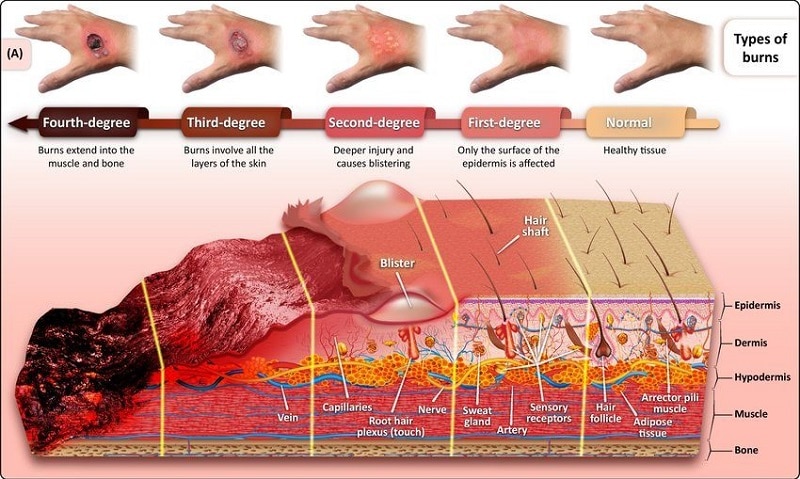
just look at this photo

just look at this photo