Hygiene
 Call Kai
 Learn
Learn Practice Test
 Spaced Repetition
 Match
Match Flashcards
 Knowt Play
1/20

There's no tags or description
Looks like no tags are added yet.
Name | Mastery | Learn | Test | Matching | Spaced | Call with Kai | Chat |
|---|
No analytics yet
Send a link to your students to track their progress
21 Terms
Creating a Plan

Hygiene and Functional Ability
Hygiene is a broad concept of cleanliness and grooming that actively improves self-image and decreases infection risk
Activities of Daily Living (ADLs); Fundamental self-care tasks
Ex: bathing, dressings, toileting, eating, transferring
Clinical: pt’s level of independence performing ADLs can influence nursing workload
Instrumental ADLs (IADLs): cx tasks needed for independent community living
Ex: cooking, cleaning, finances, managing medications
Clinical: influences discharge planning and home safety
Clinical concern: a sudden decline in a pt’s ability to perform ADLs/IADLs can indicate a change in health status and warrants further investigation to determine safety
Recognizing Cues - Assessing Influences on Hygiene
Pt-centered (subjective factors)
Ex: personal preferences, culture, religion, spirituality
Clinical (objective factors)
Ex: health status, pain level, physical mobility limitations, sensory deficits (vision/hearing loss), cognitive abilities, mental health
Recognizing Cues - Case Study
Health Status
Pneumonia and Exacerbation of COPD: excess movement may worsen respiratory symptoms
Mobility
Osteoarthritis: client may experience pain and limited ROM while trying to complete ADLs
Cognitive Abilities
Moderate Dementia: client may become confused during care and can refuse or become combative if not approached correctly
Recognize Cues/Assessment Clinical Tools
Clinical tools such as the Katz Index of Independence in ADLSs to further your assessment of our patient’s ability to provide hygiene for themselves
6 points - independent
0 points - very dependent

Neglect vs Deficit - Why does Distinction Matter?
Self-Neglect: the client is able to provide self-care but fails to maintain social standards of hygiene
Nursing role: Psychosocial Assessment and Ethical/Legal Advocacy
Ex: Mental Health, Substance Abuse, Abuse/Neglect
Self-Care Deficit: the client lacks the ability to complete independently
Nursing Role: Supportive
Ex: physical assistance, adaptive equipment
Case Study - Neglect vs Deficit
The nurse is analyzing the client’s presentations to plan morning hygiene care
For each clinical cue from the case profile, specify if the finding support the nursing concept of self-care deficit or self-neglect
Clinical cue (supports self-care deficit/supports self-neglect)
Exertional dyspnea and severe fatigue from pneumonia and COPD (self-care deficit)
Cognitive disorientation and memory impairment from moderate dementia (self-care deficit)
Grimacing and joint stiffness from severe osteoarthritis during movement (self-care deficit)
Active refusal/intentional choice (self-neglect)
Analyze Cues - Formulating a Nursing Diagnosis
Nursing Dx = Actual/Potential Problem = related to (pathophysiology/etiology) + as evidenced by (subjective/objective cues)
Nursing Dx help us recognize priority problems and how to care for our clients
Actual Problems
Bathing/Hygiene Deficit
Toileting Deficit
Feeding Deficit
Potential Problems
Risk for impaired skin integrity
Risk for aspiration
Case study ex: bathing/hygiene deficit related to exertional fatigue and joint stiffness as evidenced by body odor and dyspnea upon minor movement
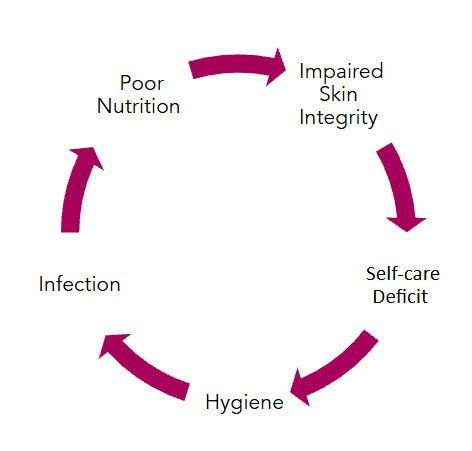
Understanding Cause and Effect (Potential Risks)
Dampness/Moisture - Prolonged exposure to (sweat, urine, or wound drainage) softens the tissue, making it highly vulnerable to breakdown
Dehydration & Nutrition Status - Dry skin and Tear Risk: Poor hydration and malnutrition compromise skin turgor and structural integrity
Clinical Considerations:
High-risk areas for moisture: under the breasts, skin folds, groin
Infants and Geriatrics may have compromised skin
Reduce friction and shearing
Solutions & Actions - Nursing Interventions
Individualize nursing activities and care activities - always promote independence when appropriate
Special Considerations
Dementia, obesity, age, patient preferences
Bathing
Levels of Assistance: independent, assist, complete, partial
Type of Bathing: prepackaged bathing products*, bag bath, bath & basin/bathwater*
Privacy and Timing of Bathing
Morning Care: hand & face washing, oral hygiene, toileting, environmental tidying, patient positioning
Prior to breakfast to promote appetite
Solutions & Actions - Nursing Interventions
Toileting Assistance
Levels of assistance: independent, assistance, dependent
Common equipment: toilet, bedside commode, external urinary catheters, indwelling catheters, urinal, bedpans
Privacy: Always provide clients with appropriate privacy during elimination
Positioning: Upright position (fowler’s/high-fowler’s) when appropriate
Frequent assessment of toileting needs
IMPLEMENTATION - Nursing Interventions (pt 1)
Assess for allergies related to products
Soaps and fragrances
Use hospital approved products
Always provide care from “clean” to “dirty”
Ex: front to back during perineal care, inner canthus to out using a different portion of washcloth
IMPLEMENTATION - Nursing Interventions (pt 2)
Foot Care & Nail
Ex: diabetes, corns, calluses, Tinea Pedis, ingrown toenails, foot odor, plantar warts, pressure injuries (PI), Bunions
Assess for alterations in sensory
Diabetes, neuropathy, etc
Never place a client’s extremities in HOT water
Never clip a client’s nails, always file
Infection risk especially with chronic diseases
Apply lotion on dry areas but never entrap moisture
Hair Care
Hair can be sensitive and clients can have cultural preferences—always ask!
Dandruff, Pediculosis, Alopecia
Be aware of contact transmission in special consideration
IMPLEMENTATION - Nursing Interventions (pt 3)
Oral Care
Dental hx, dental coverage, nutrition, medications, and medical conditions
Aspiration precautions!!
Pt should be sitting upright and have suction available
Denture Care - very fragile
Follow specific instructions
Soft toothbrushes
Be aware that patients with bleeding risk can sustain injuries from oral care
IMPLEMENTATION - Nursing Interventions (pt 4)
Eye care
Assess for visual aids
Gentle care
Infection risk
Ear Care
Assess for hearing aids
Avoid cotton tip
Never insert something into client’s ear
Nose Care
Avoid trauma to nares
Perineal Care
Privacy!
Clean to dirty
Solutions & Actions - Nursing Interventions
Assisting with Feeding
Assess for dietary order and NPO status
Positioning: upright position (fowler’s or high-fowler’s) and have the patient remain upright minimum of 30 min after meal
Offer small, controlled bites
Assess for pocketing of food
Promote Independence
The Clock Face Method: describing where items are in relation to a clock
Abnormal findings
Aspiration (choking)
Frequent coughing, clearing throat, wheezing, gurgling noises, waving hands, absence of noises but panicked movements and expressions
IMPLEMENTATION - DELEGATION
Primary Nurses Responsibility
Safety of patient and knowledge of UAP’s scope and experience
Assistive devices
Safety Concerns
Gait belt
Fall risk
Skin condition
Remember that you can assess patient while providing care
Delegation Model (ADLs)
Intervention—>Registered Nurse—>Unlicensed Assistive Personnel (UAP)
Bed bath—>performs baseline head-to-toe skin integrity assessment. Evaluates tolerance.—>performs standard bathing task on stable clients. Reports reddened/broken skin.
Perineal & Catheter Care—>Assess for signs of infection, bleedings, or anatomical/surgical complications—>performs daily hygiene (cleans front-to-back, clean to dirty). Secures device
Foot & Nail Care—>Assess for wounds and sensory deficits. Files nails straight across. Cleanses and dries feet completely. DO NOT CLIP NAILS. Reports skin breaks
Denture & Oral Care—>Assesses swallow/gag reflex, oral mucosa, and aspiration (choking) precautions—>assists with performing oral care for stable patients
Introduction
Introductions
Check Identity/Order
Check for Allergies
Get Permission for Bath and Hygiene Care
Preparing for Care
Do you have all supplies
Didi you provide privacy
Adjust bed height
Check side rails
Assess for Lines, Drains, Airways (LDAs)
Encourage Independence
Evaluate Outcomes/Evaluation
How do we know our actions worked?
Improved hygiene
Improved self-image
Free of actual/potential harm factors
Pt Education
Did we educated our patient during the process of implementation"?
Teach-back method