Meiosis and Mitosis
 Call Kai
 Learn
Learn Practice Test
 Spaced Repetition
 Match
Match Flashcards
 Knowt Play
1/83

There's no tags or description
Looks like no tags are added yet.
Name | Mastery | Learn | Test | Matching | Spaced | Call with Kai |
|---|
No analytics yet
Send a link to your students to track their progress
84 Terms
What are the two major goals of meiosis?
Reduce chromosome number (2n → n)
Increase genetic diversity
Why is meiosis essential for population survival?
Genetic diverisity
Reduction division (homologs separate) is in?
Meiosis I, specifically during anaphase I.
Equational division (sister chromatids separate) is in?
Meiosis II
What is the key difference between mitosis and meiosis I?
Mitosis: sister chromatids separate
Meiosis I: homologous chromosomes separate
What type of cells are produced by meiosis?
Haploid gametes (sperm and egg)
Homologous chromosome pairing (synapsis)
Crossing over (genetic recombination)
Chromosome condensation
Spindle formation
Prophase I
What is crossing over?
Exchange of DNA between non-sister chromatids → increases genetic variation
What is a bivalent?
Paired homologous chromosomes during Prophase I
What is a chiasma?
Physical site of crossing over between homologous chromosomes
What is independent assortment?
Random alignment of homologous chromosomes in Metaphase I
What separates in Anaphase I?
Homologous chromosomes
What happens to centromeres in Meiosis I?
They remain intact (do NOT split)
What separates in Anaphase II?
Sister chromatids (centromeres split)
How do X and Y chromosomes pair in meiosis?
Through pseudoautosomal regions near telomeres
What phase does DNA replication occur?
S phase of interphase
What happens in metaphase (mitosis)?
Chromosomes align at the equator
What happens in anaphase (mitosis)?
Sister chromatids separate and move to opposite poles
What is cytokinesis?
Division of cytoplasm into two daughter cells
same genes, different parental origin
Homologous
Identical copies of one chromosome
Sister Chromatids
What controls the cell cycle?
Cyclins and cyclin-dependent kinases (CDKs)
Why is Meiosis I called reduction division?
It reduces chromosome number from diploid (2n) to haploid (n)
Why is Meiosis II called equational division?
Chromosome number stays the same (n → n), like mitosis
At this checkpoint the cell determines if the condition of the DNA is good for synthesis, This checkpoint is also known as the restriction checkpoint.
G1/S checkpoint
During the cell cycle if there has been damage to the DNA, the cell cycle goes into arrests until the DNA has been repaired, the main protein in control of this is ?
p53
At this checkpoint, the cell is mainly concerned with ensuring that it has achieved adequate size and the organelles have been properly replicated to support two daughter cells
G2/M
P53 also plays a role here
The Molecule CDKS are responsible for the cell cycle, what needs to be done in order for them to be activated ?
They require the presence of the right cyclinsto bind with them, allowing for progression through the cell cycle.
One of the most common mutations found in cancer is mutation if the gene that produces ?
p53 called TP53. leading the cell cycle not stopping to repair damage
Mitosis occurs in what type of cells ?
Somatic cells
Mitosis phase where chromosomes condense, spindle forms
Prophase
Mitosis phase where chromosomes align
Metaphase
Mitosis phase where sister chromatids separate
Anaphase
Mitosis phase where new nuclear membrane forms
Telophase
Spindle fibers are made up of ?
Spindle fibers
In mitosis The nuclear membrane dissolves during ?
Prophase
Protein structures located on the centromeres that serve as attachment points for the specific fibers on the spindle apparatus
Kinetochores
Occurs at the end of telophase, is the separation of the cytoplasm and organelles , giving each daughter cell enough material to survive on its own
Cytokinesis
What kind of cells does Meiosis occurs in ?
Germ cells
What is the pathway for sperm in men?
SEVE(N) UP
Seminiferous Tubules
Epididymis
Vas Deferens
Ejaculatory Duct
(NOTHING)
Urethra
Penis
Sperm are produced in the highly coiled seminiferous tubules, where they are nourished by ?
Sertoli Cells
What cells in men secrete testosterone and other male sex hormones (androgens)?
Leydig Cells
As sperm are formed they are passed to the __________, Where their flagella gain motility and they are then stored until ejacualtion
Epididymis
As sperm pass through the reproductive tract they are mixed with what ? which is produced through a combined effort by the seminal vesicles, prostate gland, and bulbourethral gland
Seminal Fluid
In men for sperm, this contributes fructose to nourish sperm
Seminal Vesicles
What two structures in men give sperm the fluid mildly alkaline properties so that the sperm can survive in the relative acidity of the female reproductive tract?
Prostate gland and seminal vesicles.
In men this produces a clear viscous fluid that cleans out remnant of urine and lubricates the urethra during sexual arousal
Bulbrourethral (Cowper’s) Gland
Spermatogenesis ( The formation of haploid sperm through meiosis) occurs in the ?
Seminiferous tubules
In males, the diploid stem cells of sperm are called?
Spermatogonia
For spermatoginia , after replicating their genetic material (S) phase, they develop into?
Primary Spermatocytes
In men , when dealing with sperm the first meiotic divison will result in ?
Haploid secondary Spermatocytes, which then undergo meiosis II to generate Haploid Spermatids
Mature sperm are called ?
Spermatozoa
Body part of sperm that is filled with mitochondria which generates the energy for swimming though the female reproductive tract to reach the ovum in the fallopian tubes
Mid-piece
Each sperm head is covered by a cap known as ________, this structure is dervived form the Golgi Apparatus and is necessary to penetrate the ovum
Acrosome
In women between puberty and menopause, one egg per month is ovulated into the ?
Peritoneal sac
In women by birth, all of the oogonia have already undergone DNA replication and are considered ?
Primary oocytes
In women Primary Oocytes are arrested in ?
Prophase I of meiosis
In women when is the secondary oocyte arrested ?
Remains arrested in metaphase II and does not complete the remainder of meiosis II unless fertilzation occurs after ovulation.
Surronds the oocyte itself is an acellular mixture of glycoproteins that protects the oocyte and contains compounds necessary for sperm cell binding
Zona Pellucida
Lies outside the zona pellucida and is a layer of cells that adheres to the oocyte during ovulation
Corona Radiata
In women when is Meiosis II triggered ?
When sperm cells penetrates the layers with the help of acrosomal eznymes
In men these hormones stimulates the sertoli cells and triggers sperm maturation
Follicle-stimulating hormone (FSH)
In men this causes the interstitial cells to produce testosteorne
LH
In women Estrogen is secreted in response to ?
FSH
Progesterone is secreted by the __________ in response to the hormone ?
Corpus Luteum ; LH
Protects the endometrium
know each peaks in graph
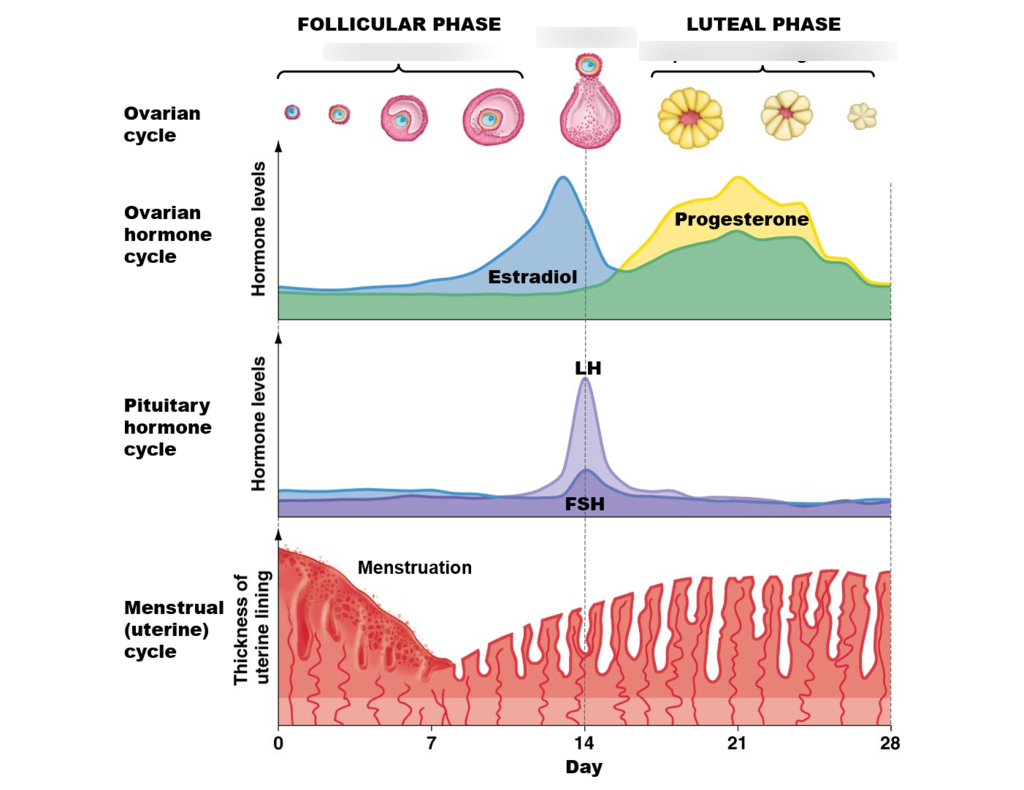
in the menstrual cycle follicles mature during the?
Follicular phase (FSH, LH)
in the menstrual cycle LH surge at midccyle triggers ?
Ovulation
In the menstrual cycle the ruptured follicle becomes the ?
Corpus Luteum, which secretes estrogen and progesterone to build up uterine lining in preparation for implanation
In the menstrual cycle when in FSH and LH inhibited?
When the ruptured follicles becomes the corpus luteum
What happens to the corpus luteum in women if fertilization does not occur ?
Atrophies
progesterone and estrogen levels decrease
FSH and LH levels begin to rise again
Germ layer that give rise to the outermost layer such as;
Epidermis ,
hair ,
nails
the epithelia of the nose, mouth, and lower anal canal,
Lens of the eye ,
nervous system (Including adrenal medulla)
inner ear
Ectoderm
Germ layer that gives rise to the middle layer and develops into several diff systems including the;
Musculoskeletal,
Circulatory,
most of the excretory systems ,
gonads,
muscular and connective tissues
layers of the digestive, respiratory systems
the adrenal cortex
Mesoderm
Germ layer that is the innermost layer and forms the:
Epithelial linings of the digestive, respiratory tracts, including the lungs
Pancreas,
Thyroid
Bladder
Distal Uninary tracts
Parts of the Liver
Endoderm
resting state, or gap phase. Many cells spend most of their time in this phase either at rest or performing assigned duties.
G0 phase
gap 1 phase(G1) or interphase.
Cells synthesize DNA and prepare for cell division.
G2 Phase
DNA synthesis completed. Microtubules of mitotic spindles produced.
mitosis (M phase)
Division of DNA and cellular proteins into two daughter cells. Return to G0 or resting phase.
in this cell phase, cells synthesize mRNA and proteins. This is to prepare for subsequent steps leading to mitosis
Gap 1 phase (G1)
At this checkpoint in the cell cycle, the cell will check that DNA has replicated correctly
GAP 2 (G2 Phase)
Where does mitosis and cytokinesis occur in ?
The M phase of the cell cycle
What are the similarities between meiosis and mitosis ?
DNA synthesis occurs prior ( during interphase)
2. In a given organism, parent cells have the same chromosome number
3. Divided into same stages
4. One parent cell undergoes cell division to produce multiple daughter cells.
What are the differences between mitosis and meiosis ?
1.four daughter cells result from meiosis whereas two daughter cells results from mitosis.
2.Haploid cells results from meiosis whereas diploid cells results from mitosis
3, Meiosis occurs to form gametes whereas mitosis occurs for growth and repair
4. Daughter cells differ from the orginal parent cell in meiosis whereas daughter cells are genetically identical to the orginal parent cell in mitosis.
5. Synapsis (close association) of homologous chromosomes occurs during meisos but not during mitosis
6. Two rounds of cell division occurs during meosis whereas only one cell division occurs during mitosis.