CSDS 440 Machine learning
 Call Kai
 Learn
Learn Practice Test
 Spaced Repetition
 Match
Match Flashcards
 Knowt Play
1/45

There's no tags or description
Looks like no tags are added yet.
Name | Mastery | Learn | Test | Matching | Spaced | Call with Kai | Chat |
|---|
No analytics yet
Send a link to your students to track their progress
46 Terms
Random Variable (R.V.)
A variable that refers to an uncertain fact
– Has a domain that can be discrete or continuous
For each value (or set of values), we can
specify a degree of belief that shows how
much we believe the stated fact---this is the
probability associated with the fact
– Denoted Pr(.)
Atomic Event
If the state of the world is described by n r.v.’s
and we assign values to all of them, this
defines an atomic event
What are the characteristics of atomic events?
Atomic events are mutually exclusive and
exhaustive
– At most one can be the true state of affairs
– The true state of affairs must be one of them
An “event” is a collection of atomic events
– Example: the event {x=2} is the collection of atomic
events {(x=2, y=1), (x=2, y=2), (x=2, y=3),…}
Sample Space
The “sample space” is the collection of all
possible atomic events ( )
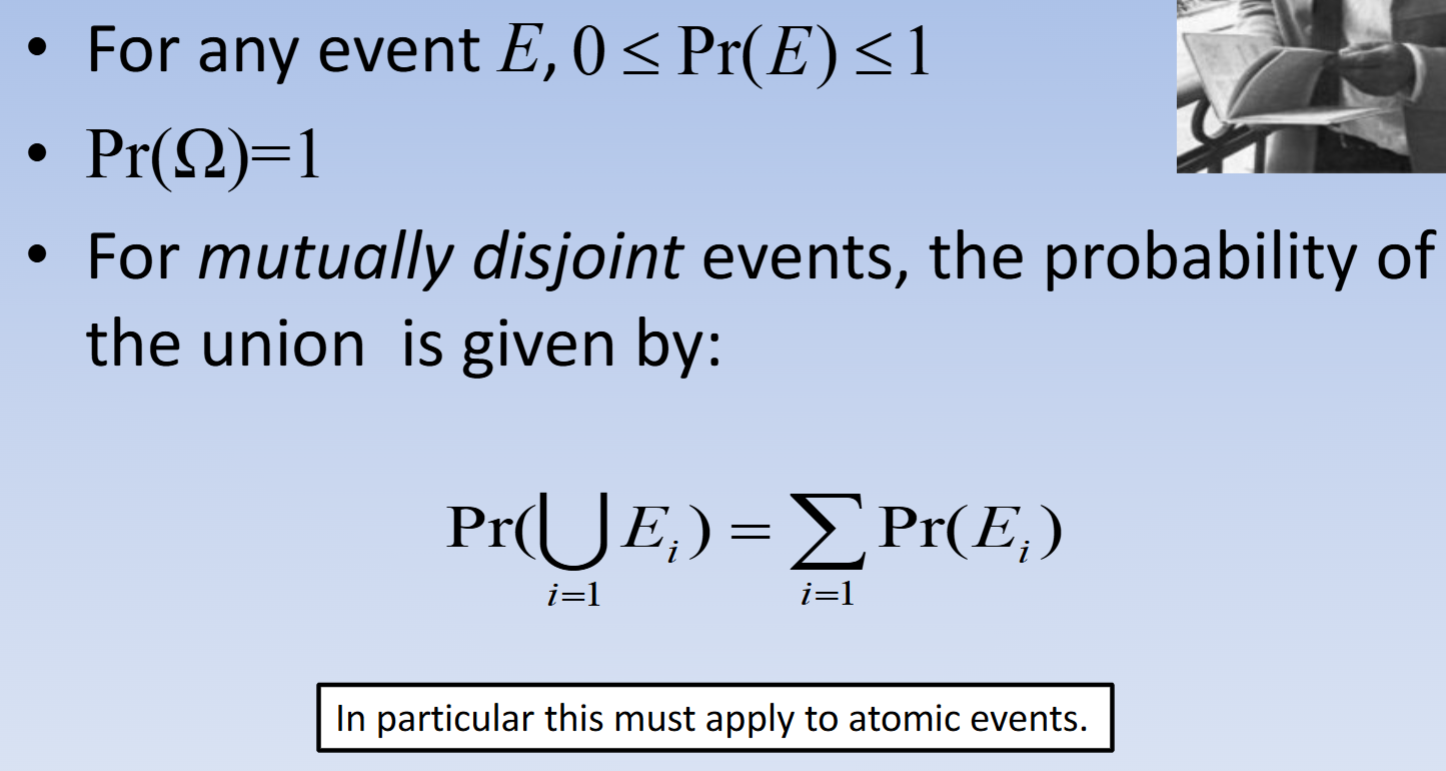
Axioms of Probability
Probability Density Function
A function that maps every value of an r.v. to a
probability is called a probability density
function (p.d.f.)

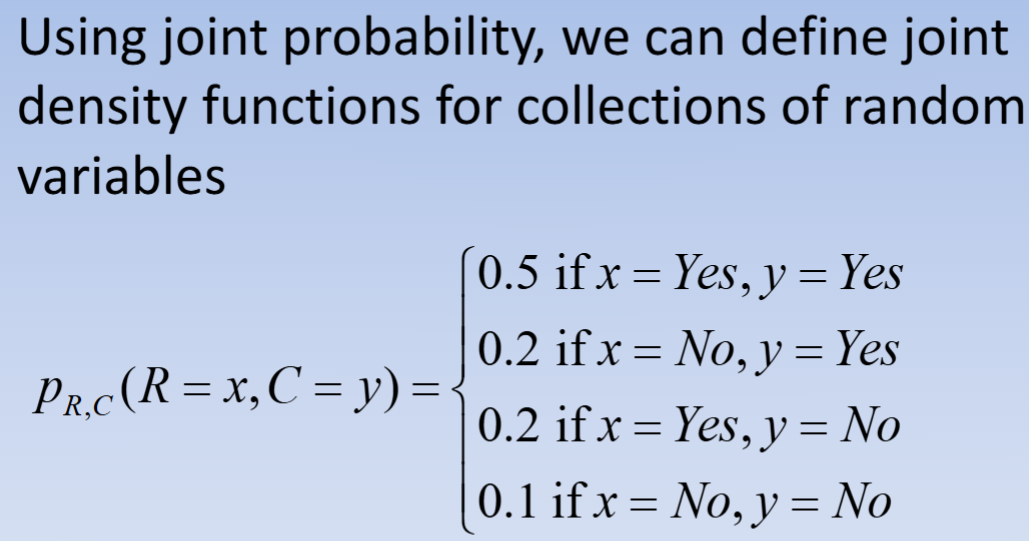
Joint PDF
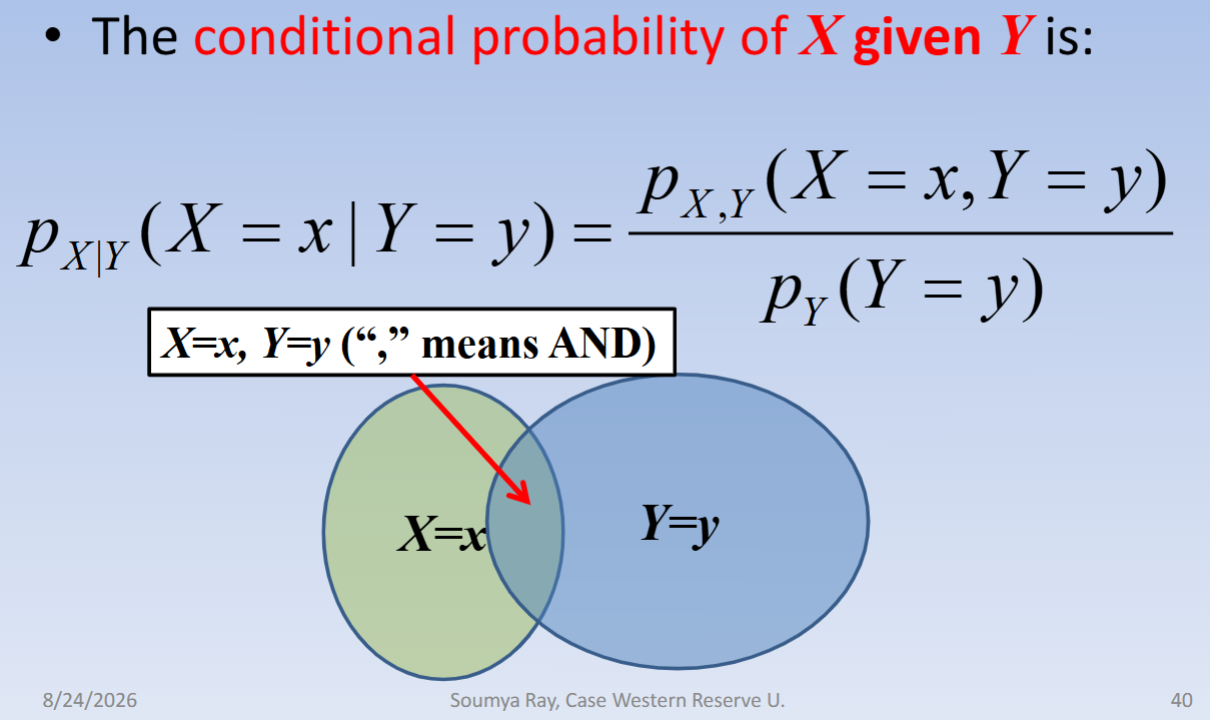
Conditional Probability
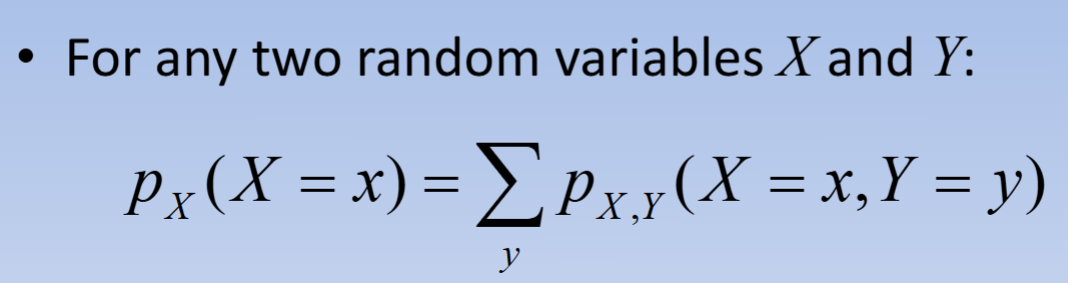
Marginalization
Conditioning

Bayes’ Rule
Bayes’ Rule therefore allows us to reason
backwards over uncertain events---
fundamental to learning

Statistical Independence

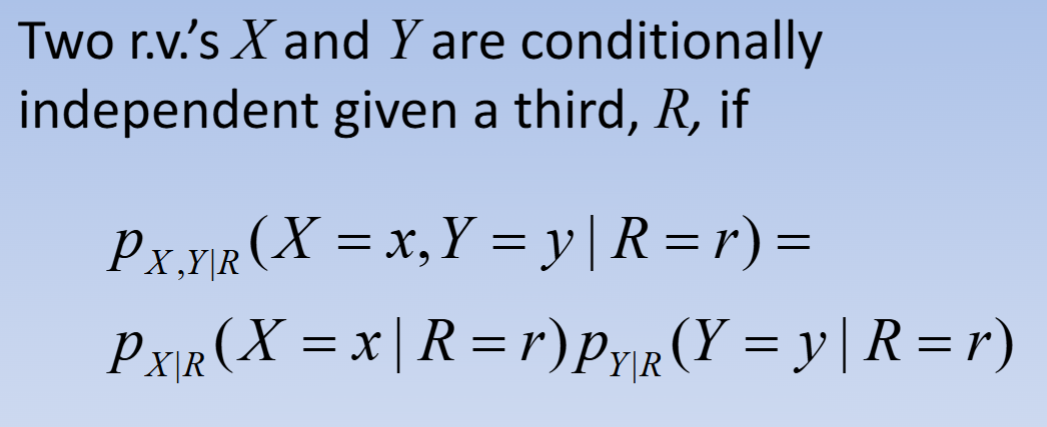
Conditional Independence
I.I.D. random variables
A collection of r.v.’s is I.I.D. if they are
– independent and
– identically distributed (the density functions are
the same)
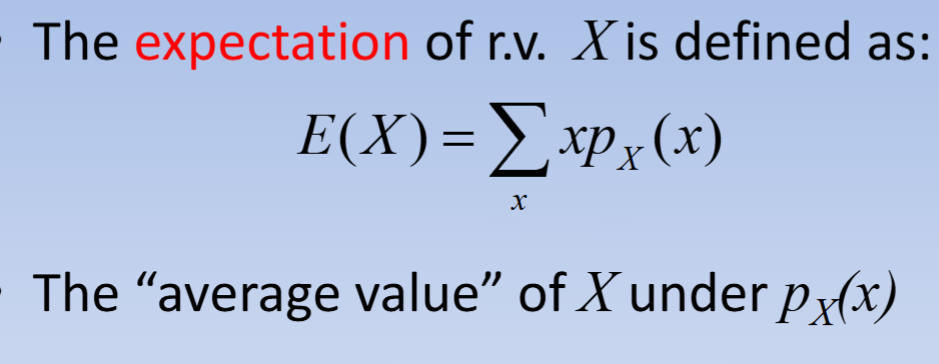
Expectation of r.v.
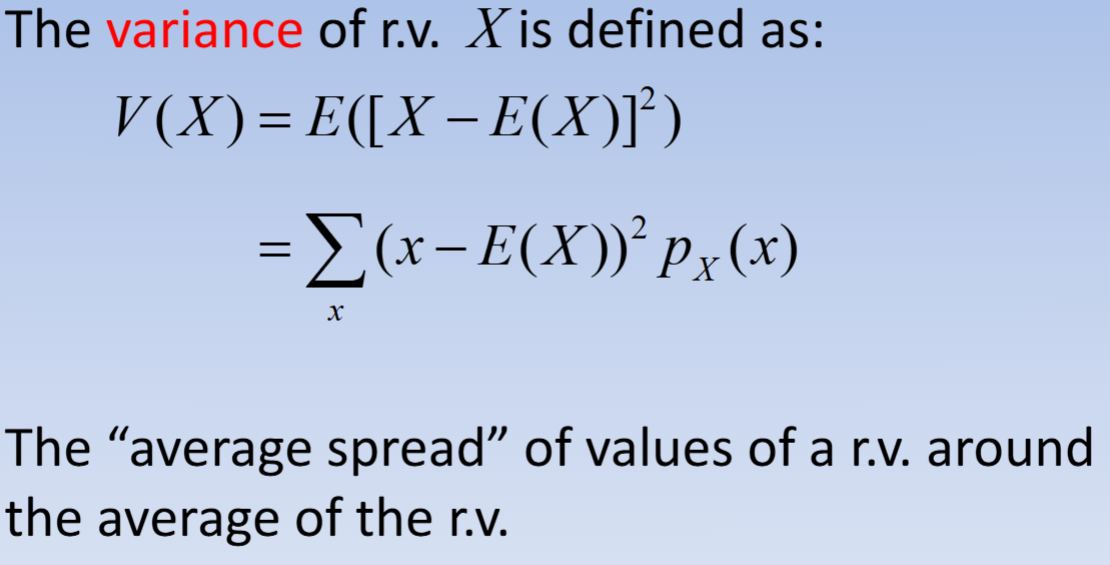
Variance of r.v.
What is a “machine” in the context of ML?
“Machine”=autonomous system
– No (or limited) human intervention
– Robots, software agents, etc.
What is “learning” in the context of ML?
“Learning denotes changes in the
system that enable the system to
do the same task more effectively
the next time.”
—Herbert Simon (1916-2001)
– Also, how to do related tasks
more effectively
A Specification for a Learning System
Given:
– Learning task (e.g. learn to play chess)
– Task examples E (e.g. games played/sequences of moves until win/loss)
– Performance measure P (e.g. games won/lost)
Do: Produce a concept that is good with
respect to P on all examples of the task
– Measured by proxy on E
(e.g. concept: Some function mapping current state of game to
suitable moves to play)
Identify and describe the “Two Phases of Learning”
“Learning” or “Training” phase
– Reason about the examples E
– Formulate a concept that does well w.r.t. P on E
– Could also use any prior knowledge
“Evaluation” or “Testing” phase
– Use learned concept on future, novel examples
Online vs Batch (Offline) Learning
Batch/Offline Learning: one learning phase,
with a large set of examples, followed by a
testing phase
Online learning: Examples arrive one at a time
(or in small groups); learning and evaluation
phases are iterated
Inductive Generalization
Specific → general
Reasoning from specific examples to a general case
Deduction/ deductive reasoning
General → specific
A type of reasoning that moves from general principles to specific conclusions
Abduction
Most likely cause
A type of reasoning that infers the most likely cause or explanation for a set of observations
Target Concept
The unknown underlying concept or rule that solves the learning task
E.g., “has-fur” and “long-teeth” and “looks-scary” → “lion”
Typically, P will be a measure of difference
between the learner’s concept and the target
concept, with respect to E
Hypothesis Space
The set of all general concepts or candidate rules that the learning system will consider
Difference between memorization and learning
Memorization involves storing specific training examples, whereas learning involves generalizing to unseen instances
No “Tabula Rasa” Learning
The principle that a learning algorithm cannot learn effectively from a completely blank slate without prior constraints or assumptions
Problems with an unrestricted hypothesis space
It contains overly complex concepts, includes memorization concepts indistinguishable from the target, and may be too big to search feasibly
Inductive Bias
The set of assumptions used by a learning system to restrict its hypothesis space
Supervised learning
A learning setting where examples E are annotated with target concept outputs by an oracle, and the system must find a matching concept
Oracle
An oracle is an idealized, hypothetical entity (or "black box") that can instantly and perfectly answer any question or solve any problem put to it, regardless of how computationally hard or resource-intensive it is.
(A theoretical machine with unlimited computational power, perfect knowledge, or infinite resources)