Klein ch.7 Alkyl Halides
 Call Kai
 Learn
Learn Practice Test
 Spaced Repetition
 Match
Match Flashcards
 Knowt Play
1/65

Earn XP
Description and Tags
Name | Mastery | Learn | Test | Matching | Spaced | Call with Kai | Chat |
|---|
No analytics yet
Send a link to your students to track their progress
66 Terms
Alkyl halide: compound where halogen (__, __, or __) is connected to __ hybridized carbon
Cl, Br, or I sp3
What are 2 functions of halogens in substitution/elimination rxns w/ alkyl halids?
1) Withdraws electron density via inductive effects. Allows carbon to be subject to be attacked by nucleophile.
2) Serves as leaving group. Good leaving groups are usually neutral molecules or very stable anions.
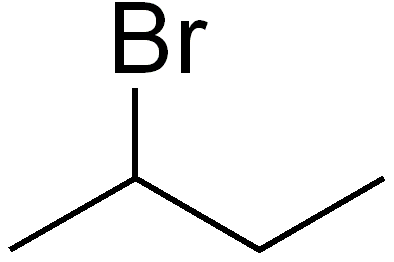
Label the α, β, and γ carbons relative to bromine.
α = directly connected to Br, β = connected to α, γ = connected to β.
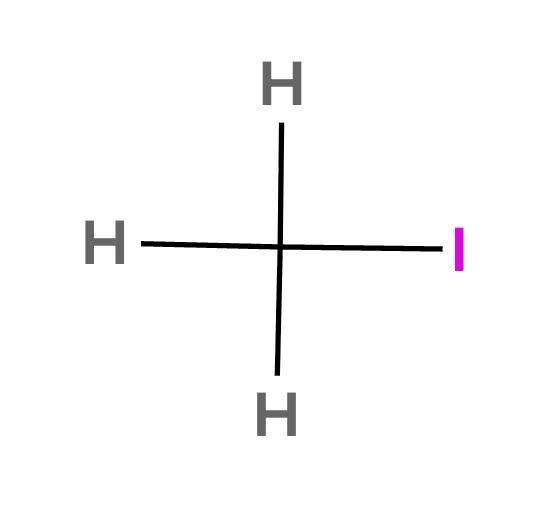
IUPAC and common name?
IUPAC: iodomethane. Common name: methyl iodide.
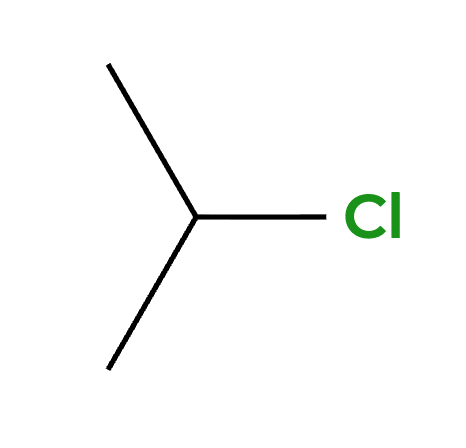
IUPAC and common name?
IUPAC: 2-chloropropane. Common name: isopropyl chloride.
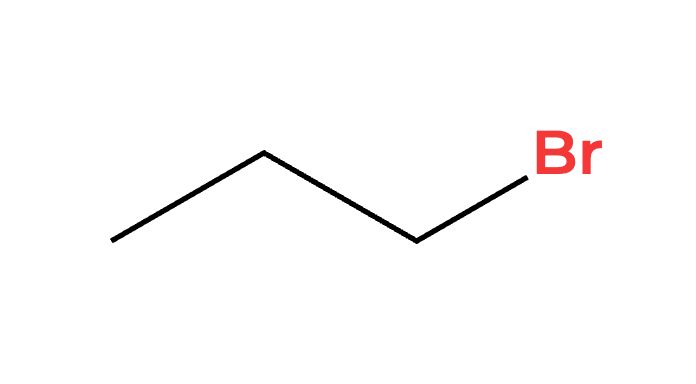
IUPAC and common name?
IUPAC: 1-bromopropane. Common name: n-propyl bromide.
What are organohalides and are they stable?
Any organic compound containing at least one covalent carbon-halogen bond. Very stable.
Which of the following mechanisms are concerted and which are stepwise: SN1, E1, SN2, E2.
Concerted: SN2, E2. Stepwise: SN1, E1.
When α position in an alkyl halide is a chiral center and reaction proceeds with SN2 mechanism, reaction proceeds with ___ and the end product is called the ___.
inversion of configuration, Walden inversion
In SN2 reaction with alkyl halides, where must the nucleophile attack?
Backside
Why is backside attack necessary for SN2 reactions?
2 possible explanations. 1) Simple explanation: lone pairs of leaving group create regions of high electron density, which block the front side. 2) More sophisticated explanation: MO theory. Electron denisty flows from HOMO of nucleophiles to LUMO of electrophile. If attack from front side, node is encountered, so no net bonding.
Will a reaction occur if there are 3 substituents connected to the β carbon?
No. Rate of reaction is extremely sensitive to substituents at α and β positions. Reaction generally will not occur with 3 substituents at either position.
Nucleophilicity definition?
Rate at which nucleophile attacks suitable electrophile
What 2 factors can increase nucleophilicity?
A stronger nucleophile will result in a faster rate. A nucleophiles is stronger if it: 1) Has a negative charge 2) Is more polarizable
Reaction between alkyl halide + strong base can be called ___ elimination
Beta (or 1,2-). Also called dehydrohalogenation.
Is the cis or trans alkene generally more stable?
Trans
What 2 factors contribute to alkene stability?
1) Steric effects 2) Degree of substitution (higher —> more stable - hyperconjugation by donating electron density to sp2-hybridized carbons)
Regioselective definition?
>1 possible product AND one of them is a major product
In the products of an E2 reaction, the more substituted alkene is called the ___ product.
Zaitsev
In the products of an E2 reaction, the less substituted alkene is called the ___ product.
Hofmann
Is the Zaitsev or Hofmann product in an elimination reaction more commonly the major product?
Zaitsev
In an E2 reaction, a ___ (bulky/non-bulky) base will result in the Hofmann product being the major product.
bulky
In an E2 reaction, a ___ (bulky/non-bulky) base will result in the Zaitsev product being the major product.
non-bulky
Is NaOEt a bulky or non-bulky base?
non-bulky
Is t-BuOK a bulky or non-bulky base?
bulky
Stereospecfic definition?
Stereoisomerism of product dependent on that of the substrate.
In an E2 reaction, if hydrogen and leaving group are ~180° apart during transition state, they are ___
anti-coplanar or anti-periplanar
In an E2 reaction, if hydrogen and leaving group are ~0° apart during transition state, they are ___
syn-coplanar
For an E2 reaction, stereospecificity is only relevant when β position has ___
ONLY 1 proton
E2 reaction can only take place for substituted cyclohexanes when leaving group is ___ (axial/equitorial) AND on ___ (opposite/same) side of proton.
axial, opposite
Rate of E2 reaction for substituted cyclohexane depends on how much time leaving group spends ___
in axial position
When a primary alkyl halide reacts with NaOH (both a strong base and a strong nucleophile), what is the major and what is the minor product? (substitution vs. elimination)
Major product = SN2 product. Minor product = E2 product.
When a secondary alkyl halide reacts with NaOH (both a strong base and a strong nucleophile), what is the major and what is the minor product? (substitution vs. elimination)
Major product = E2 product. Minor product = SN2 product.
When a tertiary alkyl halide reacts with NaOH (both a strong base and a strong nucleophile), what is the major and what is the minor product? (substitution vs. elimination)
Produces ONLY E2 product.]
When a primary alkyl halide reacts with t-BuOK, what is the major and what is the minor product? (substitution vs. elimination)
Major product = E2 product. Minor product = SN2 product.
Solvolysis definition?
Solvent molecule functions as the attacking nucleophile.
What ion intermediate forms when a neutral nucleophile (like water or an alcohol) attacks the carbocation in an SN1 reaction (after the first 2 steps)?
oxonium ion
What is an oxonium ion
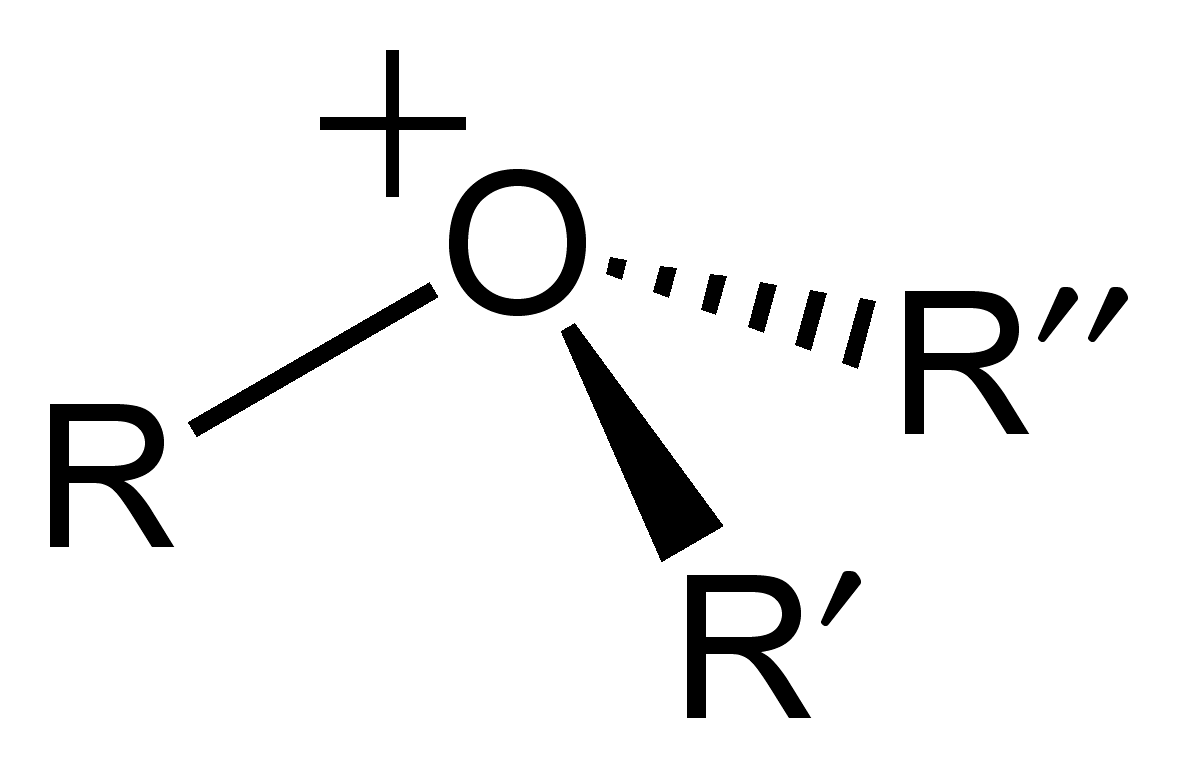
Why does the SN2 mechanism proceed with racemization?
Intermediate carbocation allows attack from either side
What term is the opposite of “inversion of configuration”
Retention of configuration
Although SN1 reactions create nearly racemic mixtures, which configuration is slightly more preferred and why?
Inversion because LG slightly blocks front side.
Why can rearrangements such as hydride or methyl shifts happen with SN1 but not SN2 reactions?
Because carbocation intermediates are formed for SN1 reactions while SN1 reactions are concerted.
The polar solvent in an E1 reaction also acts as a ___
base
What products are favored in an E1 reaction and can we control the outcomes?
Most stable alkenes are always favored. Cannot control.
OH- can be used as a reagent for which of the following mechanisms: SN1, SN2, E1, or E2
SN2 and E2 because it is both a strong nucleophile and strong base.
MeO- can be used as a reagent for which of the following mechanisms: SN1, SN2, E1, or E2
SN2 and E2 because it is both a strong nucleophile and strong base.
EtO- can be used as a reagent for which of the following mechanisms: SN1, SN2, E1, or E2
SN2 and E2 because it is both a strong nucleophile and strong base.
I- can be used as a reagent for which of the following mechanisms: SN1, SN2, E1, or E2
Only SN2 because it is a strong nucleophile but not a strong base.
Br- can be used as a reagent for which of the following mechanisms: SN1, SN2, E1, or E2
Only SN2 because it is a strong nucleophile but not a strong base.
Cl- can be used as a reagent for which of the following mechanisms: SN1, SN2, E1, or E2
Only SN2 because it is a strong nucleophile but not a strong base.
CN- can be used as a reagent for which of the following mechanisms: SN1, SN2, E1, or E2
Only SN2 because it is a strong nucleophile but not a strong base.
HS- can be used as a reagent for which of the following mechanisms: SN1, SN2, E1, or E2
Only SN2 because it is a strong nucleophile but not a strong base.
CH3CO2- can be used as a reagent for which of the following mechanisms: SN1, SN2, E1, or E2
Only SN2 because it is a strong nucleophile but not a strong base.
DBN can be used as a reagent for which of the following mechanisms: SN1, SN2, E1, or E2
Only E2 because it is a strong base but not a strong nucleophile.
DBU can be used as a reagent for which of the following mechanisms: SN1, SN2, E1, or E2
Only E2 because it is a strong base but not a strong nucleophile.
H2O can be used as a reagent for which of the following mechanisms: SN1, SN2, E1, or E2
SN1 and E1 because it is neither strong nucleophile nor a strong base.
MeOH can be used as a reagent for which of the following mechanisms: SN1, SN2, E1, or E2
SN1 and E1 because it is neither strong nucleophile nor a strong base.
EtOH can be used as a reagent for which of the following mechanisms: SN1, SN2, E1, or E2
SN1 and E1 because it is neither strong nucleophile nor a strong base.
Which of the following alkyl halides could proceed with SN2 mechanism: CH3X, 1°RX, 2°RX, 3°RX
Good: CH3X, 1°RX. Ok: 2°RX.
Which of the following alkyl halides could proceed with SN1 mechanism: CH3X, 1°RX, 2°RX, 3°RX
Good: 3°RX. Ok: 2°RX.
Which of the following alkyl halides could proceed with E1 mechanism: CH3X, 1°RX, 2°RX, 3°RX
Good: 3°RX. Ok: 2°RX.
Which of the following alkyl halides could proceed with E2 mechanism: CH3X, 1°RX, 2°RX, 3°RX
Good: 2°RX, 3°RX. Rare: 1°RX.
Are SN2 reactions generally faster with protic or aprotic solvents?
Faster with aprotic solvents because protic solvents stabilize the anion/nucleophile.
In protic solvents do Br- or F- ions have greater nucleophilicity?
Br- because F- is more stabilized by the protic solvent
In aprotic solvents do Br- or F- ions have greater nucleophilicity?
F-
Are SN1 reactions faster with protic or aprotic solvents?
Faster with protic because carbocation will be stabilized, which lowers Ea.