OCPG
 Call Kai
 Learn
Learn Practice Test
 Spaced Repetition
 Match
Match Flashcards
 Knowt Play
1/26

There's no tags or description
Looks like no tags are added yet.
Name | Mastery | Learn | Test | Matching | Spaced | Call with Kai | Chat |
|---|
No analytics yet
Send a link to your students to track their progress
27 Terms
Structure of prokaryotes
Double stranded DNA genome, bacterial chromosomal DNA usually circular
Plasmids: extrachromosomal DNA, double stranded
Structure of genome
One origin of replication
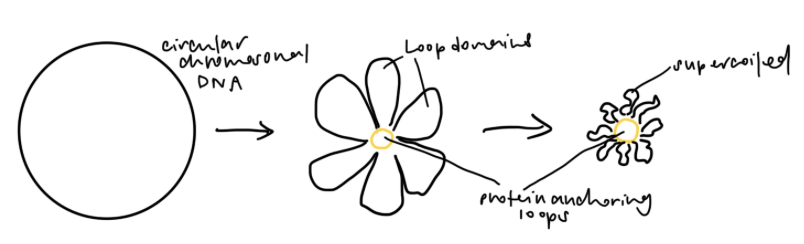
Bacterial DNA bind to DNA-binding proteins (non-histone) to form loop domains, which are supercoiled to further compact
Contain operons
Plasmids
Small, double stranded DNA molecules existing independently of the chromosome
Genes are not essential, but beneficial and confer selective advantage
Binary Fission process
(1) Chromosome replication begins
(2) DNA replication proceeds bidirectionally from origin of replication, replicated loops separate into two independent circular chromosomes. Replication continues, one copy of the origin is now at each end of the cell while the cell elongates
(3) Replication finishes, plasma membrane is pinched inward by a tubulin-like protein, and a new cell wall is deposited
(4) Two daughter cells result
Why does bacteria genomes differ?
Bacteria have short generation time due to rapid process of binary fission
Fast reproduction process leads to considerable number of mutations in a bacteria population, contributing to overall genetic diversity
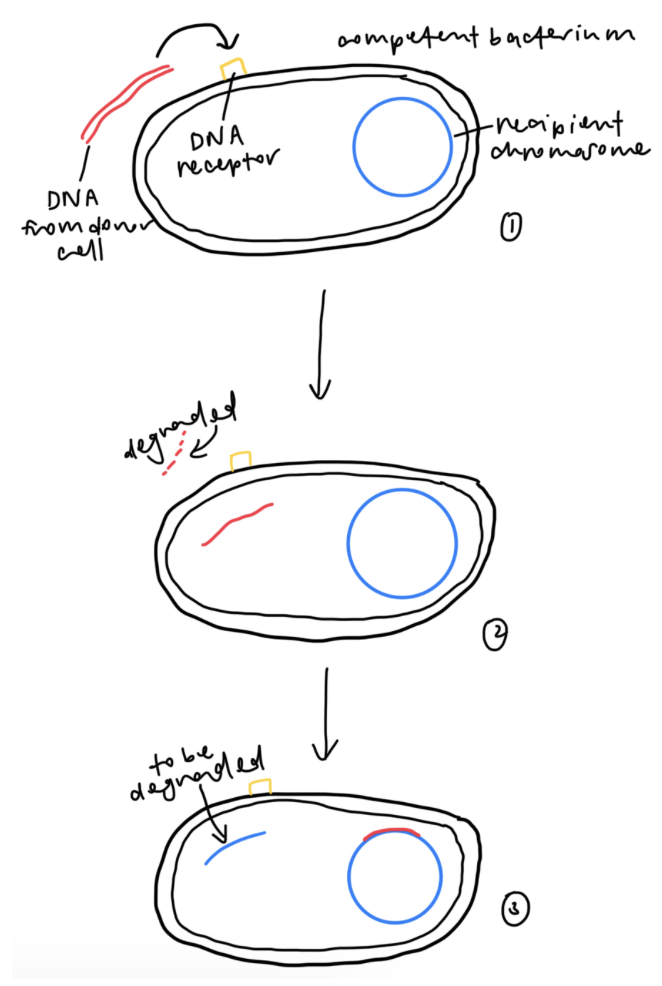
Transformation process
(1) A competent bacterium can bind exogenous DNA and transport it into the cell
(2) Entering of exogenous DNA
Exogenous DNA binds to receptor complex by competence proteins ComEA and ComG
As DNA is pulled through the channel, one strand of DNA is degraded by a deoxyribonuclease
Surviving strand of DNA is stabilised by single-strand DNA binding protein and RecA protein
(3) Integration
Single strand of donor DNA is integrated into chromosome, producing a DNA heteroduplex with different alleles in the 2 strands
Replaced recipient strand will be degraded
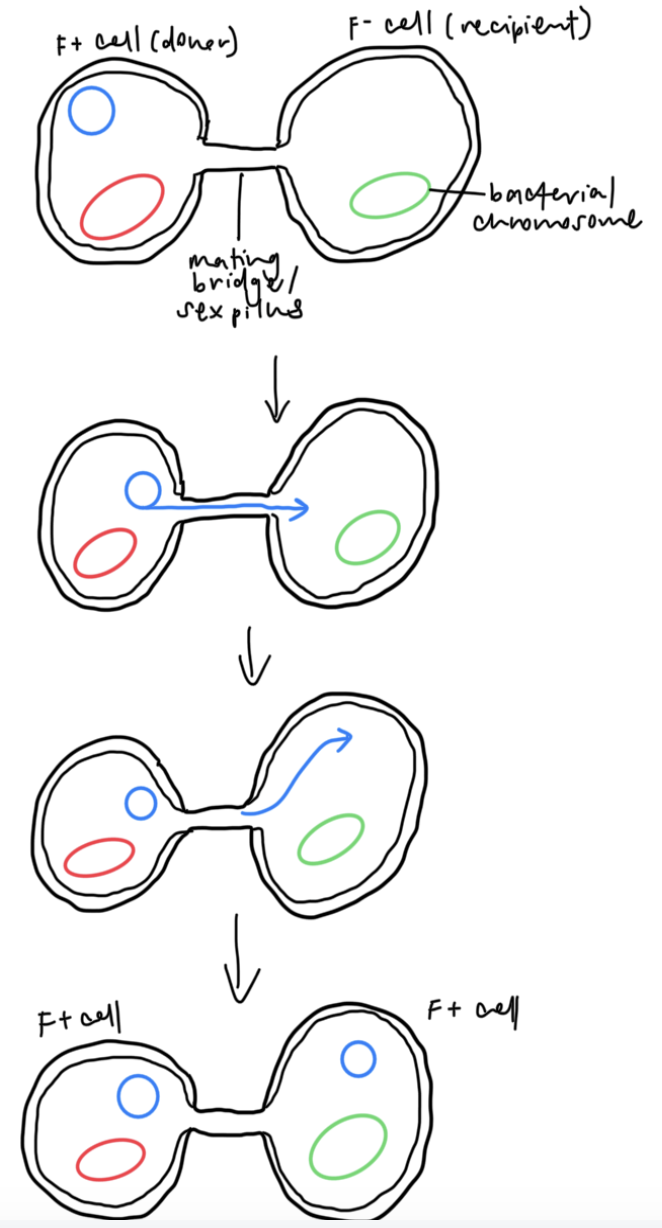
Conjugation
(1) Mating bridge formation
Cell carrying F plasmid (donor cell) uses sex pilus to attach to recipient cell, which retracts and pulls both cells together to form a mating bridge
(2) Transferring of plasmid
One strand of plasmid DNA breaks
Broken strand peels off and one end enters the F- cell, where synthesis of complementary strand begins
Unbroken strand is used as a template to synthesise a new strand, known as rolling circle replication
Genes involved in pilus formation are transferred
(3) DNA Replication
DNA replication continues in both donor and recipient cells, as transferred plasmid strand moves farther into the recipient cell
(4) Formation of 2 F+ cells
Once DNA transfer and synthesis complete, plasmid in recipient cell circularises
Recipient cell (F-) is now a F+ cell too
Generalised transduction
(1) Phage infects a bacterial cell containing alleles A+ and B+
(2) Host DNA is fragmented and hydrolysed by phage enzymes after infection, phage DNA and proteins are made in the donor cell
(3) Packaging
Bacterial DNA fragment containing A+ allele may be accidentally packaged into phase capsid
Bacterial cell is lysed, releasing virions into the surrounding
(4) Transducing phage
Transducing phage containing A+ allele infects another bacterial cell containing A- allele
Recombination occurs where homologous region of recipient cell’s chromosome is broken, exchanging corresponding sections with donor DNA, and is rejoined
(5) Recombinant bacteria
Genotype of resulting recombinant cell differs from genotype of both donor and recipient (A+ B-)
Specialised transduction
(1) Bacterial cell has prophage integrated between genes A and B
(2) Improper excision
Occasionally, prophage DNA exits incorrectly, taking adjacent segment of bacterial DNA with it during an induction event
(3) Packaging into phage
Phage-bacterium hybrid DNA is packaged into a capsid head
During cell lysis, defective phage will infect another bacterium and inject bacterial DNA into new bacterium
(4) Joining
New alleles from previous bacterial cell can be incorporated into genome of new host by homologous recombination or integration of phage-bacterium hybrid DNA
(5) Recombinant bacteria
Genotype of resulting recombinant cell differs from genotype of both donor and recipient (A+ B-)
Structural genes
Encodes for proteins or noncoding RNAs such as tRNA and rRNA
Regulatory genes
Encode proteins that regulate expression of genes
Constitutive gene expression
Continually expressed as proteins encoded are essential for survival (eg tRNA, rRNA, ribosomal proteins)
Inducible gene expression
Turned on in response to a substance in the environment, usually catabolic enzymes (degradative)
Aim: save energy and not make unnecessary proteins
Repressible gene expression
Turned off in response to a substance in the cell, usually anabolic enzymes (biosynthetic
Aim: avoid accumulation of products that are not needed
Positive control
regulated by activator, a protein that increases rate of transcription
Negative control
regulated by repressor, a protein that inhibits transcription
Inducer
Increase rate of transcription
Binds to repressor to prevent from binding to DNA OR bind to activator to cause it to bind to DNA
Corepressor
Inhibition of transcription
Binds to repressor to cause it to bind to DNA
Inhibitor
Inhibition of transcription
Binds to activator to prevent from binding to DNA
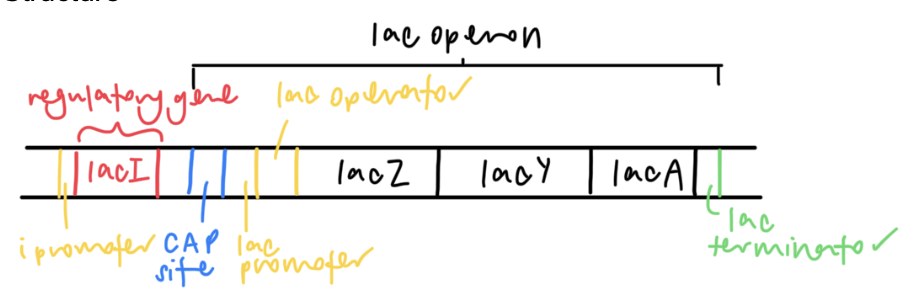
lac operon structure
lacZ: encodes b-galactosidase, catalyses hydrolysis of lactose to glucose and galactose and isomerisation of lactose to allolactose
LacY: encodes lactose permease
lacA: encodes galactosidase transacetylase (not needed to know)
CAP site: DNA sequence recognised by activator protein catabolite activator protein (CAP)
lacP: DNA sequence recognised by RNA polymerase
lacO: DNA sequence recognised by repressor protein lac repressor
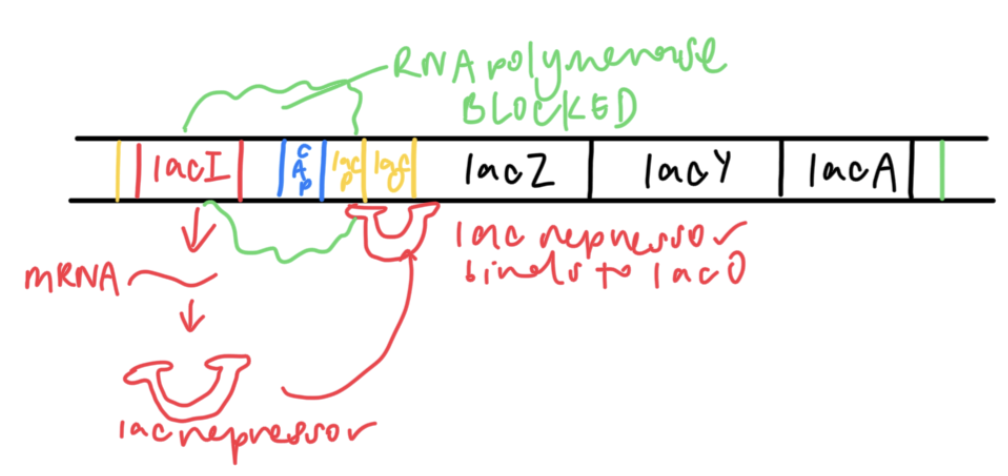
Absence of lactose in environment
lacI encodes for lac repressor, a protein that regulates lac operon by binding to lacO
lac repressor binds to lacO and prevents RNA polymerase from transcribing genes
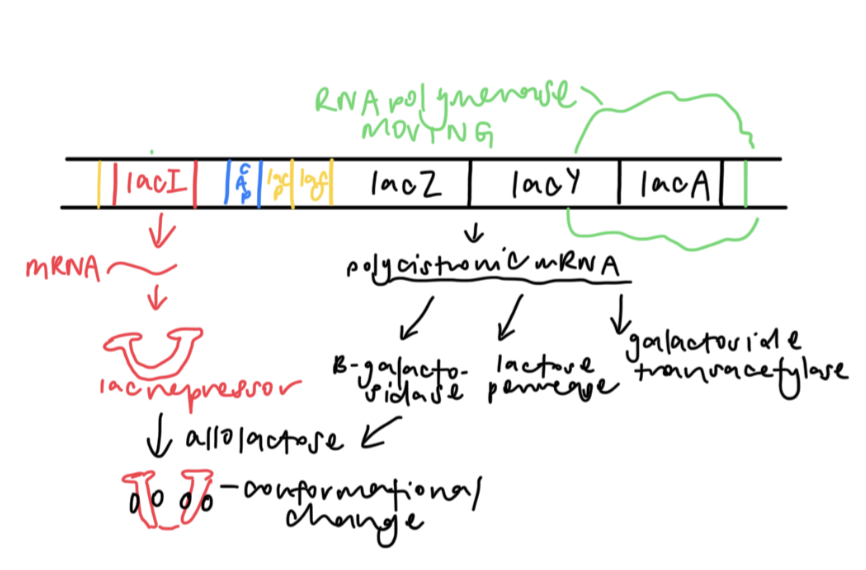
Presence of lactose in environment
basal transcriptional level allows for small amount of proteins to still be encoded by lacY, lacZ and lacA
lacZ encodes b-galactosidase, which converts lactose to allolactose, the inducer molecule
alloclactose binds to lac repressor and causes conformational change, preventing lac repressor from binding to operator
RNA polymerase can transcribe the operon
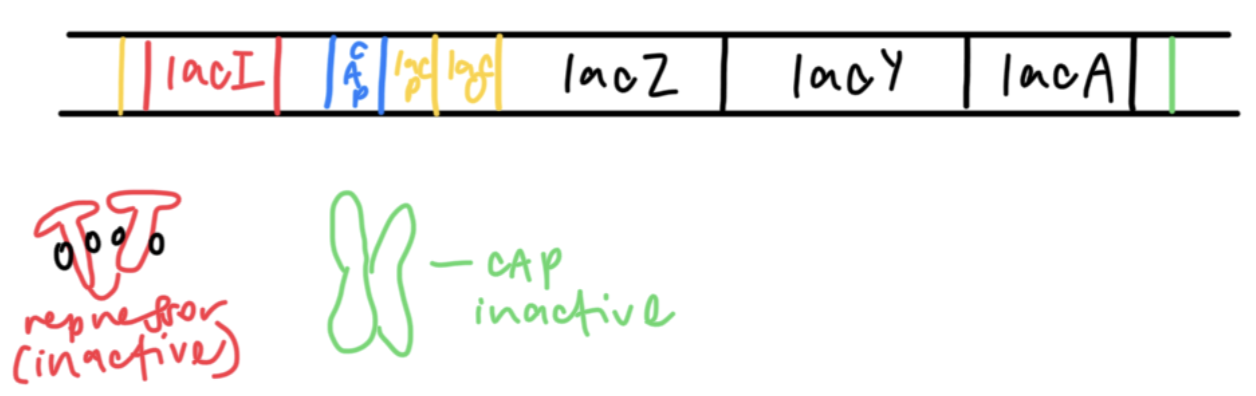
Presence of glucose + lactose
transport of glucose into the cell stimulates a signalling pathway that causes intracellular concentration of cyclic-AMP (cAMP) to decrease
cAMP is produced from ATP catalysed by adenylyl cyclase
low concentration of cAMP prevents cAMP from binding to CAP, hence CAP is inactive
inactive CAP does not bind to CAP site, hence transcription of lac operon is low
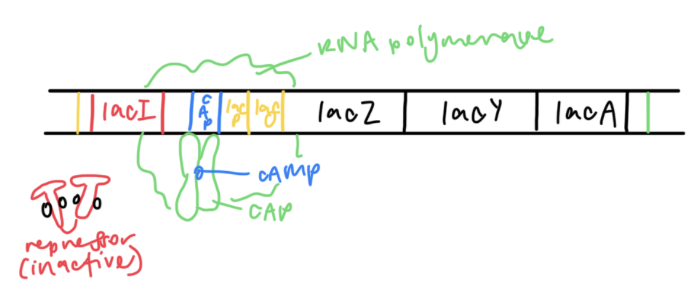
Presence of lactose + absence of glucose
allolactose and cAMP levels are high
allolactose binds to lac repressor and prevents it from binding to operator
cAMP binds to CAP, CAP binds to CAP site
CAP interacts with RNA polymerase which facilitates binding of RNA polymerase to lacP
transcription of lac operon is high
trp operon structure
trpE, trpD, trpC, trpB, trpA: encodes for polypeptides that form the 3 enzymes involved in biosynthesis of tryptophan
trpP: DNA sequence recognised by RNA polymerase
trpO: DNA sequence recognised by repressor protein trp repressor
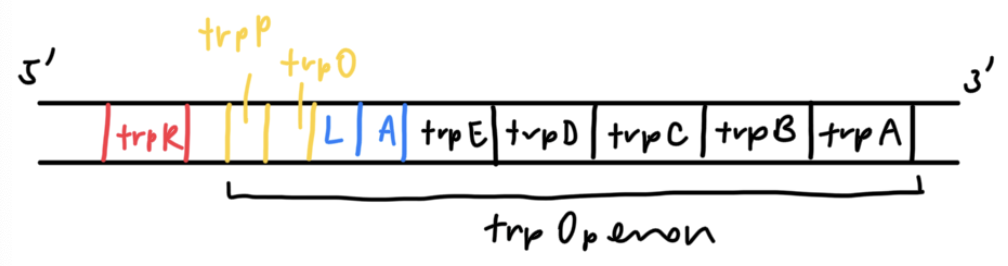
low tryptophan levels
tryptophan does not bind to repressor, preventing repressor from binding to trpO
trp operon not repressed, RNA polymerase is free to transcribe operon
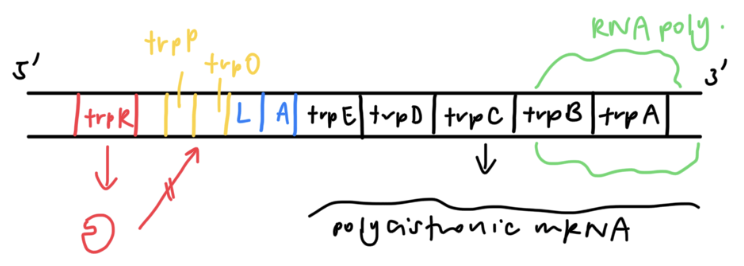
high tryptophan levels
tryptophan acts as a co-repressor and binds to repressor protein
causes conformational change in repressor protein, allowing it to bind to operator
trp operon is repressed, RNA polymerase cannot transcribe operon